

Have you ever wondered why we don’t solve the climate crisis, why we fail to stop pollution, why we can’t have clean energy supply, why there are people starving while rich countries throw away tons of food every day and why so many people still have no access to education, clean water and medical services?
Have you ever been in that depressing state of mind, where you were about to loose faith in that humanity will be able to solve it’s problems and that whatever you do it just has not enough impact to turn around the steering wheel?
Have you ever had the feeling that no matter how much you reuse and recycle, no matter how little electricity you need and how often you choose the bike over the car, no matter how much you reduce your animal-product consumption, how little you fly and how organic you buy it just doesn’t change anything if other people just don’t fucking care about all these things or if the majority of the worlds population does not even have the option to choose for a sustainable lifestyle.
Have you ever had these moments where all your optimism faded and you thought - well maybe we as humanity are just too stupid to solve our problems and to egoistic and ignorant to care about others and just deserve to get extinct?
Don’t worry, you are not alone and most of us - who want to make this world a better place - have been there. It’s a normal part of being human to loose hope from time to time. We all have these lows. Hope comes and goes, but it’s our responsibility to cultivate a habit of hope and to keep ourselves informed and to always be ready to believe that everything can be changed - no matter how bad it might look.
Now you might ask - but is it still realistic to have hope in times like these? In this case we want to give the question back to you and want to challenge you to think about the following two questions:
Think about these two questions for a moment. Or a day or a week and then afterwards come back to following additional questions.
Regarding 1. If you think about the problems that humanity is facing as of today and if you think about the methods that we tried so far to solve these problems, do you think that we actually really had a chance to solve these problems? Can what you do day-by-day save our planet - if at the same time other people always do the exact opposite of what you do? Can what our countries did, solve our crisis-es - if they only have their national budgets and political power of their national area? Is it maybe possible that what we wanted to do is mathematically impossible? Did I, you, we - we all tried to solve collective problems individually? Did our governments tried to find national solutions for international problems? Did we try to fix 8-billion-people problems with 1-person-solutions? What if we never really had a chance to change what we wanted to be changed, because countries just don’t have the money and power to fix international problems? What if climate change needs billions of people to act - together? What if poverty, hunger, education, gender-equality need billions of people to care - at the same time? What if common sense and mathematics tell us that single-persons working alone, single NGOs working alone or single governments working alone - even if its many of them - just don’t have enough financial and human resources to fix collective problems?
So if you ever come back to this pessimistic state of mind and think “I tried so hard to change the world and failed”, maybe ask yourself “Why did I fail? - Was it because I didn’t try hard enough? Or was it because I was trying something, that I cannot do on my own - that I was trying to do something impossible?”
Regarding 2. After thinking about the above section we might come to the conclusion that world-wide problems have to be solved world-wide.
Our current way is to solve these problems over
or
If we look at it, it seems like all these organizational forms that we can choose from are too rigid, too slow and not equipped with enough global power to really achieve any global scale change.
But at the same time if we look at our world, we as normal grassroots people never were in a better position to change the world into a better place. If you compare our current situation to the past you can see that we never before had such an easy access to knowledge. We never before had so many educated humans on this planet. Never before we had so many people living with civil rights in a democratic state. Never had we so many people equipped with a universal right of fighting for their ideas - be it in demonstrations, be it by contributing to their political system or be it in legal fights against laws or decisions of their governments. Never before were there so few kings and dictators and never before so many options to participate with a realistic chance of accomplishing real change.
But most importantly there is one more ingredient that was never there before in human history - technology! All the big problems that humanity is facing at the moment are already today possible to be solved from the technology point of view. We have all the solutions available and the “only” thing that is missing is that someone is starting to use them on a global scale! This on its own is so mind-blowing that it is hard to wrap the head around, but it shows that we live in a very special time.
Even more exciting is, that it was never before easier - for a normal citizen - to start global-scale world-changing movements. We have all the ingredients we need to connect all the people in the world that are dreaming of a better future. And once we connected them, we can all act together, at the same time, into the same direction to reach real global-scale change. With this new freedom that technology gave us, we are not dependent anymore on that our governments or a super-rich messiah suddenly turns up and saves our planet. We can do it right now on our own and we don’t need any permission from anyone to do it. Already now we have apps and other forms of media that can reach millions of people in seconds of time. If funny cat videos or the latest celebrity scandal can go viral around the whole world within days - the same is true for world-changing ideas. If crowd-funding platforms can finance the newest film, video-game or the craziest tech-gadgets - the same is true for financing global scale utopian projects. If we want to connect all the people, who are willing to change the world into a better place, we now - today - have the first real chance to do so.
Our current democratic system is based on choosing leaders for the country, which is very good for national processes, laws and and regulations - but it is not good for global projects. But this isn’t a problem, because for the first time in history we have the technology available that allows us to build something on-top of that system. Something like a democracy 2.0, our governments can continue to do what they do, but on top of that we could have a second meta-layer that helps us to solve the problem how to solve international problems. This democracy 2.0 could be build like a fully democratic system with no hierarchies, no leaders and no heroes. It can enable the normal people to not only vote leaders for their countries, but to vote on solutions for their planet. Why don’t we use these new technologies to connect billions of people and let the normal people bring in their own ideas and let them and only them decide on how they want our world to be fixed. We already now have so many people devoting their lives to change the world, but they are fighting their fights alone, because they are missing a communication system. So why don’t we just create one to help them bring their efforts together on a global scale and make big masses of dedicated people move into the same direction at the same time?
Life seems hard to us because we try to play it in single-player mode. But it’s actually a multiplayer game - we just have to realize that and turn on our communication channels!
Is it possible to change the world to a better place? And if yes, who has the power to do this?
What does ‘Change’ mean?
To change a thing means to make it different than it was before. To ‘change’ something one has to analyze what part should be different after the change and then find out what needs to be modified to reach the modification. So, what is needed to change something? To implement change we need a list of following prerequisites:
What does ‘power’ mean? A person who has ‘power’ over other persons has something that other persons don’t have and this something enables them to do or decide things that other persons cannot do or don’t want to be done.
So how is decision making done? To make a decision that is accepted by all counterparts you have to find a solution that the majority of affected people are agreeing with. To reach this majority there are different ways possible:
If a person can implement one of the above three ways to make a majority of people agree to his decision he has the power to make a change that affects this group of people.
Looking at the above definition of “Change” and “Power” we can ask the two questions:
To answer this question we first have to define what a change to “a better place” actually means. Once this is understood we need to check if the above three prerequisites to make a change reality apply.
To define changes that make the world “a better place” we don’t need to find a new definition, but we can simply check if these changes match to the “Sustainable Development Goals” (SDGs) that are defined by the United Nations (e.g. “No Poverty”, “Zero Hunger”, “Quality Education”, “Gender Equality”, “Affordable and Clean Energy”, “Climate Action”, …) . Additionally we can make sure that all these changes are not in any conflict with the “Universal Declaration of Human Rights” (e.g. “All human beings are born free and equal in dignity and rights….”). If both these prerequisites match, we can say that such a change would “make the world a better place”.
Now the next question is whether or not it is possible to implement such changes. Is it for example possible to reach a global level of “Zero Hunger” or “Quality Education for all genders”, or can we make it happen to provide “Affordable and Clean Energy” to every human being in the world and to take “Climate Action” by reducing our greenhouse-gas emissions to zero and to rebuild destroyed and threatened eco-systems for a future that is worth living for. Let’s make the check, do we fulfill all three requirements?
As we said before having the ‘power’ to make a change that affects a group of people depends on whether or not you can convince this group of people to accept your change.
So who could have the power to make such global-scale changes happen?
Does a single person have such a power? Even if we think about the most intelligent,most charismatic or richest human-being it still seems impossible that a single such person could have enough power to make changes that will affect the whole world. A single person cannot buy or force the rest of the world to accept the change that they want to happen. If there are more people against the change than the number of people than can be “convinced” by money or threat the person will not be able to implement his change. If a single person does not have enough power, how does it look for a government maybe even a government of a big, rich country? Governments indeed have huge financial abilities and even more they have the power of legislation (law-making) and the power of adjudication (court) and the power of execution (police). This means they have the power to make new laws to change the world to a better place and they also have the power to sentence someone in court who does not follow the new law and even more they have the power to use the police to execute the sentence the court decided on (e.g. they can force people to go to jail or to work or to pay money). But even though when a government theoretically has all this power it still seems that it does not have the power to force any change that the population does not agree on. Maybe this will work for a short time, but on bigger time-scales governments who work against the will of their population always seem to fail. So why is that? The reason is that a government can only have as much power as the population gives to it. The government only is a representation of the population and if it does not represent the population in a way that the majority of people are happy with, this majority of people will replace the government with a new government. In a democratic state this means new elections and in an autocratic state this means demonstrations and finally an overthrow of the ruling person / party. If the majority of the population is not happy with the government, the government will lose all its power and how history shows us it doesn’t even need a full majority to make this happen. As a scientific study found out by analyzing historic violent and non-violent conflicts it seems to be enough if 3.5% of the population go on the street and non-violently demonstrate for a change to finally change the government for a new one. (Source : https://www.nonviolent-conflict.org/resource/why-civil-resistance-works-the-strategic-logic-of-nonviolent-conflict-article/ and https://en.wikipedia.org/wiki/3.5%25_rule) So if we ask the question ‘does the government have enough power to finally change the world for a better place’ - the answer seems to be - yes and no. It can have the power to change something if the population wants this thing to be changed, but it cannot have any power - on long term - to change anything if the population does not agree with it. The same seems to be true if we have a look at multi-national groups of governments (e.g UN, EU, ASEAN, AU, USAN, …). They have a lot of money, but still they only have the power to change things that find acceptance in the populations of all states that belong to the group, on long term they cannot force any change that is not accepted by the population.
So now when we say that governmental organisations or governments can only change the world for the better if the population agrees with that and when we also say that in the current moment we don’t see governments implementing such big-scale positive changes, what does that mean for us as populations? Does it actually mean that the majority of the human population does not want to see these changes implemented? Is it true that we don’t want hunger, poverty, education, equality, climate change to be solved? Looking at science we can see numbers like
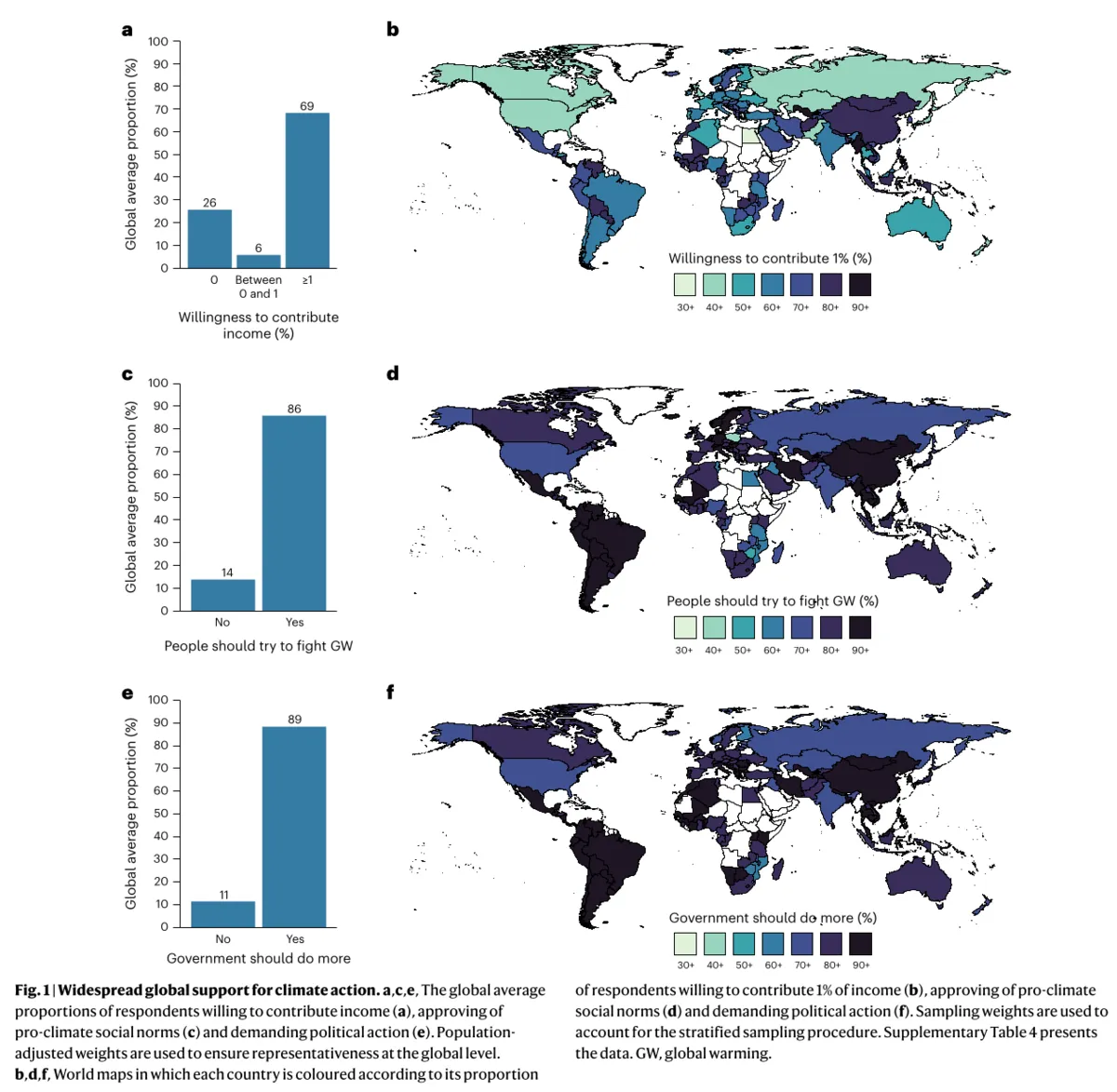
“A Ipsos survey from 2021 conducted in partnership with the World Economic Forum about the United Nations’ Sustainable Development Goals finds “zero hunger”, “no poverty” and “good health and well-being” ranking as the global public’s top priorities.” (Source: IPSOS survey “U.N. SUSTAINABLE DEVELOPMENT GOALS IN 2021: PUBLIC OPINION ON PRIORITIES AND STAKEHOLDERS’ COMMITMENT” ( Source: https://www.ipsos.com/en/global-public-ranks-ending-hunger-and-poverty-and-ensuring-healthy-lives-top-priorities-among-un ))
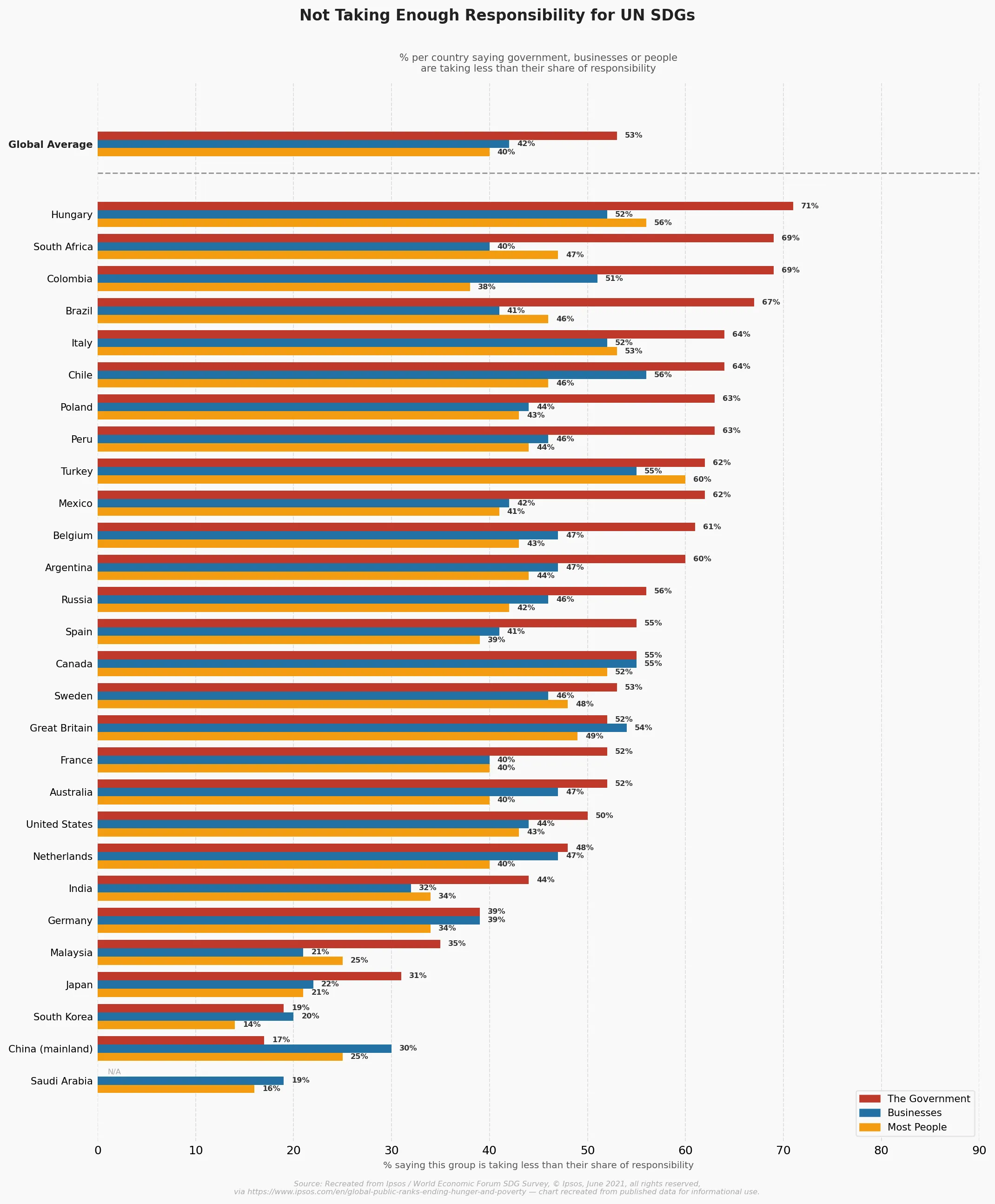
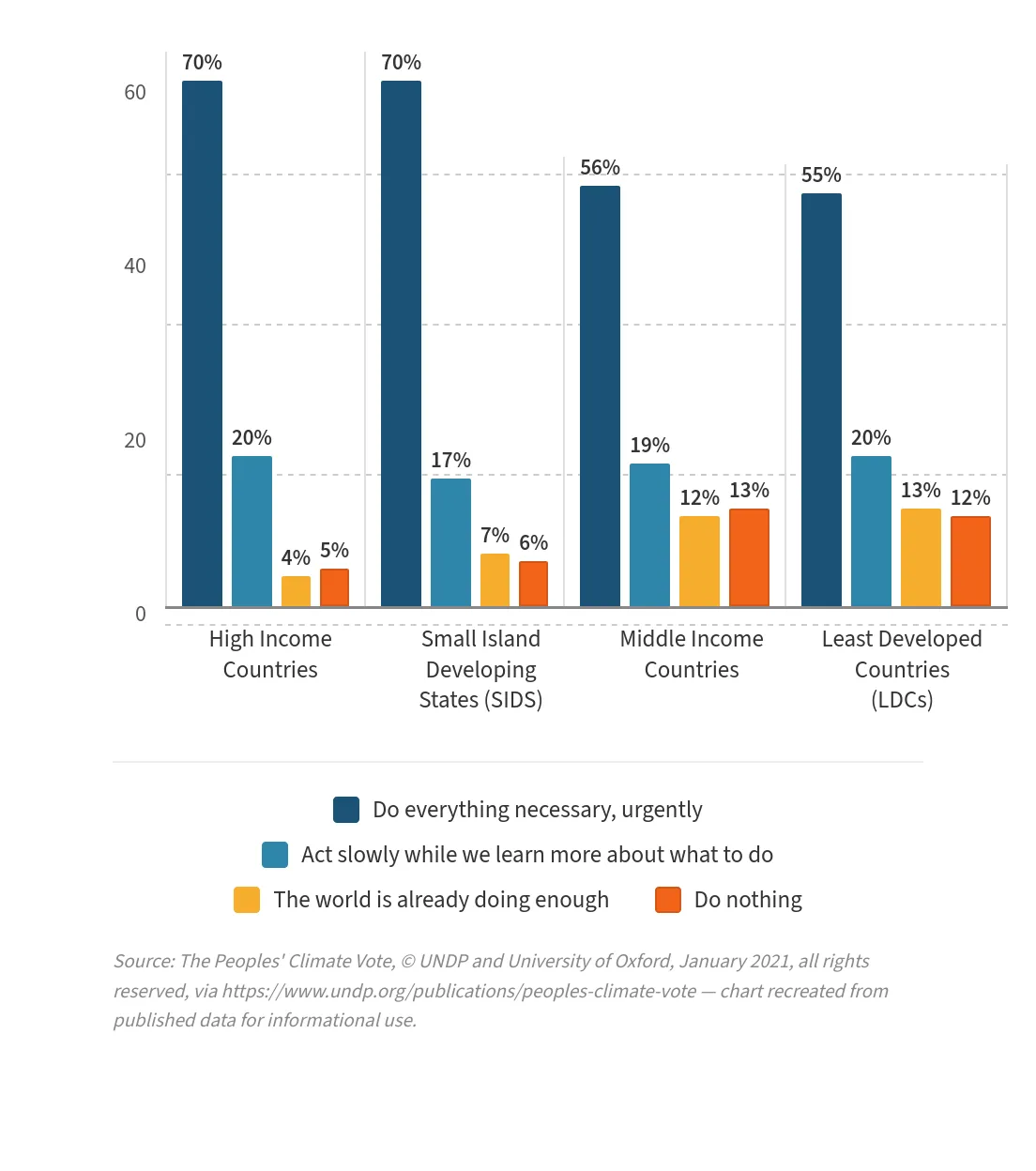
The UDNP-Study ‘Climate-Vote’ asked people for how urgently they think we need response to the ‘Climate Emergency’. The majority of the population voted for “Do everything necessary, urgently”
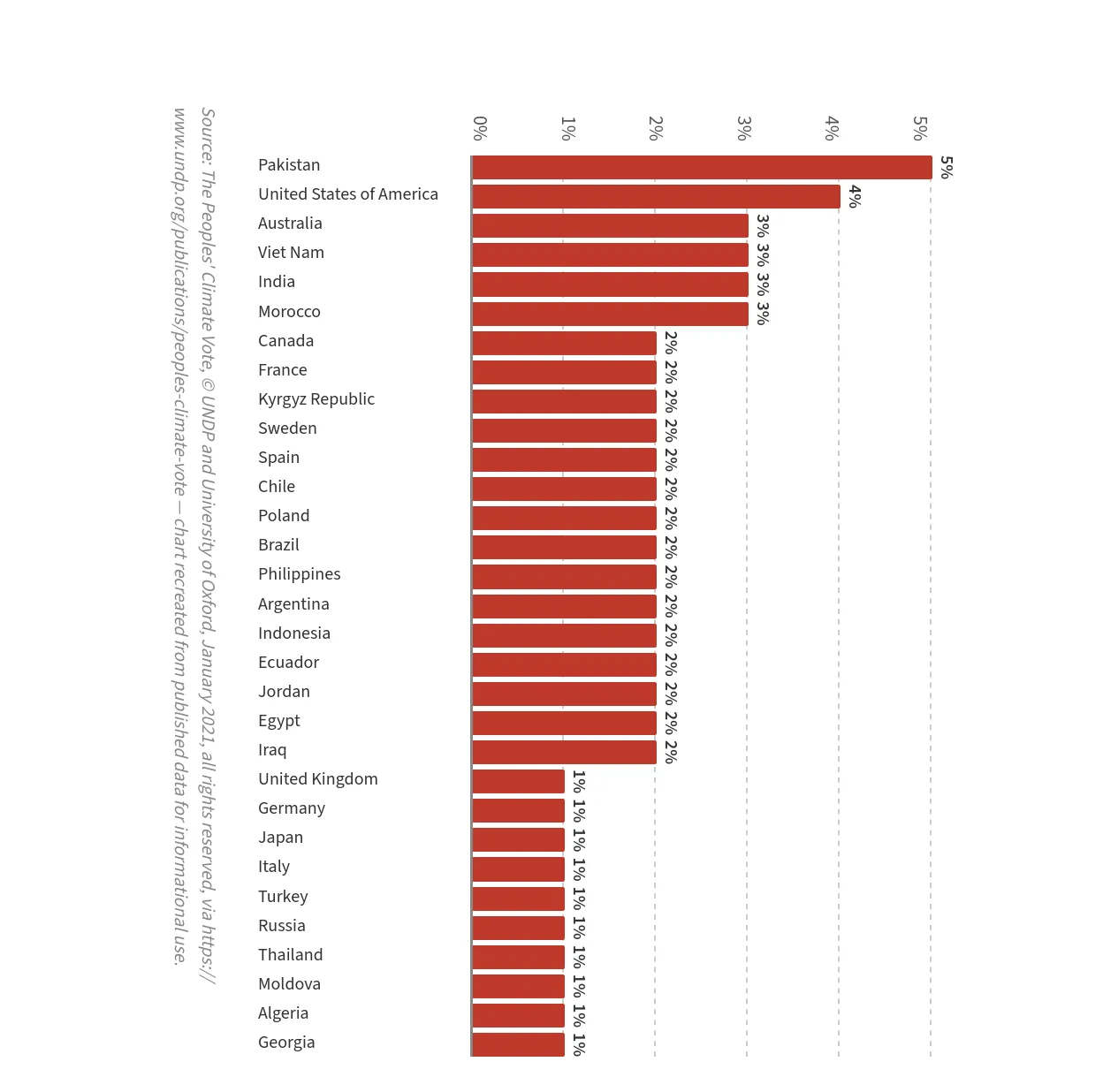
Across 34 countries surveyed by PEW Research Center, a median of 94% think it is important for women in their country to have the same rights as men, with 74% saying this is very important. (Source: https://www.pewresearch.org/global/2020/04/30/worldwide-optimism-about-future-of-gender-equality-even-as-many-see-advantages-for-men/ )
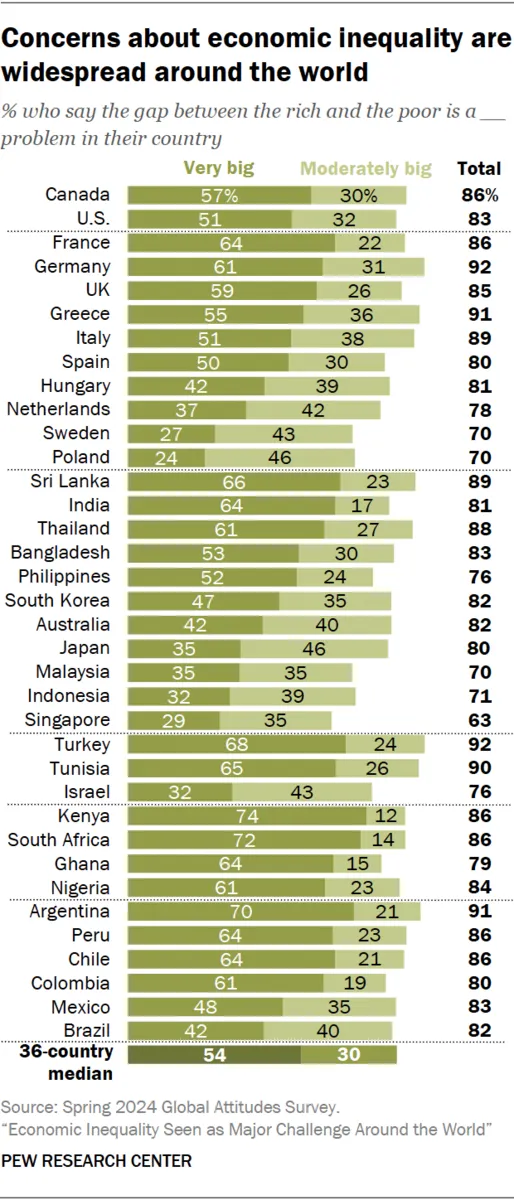
And also besides the official scientific numbers it sounds reasonable to assume that most humans would agree that it is time to finally end hunger, child-labor and no-access to education.
So if all that is true and the majority of the population of planet earth would like to change the world to a better place, how can it be that we don’t see these changes? Why is the government not implementing such changes, why are we not pushing them to do what we would like to see? The answer seems to be that in the same way that small percentages of the population can push the government to change for better, also small percentages of the population can push the government into the other direction. A small percentage of the population still results in big amounts of people and if a small minority is loudly and clearly pushing in the direction to “close the borders against refugees”, to “support the rich while discriminating certain groups of the population” and to “close the eyes for international problems like climate change or global inequality in favor of simple national solutions”, this small percentage seems to be big enough to scare the government in a way that they fear to work on “good solutions” because they are scared to not get re-elected. Additionally big, financially well-equipped companies are financing their favorite politicians and by this have power over them and can tell them what political decisions they would like to see. But didn’t we just say that single persons or companies don’t really have much power if their interests are against the will of majority of the population?
So who now has the power to finally change the world for the better. Does anyone have such a power?
In the current world we see small privileged groups of people making decisions for big groups of people, even though often a big part of these groups are not happy with the decisions being made. This is only possible because these big groups don’t understand that their sheer mass of people has a much higher power, than the small privileged group can ever have. If we imagine that we can find a majority of the worlds population agreeing on a global-scale change to be made, it is in the same time impossible to imagine that anyone can stop this change to happen. The world as a whole has a power that no one can stop, not even with a lot of money or threats of physical or psychological violence. So if we ask if the world has the power to eradicate all poverty, or to change our energy supply to 100% clean and affordable energy we come to the conclusion that we indeed have the power to make such a change become reality, if - and only if - the world realizes that there is a majority of people on this planet who wants to make this world a better place and if this majority comes together and decides to become a movement that wants together make such a change happen.
The people themselves - and only all these people together - have the power to change the world for the better.
If we wait for any rich savior, any big company or any governmental organization we will realize one day that they never had the power to change what we wanted them to change. The only entity of power that really exists and that can change the world to a better place is a big - a really big percentage - of the worlds population.
If we trust in science and our common sense we know that this group, this big percentage of the worlds population already exists - we only need to realize that we can change everything as long as we organize and work together.
Is the majority of the world interested in making the world “a better place”? Science and common sense tell us a clear answer to this question. Most people of the worlds population would love to live in a world without war, poverty and climate change. If we could choose between living in our current world or in a utopia where everyone is living with his human rights and where we put the well-being of nature and humanity first, it would be an easy choice for most human-beings.
But why can’t we have this utopia? The reason is as simple as it is complicated.
Why should I stop emitting greenhouse gases if everyone else is continuing to have all the benefits of a good wasteful life? If only I stop eating meat, this won’t have any impact. Why should I pay to dispose my trash, if everyone else is just dumping it for free in the woods? If only I change, nothing will change, except for that I will have a harder life.
As small as the impact of our own single person might seem, as big it is if we team up with a big group of people that can only exist if many single persons join this group. If 80% of the population agree to only buy energy that is clean of emitting green house gases, or if the same group agrees to eat less meat, to not accept gender-inequalities or to sort and recycle their trash this will have an enormous power and it will easily change the world for better.
So what are we missing to make this world a utopia? Are we missing the people that would love to see a change? Obviously not. Are we missing ideas and motivation to make these ideas come true? - No, just look at all the NGOs and people who already now devote their lives to improve the life of others. Are we missing time, money and workforce? - No! There is a lot of money and workforce circulating the earth. Just think about what big amounts of money governments can already accumulate if they take a percentage of the populations income. If we have the majority of the worlds population agreeing to make a change happen, time, money and workforce will not be the problem.
So what are we missing? We are missing the feeling of that our individual changes really have an impact. But there is a way to reach this status. There is a way to give the individual person back its feeling of empowerment. Currently we are missing the opportunity to team up with the rest of the world. but if we would have the majority of the worlds population team up in one big group - Team Utopia - we could solve the worlds most urgent problems without a problem. We have the power to change whatever is needed to make this world a utopia. We just have to put on our jerseys, find our team mates and rock this show. So let’s get started!
Today is the day that we open the call for participants to form Team Utopia. Become part of the worlds biggest movement, the NGO which connects all NGOs, the group of all the people who want to live in a better world and are not willing to accept the current status quo and dark future that we are currently forecasting for the next generations. We will make the world a better place, we will build Utopia - not because it’s easy, but because it is possible.
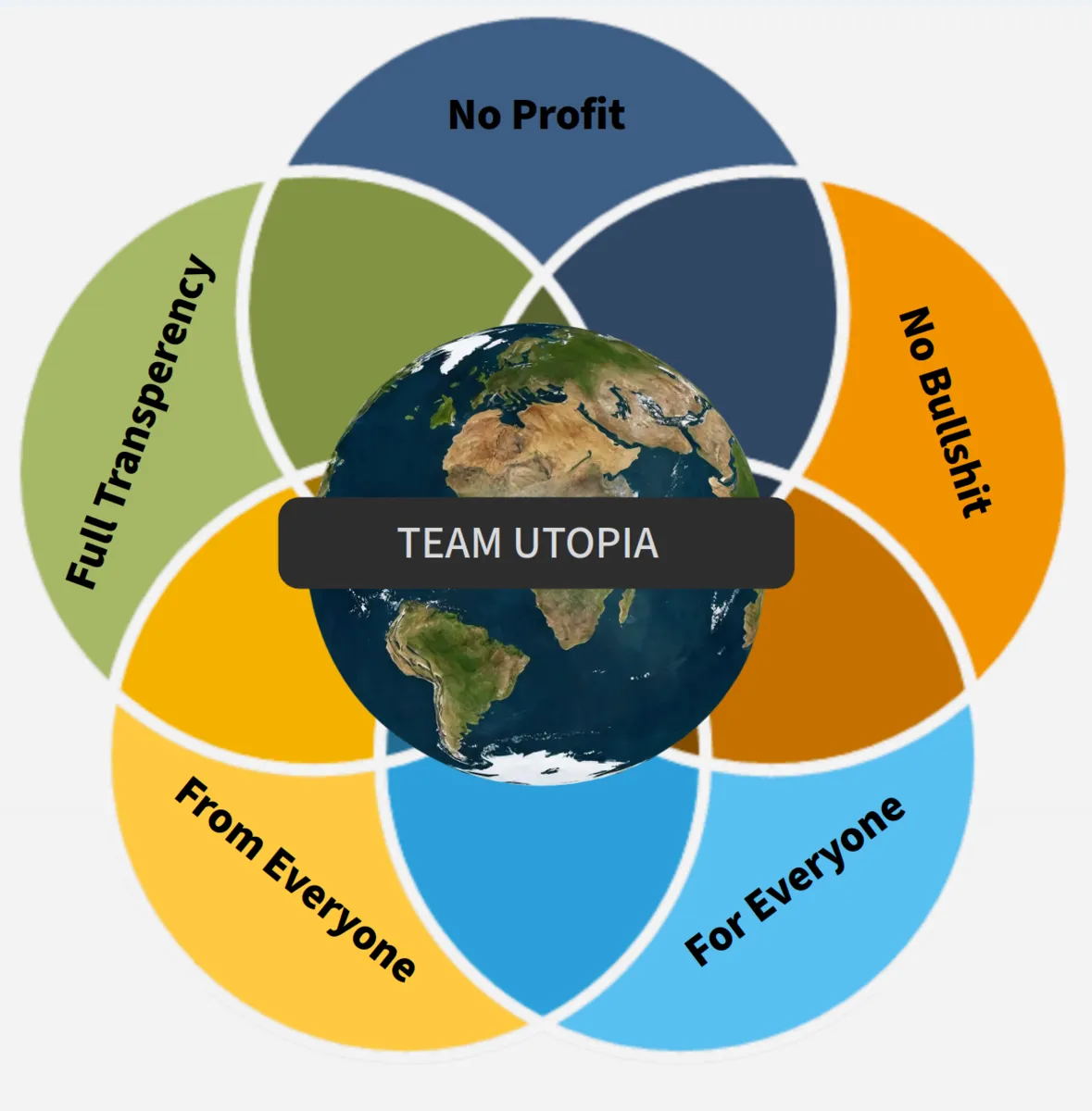
The following 5 pillars form the basis of Team Utopia:
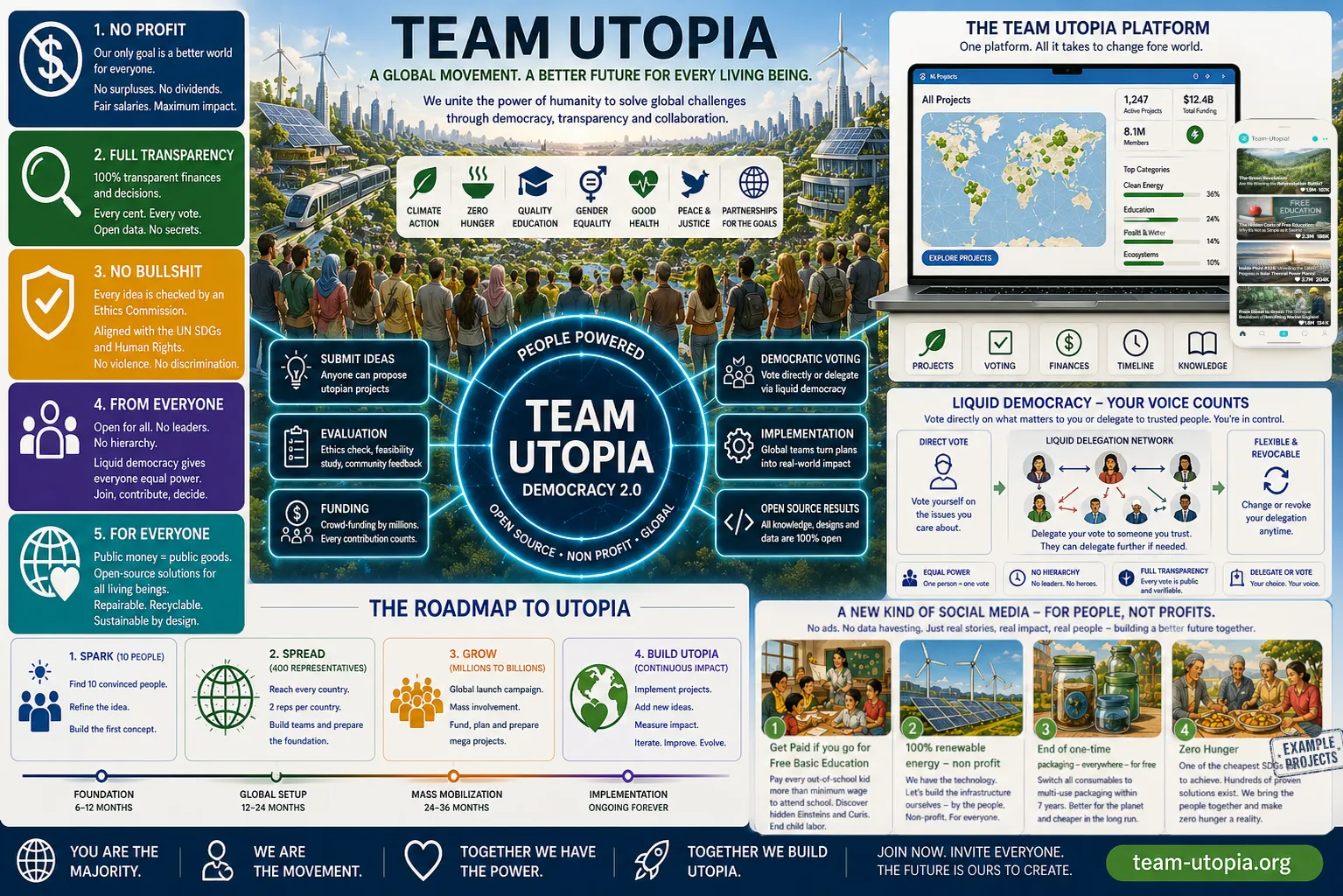
The following chapter describes some potential ideas in how to implement the Team-Utopia project. Since this project intends to build a democratic movement all concrete future plans have to be decided by vote with the rest of the team. Referring to this the following ideas are only inspirations that want to open up a dialog with interested persons, about the feasibility of this project.
As described before the only chance that humanity can implement global-scale changes that really change the world into a utopia, is to gather a super big group of people that are motivated to work on the same topics at the same time. This group of people has to include a decent percentage of the population of humanity or even better the majority of humanity. If we don’t manage to gather hundreds of millions or better billions of people chances are very high that Team Utopia will never produce any global-scale output.
If this is true the main goal to launch Team-Utopia has to be to gather a big part of humanity in one big organization. If we manage to do this, we will be able to solve the worlds urgent-st problems. If not we will most probably fail.
To reach this point the following picture will show a potential road-map how to build up a world-wide organization:
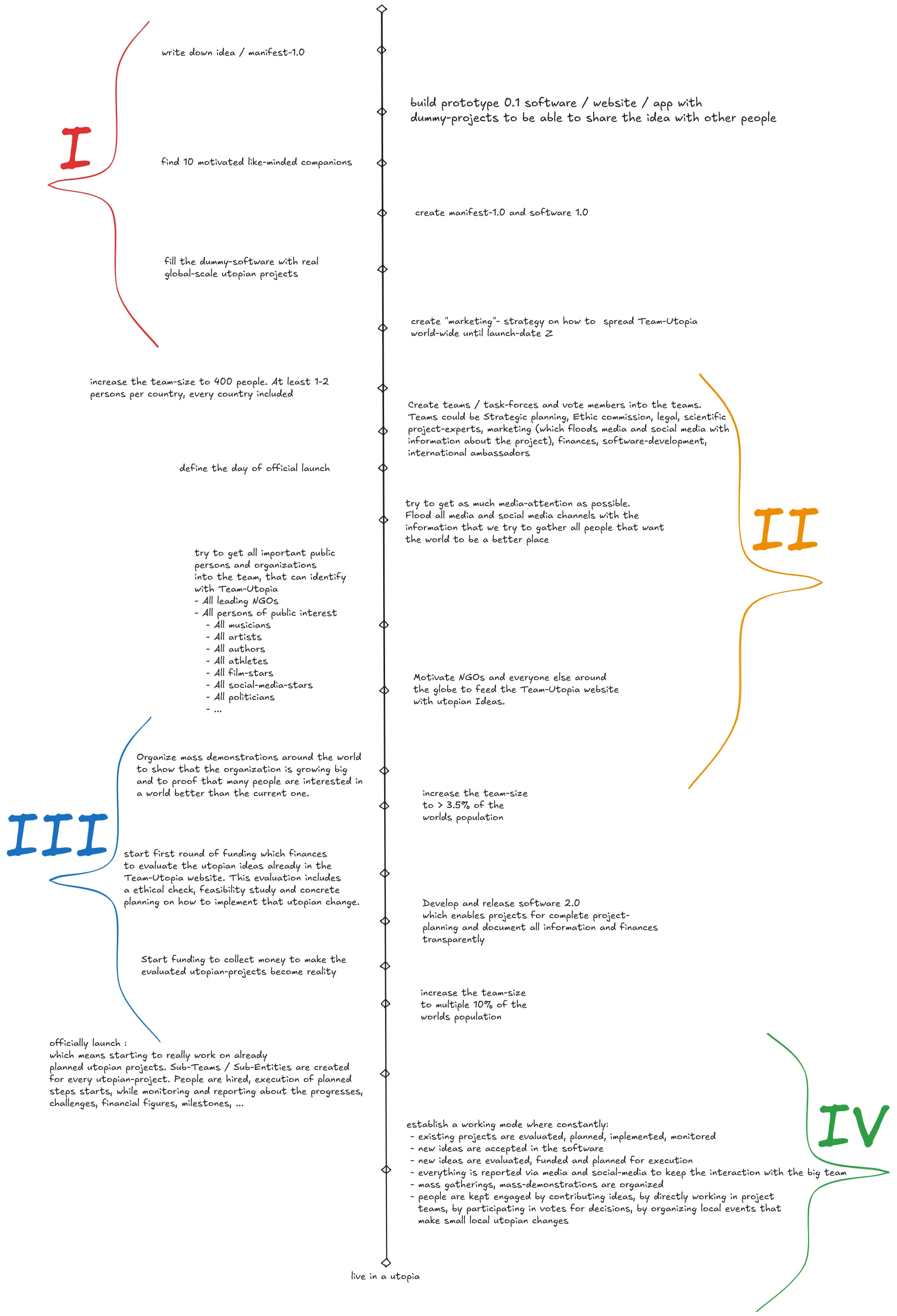
In the second stage we have to try to spread Team-Utopia into a world-wide project, that covers every single country in the world. The aim of this stage is to reach at least 400 motivated team-members of which we have one or even better two representatives for each country in the world. By bringing Team-Utopia into every part of the world in the very beginning we can consider input and ideas from various viewpoints early on. With this big team we now have to prepare stage 3. This means we have to create teams / task-forces like for example “Strategic planning”, “Ethic commission”, “Legal”, “Scientific project-experts”, “Marketing”, “Finances”, “Software-development”, “International ambassadors”, … and develop concrete plans on every aspect of the project. The members of these teams are voted democratically now (and later again and again). For the initial setup of Team-Utopia they will probably need to organize internally, but the ultimate goal is that all these teams are only executing the decisions that are made from the voting-results of all members of Team-Utopia. Since there is no hierarchy in Team-Utopia, these people have not any more power than anyone else, but their job will be to implement the wishes of the overall team. The main two aspects of this stage will be to prepare Team-Utopia for really big masses of people. This means on one hand to develop a bullet proof concept for all legal, finance and ethic questions and on the other hand build a bullet proof software that can handle extremely big-masses of people, while being totally open-source and provides 100% transparency to financial and decision-making questions. Besides this, stage two will be defined by “spreading the word” world-wide. This means we will try to flood the whole world of media with the idea, that there is a global democratic movement ramping up, that aims to gather each and every person that would like the world to be a nice beautiful place and who would like to solve our current problems to build a utopian future instead of this ugly place we call our future at the moment. We will define a concrete “official launch day” and try to reach a status where there is not a single day where people cannot turn on radio, television or social media without hearing / seeing / reading that some important person is talking about this new world-wide movement and without getting invited by them to join this movement. For this we also want to get important public persons and organizations into the boat early on. If we manage to get the biggest and most important NGOs, musicians, artists, authors, athletes, film-stars, social-media-stars and maybe even politicians - that are already now fighting for a better world - to continue their fight in a bigger context of a global team, we certainly have a chance to make this project have a real global-scale impact. As said before Team-Utopia does not aim to replace existing structures and NGOs - our main goal is to connect them. And if stage two manages to reach a working mode where NGOs, activists, persons of public interest and most importantly normal persons like you and me work on a global plan to make the world a better place we can
Stage 3 could also be named “growing, growing, growing”. Coming from stage 2 we have all the ingredients we need: we have the best people involved that are already now doing activist work, we have the best utopian ideas described and prepared, ready to be funded, planned and started inside the Team-Utopia platform and we have a global-scale media-coverage. The only thing that is missing is masses of people. Team-Utopia can only work if it is a gigantic global movement. Only with at least hundreds of millions of people we have the power to implement changes that need enormous financial and human resources. We need to reach a size where we can say: “Oh well this project needs 100.000 people to work on it and 100 billion dollar budget? No problem - who wants do the job and who can ship in some money?” Only if we reach this momentum we have a chance to make it happen. To reach this goal we will add one more ingredient: Time pressure. As proven time and time again humans are particularly good in reaching their goals very efficiently if they have a fixed due date. In the case of Team-Utopia the “official launch date” will play this role.
Around the official launch date we can create a dramatic story-telling like for example:
"On the XX.YY.ZZZZ - one year from now - the biggest democratic movement in human history will start operation and the one main goal is to get involved NOW. Because this operation is humanities one big chance and if we don't manage to gather the necessary amount of people we will fail. So join NOW, bring all your knowledge, your ideas, your money and most importantly all your family and friends!"
Already involved people can use their network and involve even more people. Media should be used to spread the word about already planned utopian ideas and talk about how these ideas could change the world if enough people would get involved. Around such a story we can organize events like mass demonstrations of people who want to live in a better world to proof how many people actually dream of a utopia. Also there might be already small-scale utopian projects organized now, like local trash-collection-, tree-planting- or repair-events or people that gather to cook together and feed the poor. Everything that grows the movement and does something good is imaginable. In parallel to this we will start the first and second rounds of funding. The first funding of each idea finances to evaluate the idea. This evaluation includes an ethical check, a feasibility study and concrete planning on how to implement that utopian change. The second funding is based on the result the first funding provided. Since the evaluation found out what exactly is needed to implement the change, we now have to officially raise money for the implementation. These amounts are of course orders of magnitude bigger than the first round of funding. For this it’s now necessary to involve hundreds of millions of people. Everyone who is interested in this topic, will most probably also be needed to contribute financially. While people from developing countries can maybe only contribute smaller amounts, these amounts are still super important contributions, because the sheer mass of these people will still result in big amounts of contribution. On the other hand more privileged persons, organizations, maybe even companies or governments have the abilities to contribute bigger amounts of money. All together, if everyone contributes, what they can contribute, stage three can prepare the already existing utopian ideas into completely planned and financed projects that wait to be implemented in stage four.
Stage four is the end-goal of Team-Utopia. We first want to officially launch the project, which means we start to implement the already planned and financed projects and also we continually add, evaluate, plan, finance and implement new projects. We want to reach a working mode, where people around the world finally realize that they can change the world and have the power to make the world better. If you know, that you are not alone and the majority of humanity is on your side, why not trying to bring in your idea and trying to get it to a stage where it is actually changing the world? We want to be able to invite every human being to dream crazy dreams, to think big and to think about in which kind of world they would like to live and finally we want to motivate them to bring these ideas from their brain into reality.
The Team-Utopia platform must be a easy to use platform / website / app that enables people to
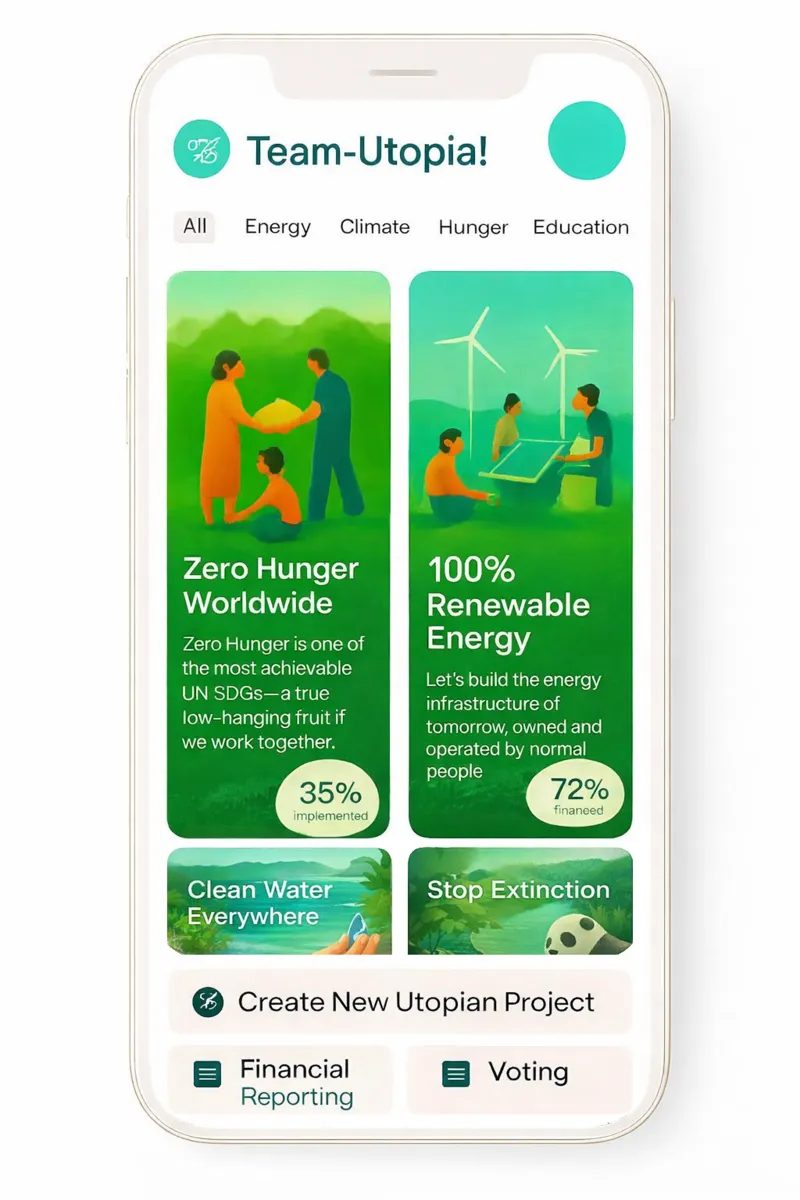
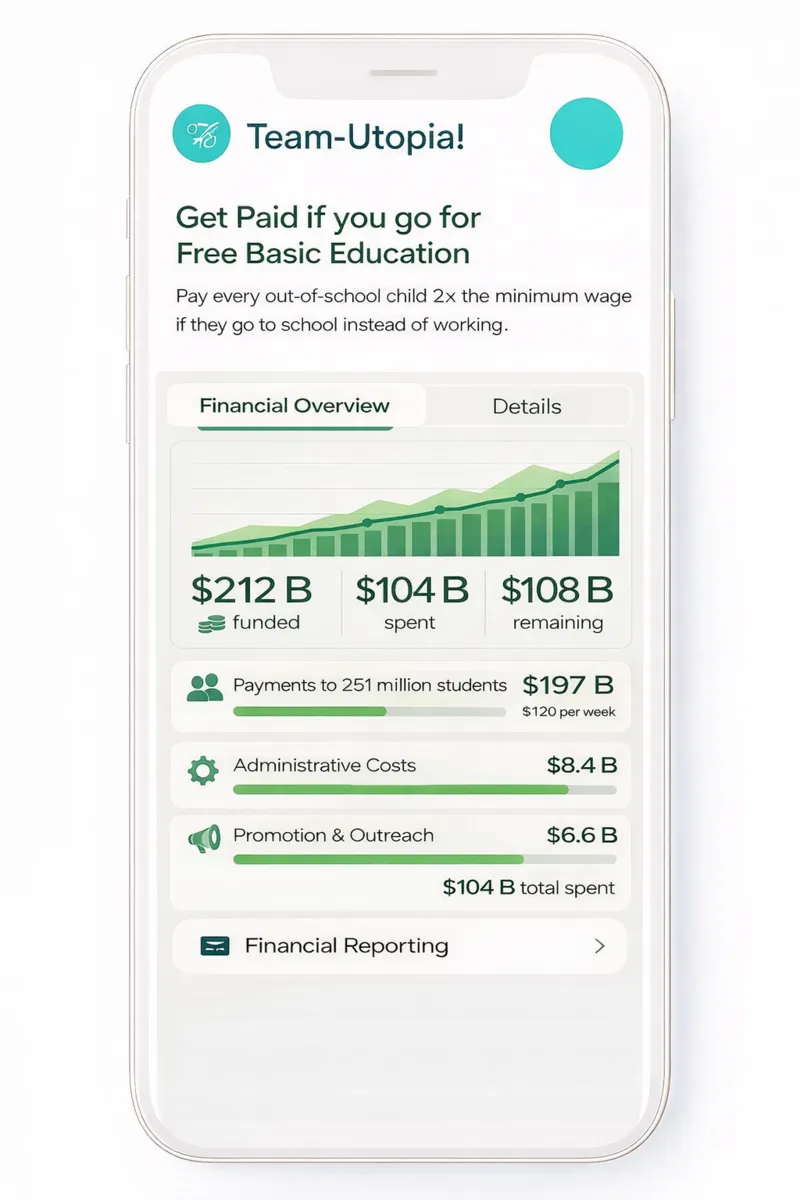
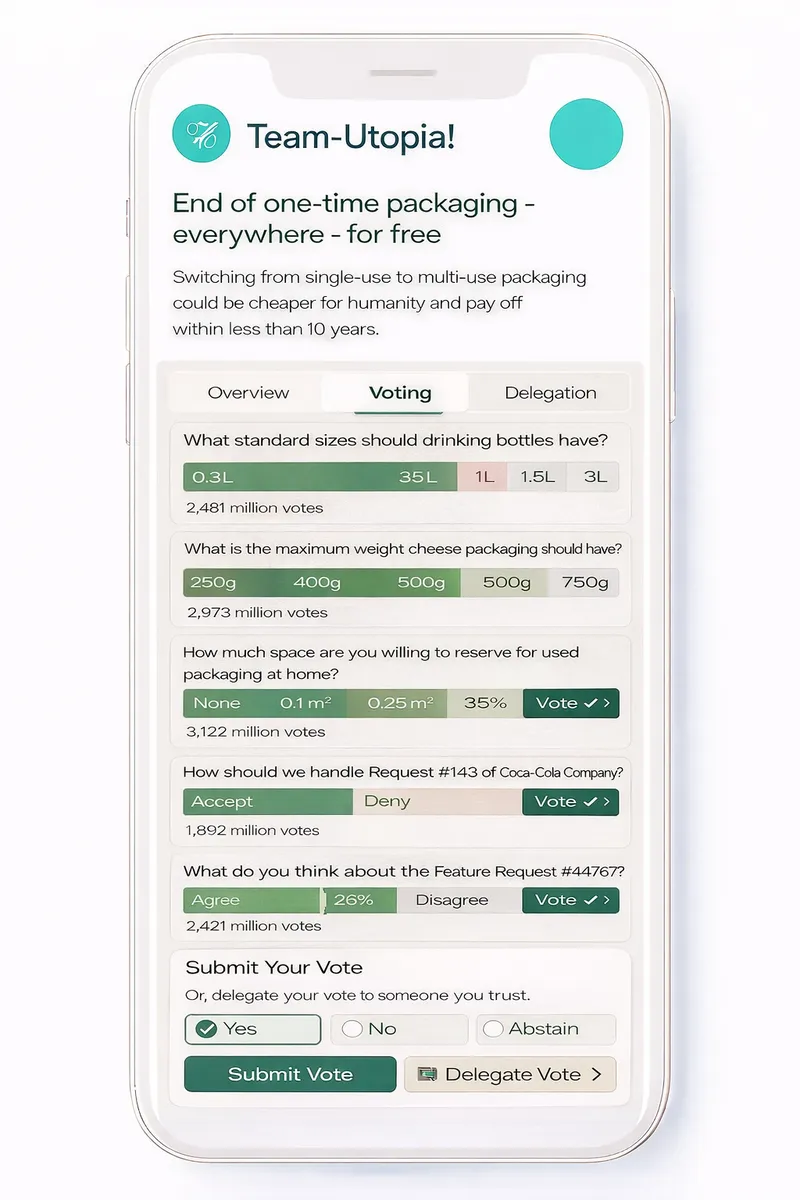
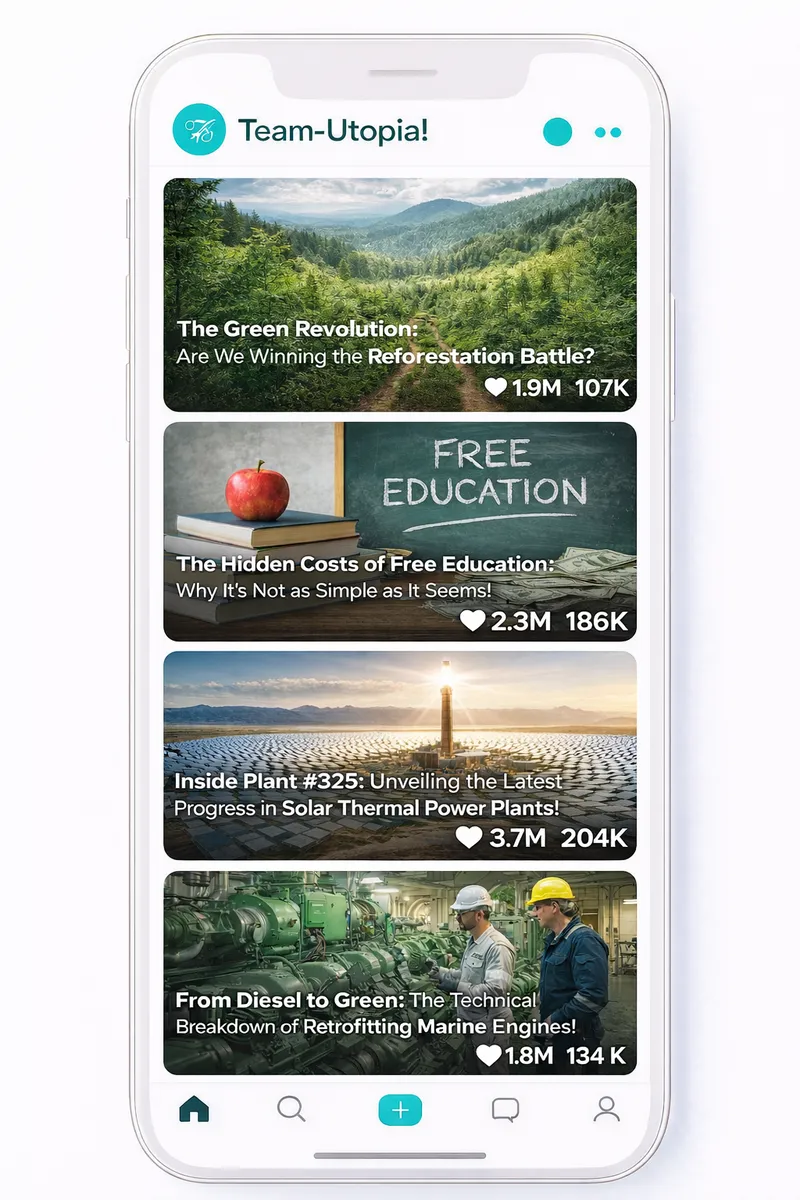
The software/app/platform could be something like a wild mix of
Crowd-Funding Platforms
Voting / Decision-Making Platform
Video-Streaming / Social Media
Project and Finance planning software
Transparent Financial Reporting
Knowledge Database / Online Manual / Online Tutorials
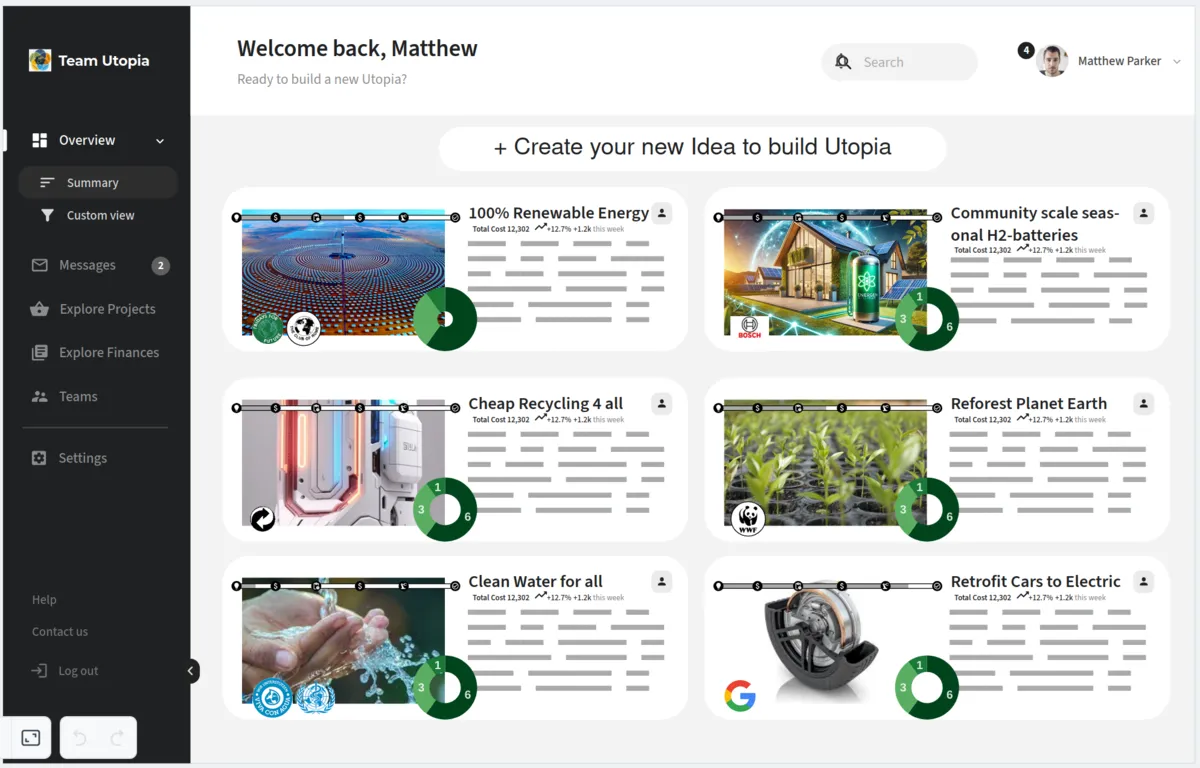
A landing page of the software could look something like the following picture. It could give you a quick overview over currently running and planned utopian projects. You can click into a project to either discover more details, support it with your money or knowledge, get hired as a full-time supporter/employee of the project, deep-dive into the technical documentation of the project, participate in democratic polls to decide over the future of the project or analyze the transparent financial numbers and report any numbers that seem strange to you.
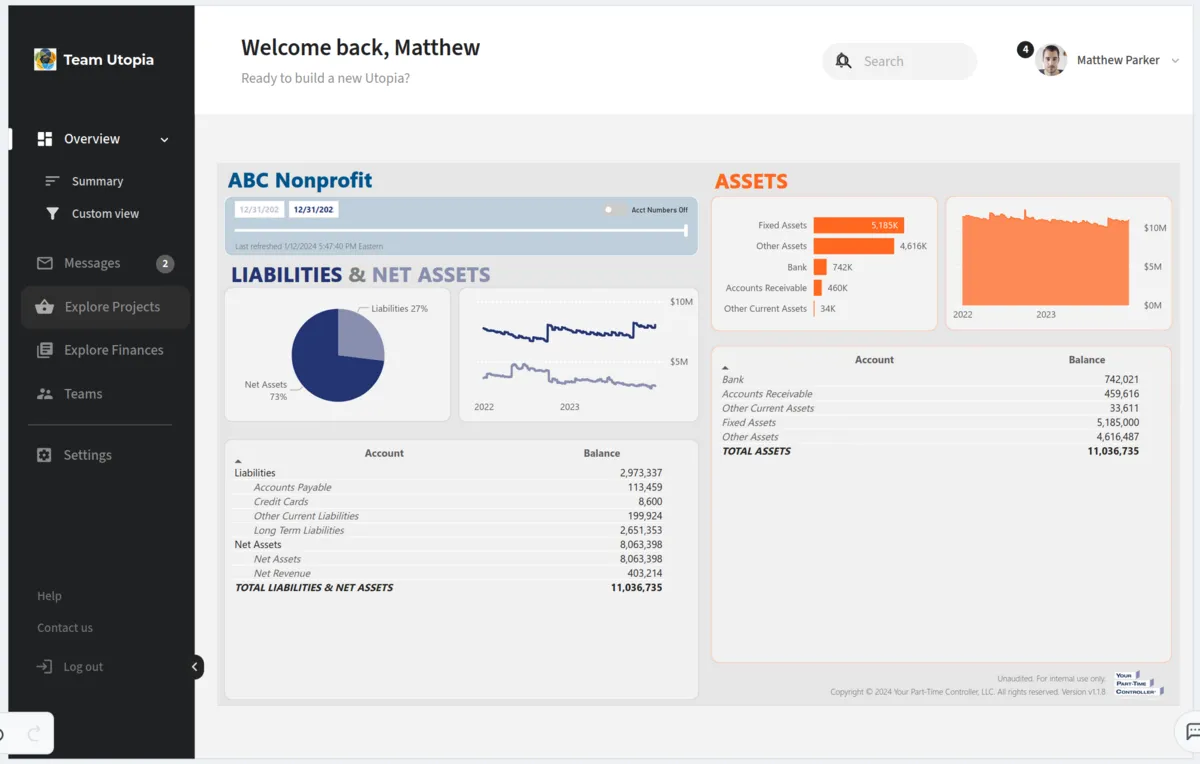
The following picture shows how a financial report overview could look like. The idea is to make every cent in every money flow transparently visible. By this users can analyze the finances and report any potential issues.
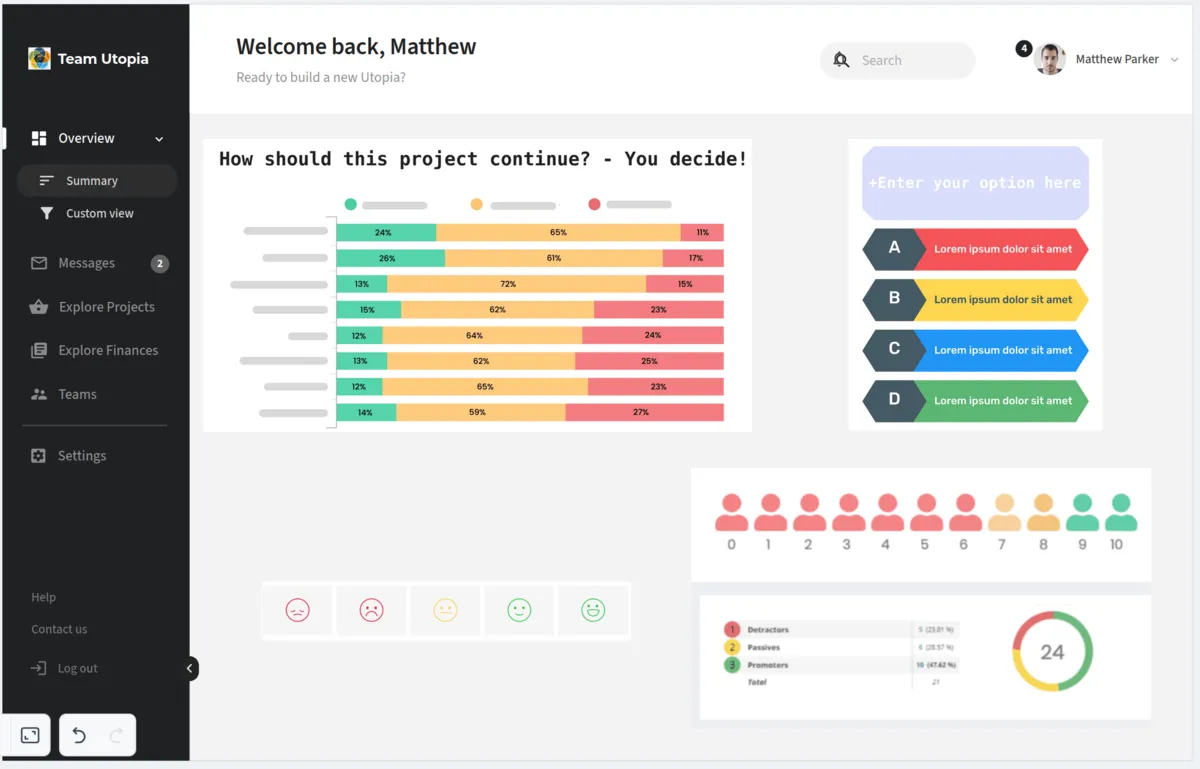
To run Team Utopia as a fully democratic movement, each team member has to have the possibility to contribute into every decision making process. Since online voting platforms have many problems that always lead to the risk of not being able to guarantee the integrity of results and to not being able to check if there was any vote-result manipulation, it still has to be discussed how such a voting platform can be used and for what kind of decisions / polls it is safe to use. For example decisions of not so high importance might be okay for online-voting. For these kind of decision-making polls it might be necessary to identify your self with your passport to get the right to vote and to publish vote-results in a way that show which person, voted for what option. Otherwise it will probably not be possible to reach integrity of results. On the other hands-side high-important decisions most probably have to be run like a normal paper-based election to ensure privacy and also integrity of the vote/poll. One option for the implementation of democratic votes could be to integrate the liquid democracy framework into Team Utopia.
Liquid democracy is a flexible governance system that bridges direct and representative democracy. It allows participants to either vote directly on issues themselves or delegate their voting power to trusted representatives. The key innovation is that these delegations are “liquid”—they can be issue-specific, temporary, and revocable at any time. For example, you might delegate your vote on environmental policy to an expert you trust, while voting directly on education issues. This creates dynamic chains of delegation where representatives can further delegate to others with more expertise. The framework aims to combine the expertise and efficiency of representative democracy with the empowerment and legitimacy of direct participation, while reducing the “all-or-nothing” nature of traditional electoral systems. (More info at : https://medium.com/organizer-sandbox/liquid-democracy-true-democracy-for-the-21st-century-7c66f5e53b6f and https://en.wikipedia.org/wiki/Liquid_democracy and https://liquidfeedback.com/en/ and https://github.com/DemocracyOS and https://democraciaos.org/en/)
While the details for such a voting platform still have to be discussed, the following picture shows how it could potentially look like.
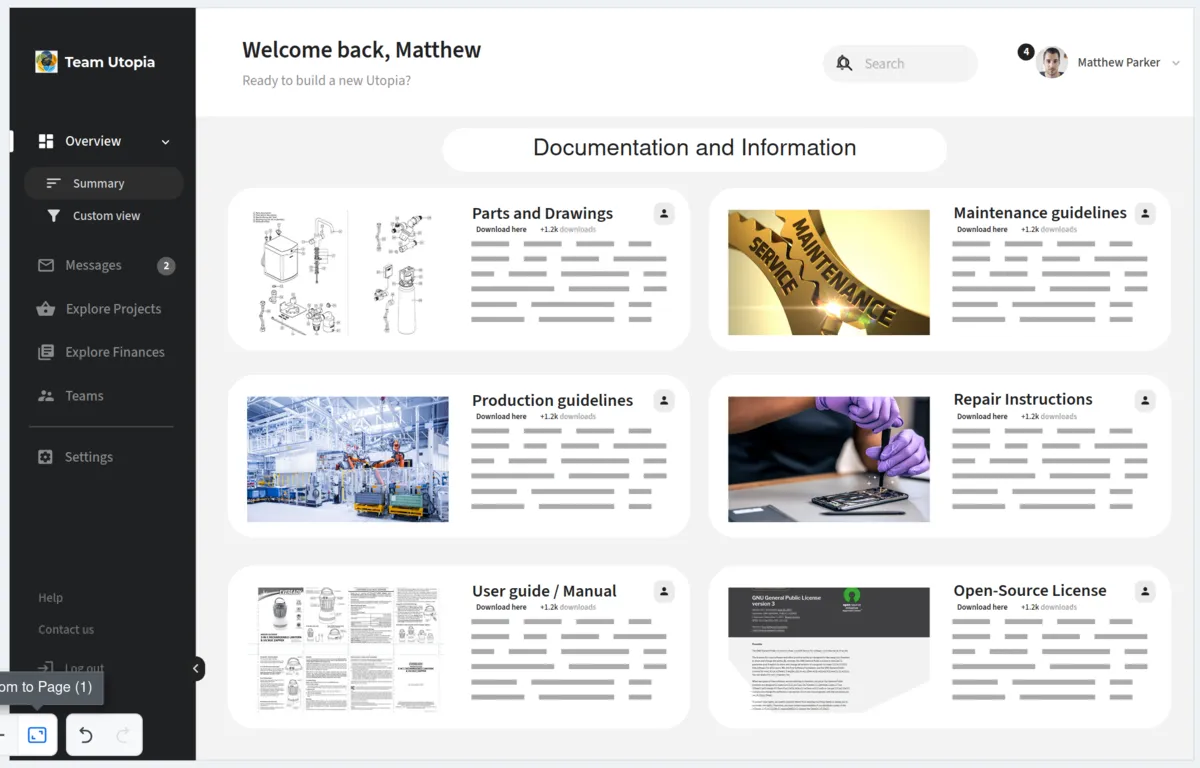
The following three images show how the documentation section / knowledge database of the Team Utopia platform could potentially look like. In Team Utopia every project is always following the principle public-money -> public goods. Every project that is planned, developed and implemented over Team-Utopia will be 100% open-source. In contrast to profit-oriented organizations and companies Team Utopia aims to release all information that exists to the customer. By this everyone is able to copy and maybe even improve what was done by Team-Utopia. Also everyone has the chance to use all this free and public knowledge to learn new things, to understand the technical details, become an expert in this field or if not maybe just be able to repair his product that he initially bought from a Utopian Project.
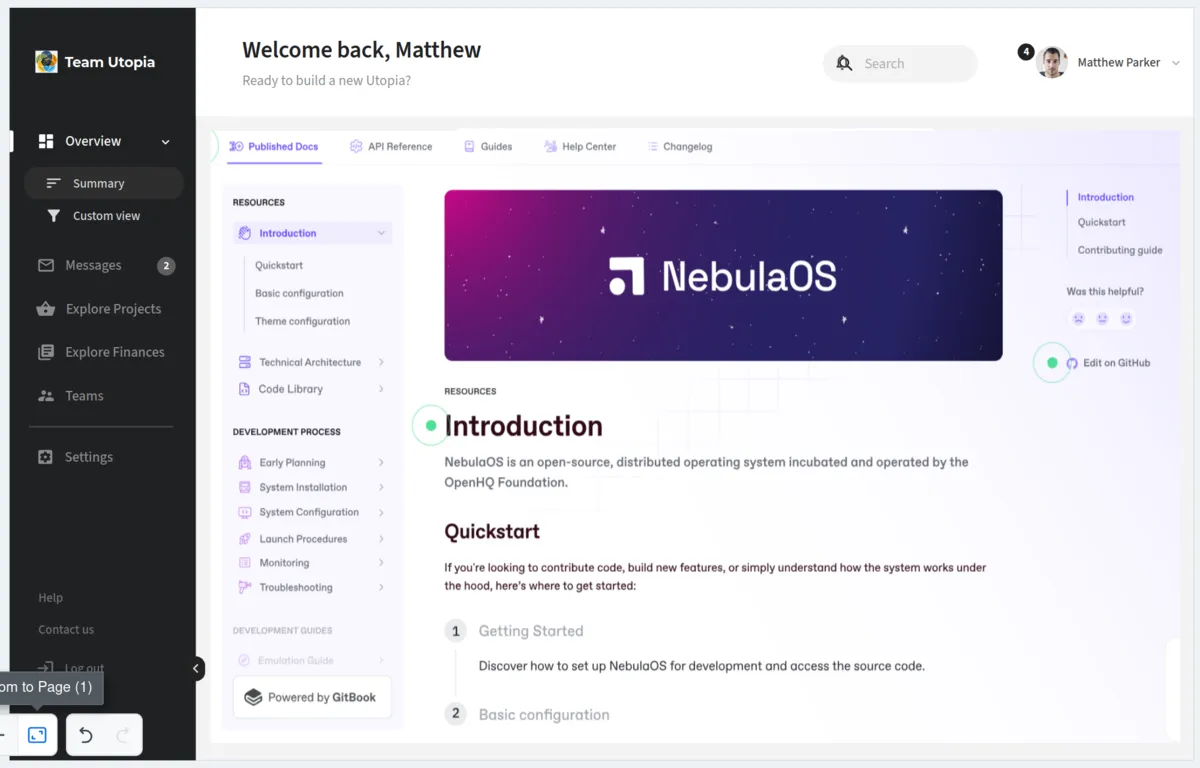
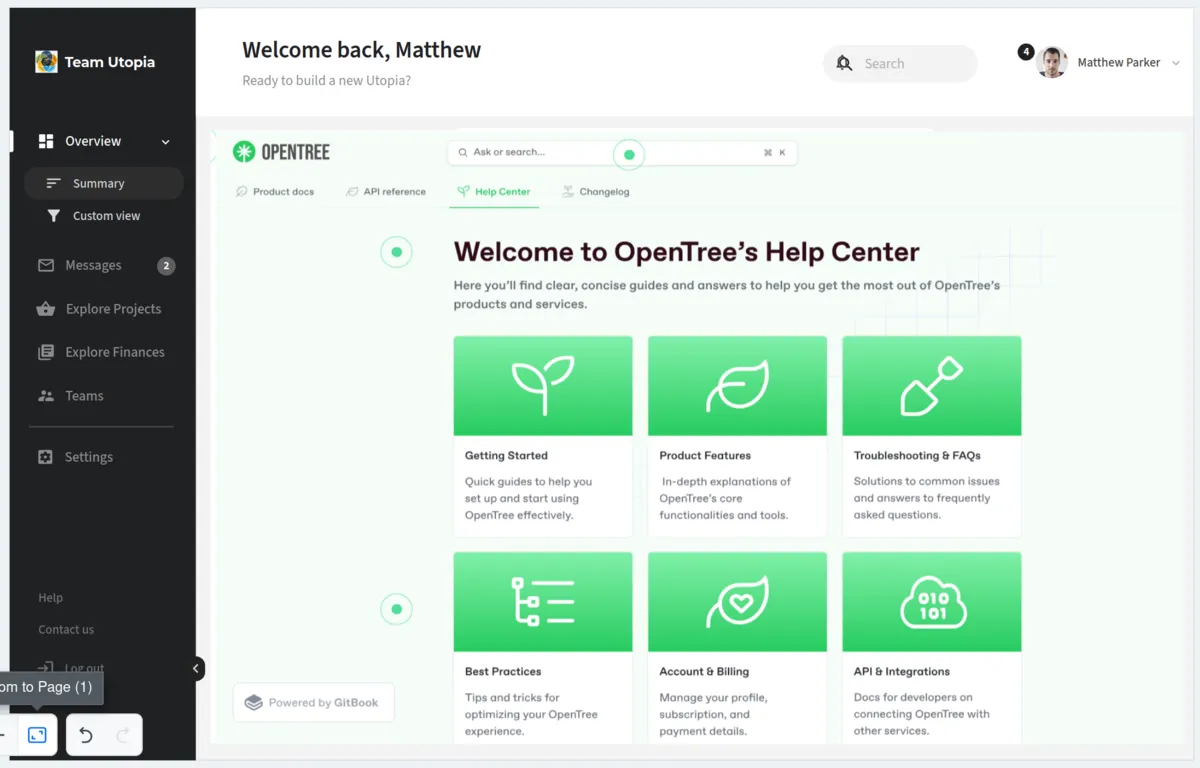
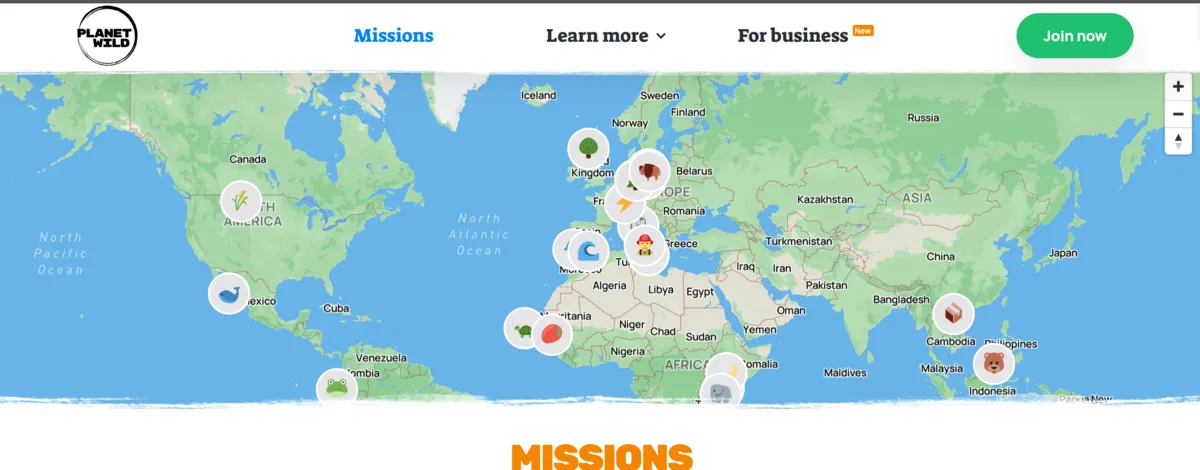
Besides this they create high-quality video content for the promotion of all projects and also constant documentation of the progress each project reached. The donors can watch these videos like a normal tv-show that releases videos every couple of days and while doing this feel good, because they can see how their money did something good in the world.
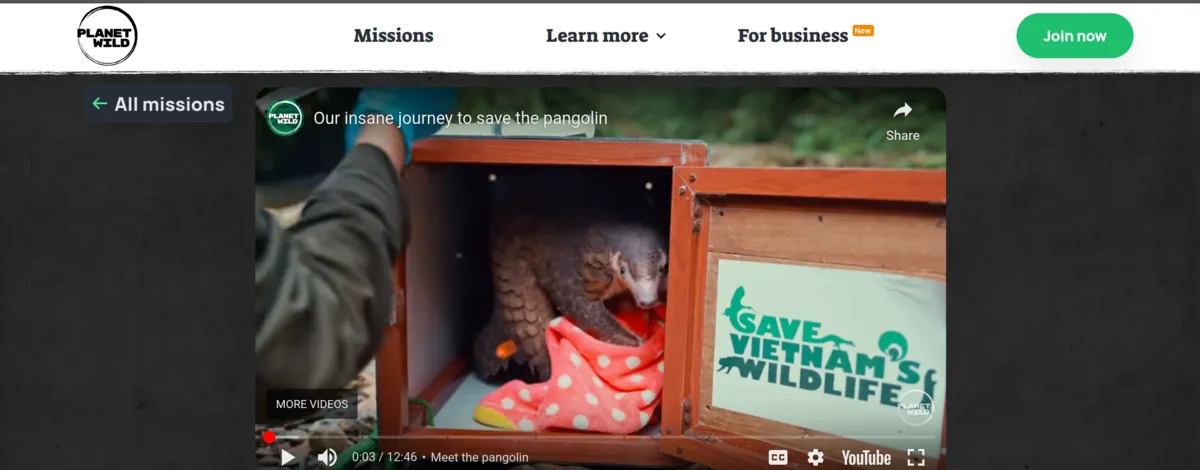
If we could reach a similar mode with Team Utopia that constantly reports on planned and ongoing projects in a very high-quality, social-media-ready way we might reach even more new Team-members for Team Utopia.
Is it possible to make the world a better place? Can we fix the worlds most urgent problems? The answer of this question has two main sides to it:
From technology point of view we are in the lucky situation that all the seventeen SDGs (Sustainable Development Goals) that were defined by the United Nations (UN) in 2015 are technically solvable with the already existing technology now. While this doesn’t mean that we don’t need innovations anymore - in fact we still need innovations in every field to make everything cheaper, faster, more efficient, .. - we could already now solve all our existing problems with today’s existing technology.
The financial aspect will be a harder job though. Many of the challenges we face today will need billions to trillions of dollars of investment. It’s only fair to ask the question if it is realistic to raise the money to fix these problems. To answer this question there are two ways possible:
From scientific point of view we have to look at the raw numbers and try to find out, what amounts of money we need for global scale projects and what amounts of money might be available.
So how do we do that? One way to estimate what money might be needed, could be to look at the UNs SDGs again. Financing one or more Sustainable Development Goals would probably be the biggest imaginable Utopian Project, Team Utopia could work on. Using SDGs as financing examples is also good, because the UN, other NGOs and Think-tanks spend a lot of resources already in estimating the costs of their implementation.
One interesting way to look at the implementation and financing of the SDGs is to look at it not goal by goal but by different pathways. Each pathway focuses on multiple SDGs that are somehow interconnected and that could benefit from each other.
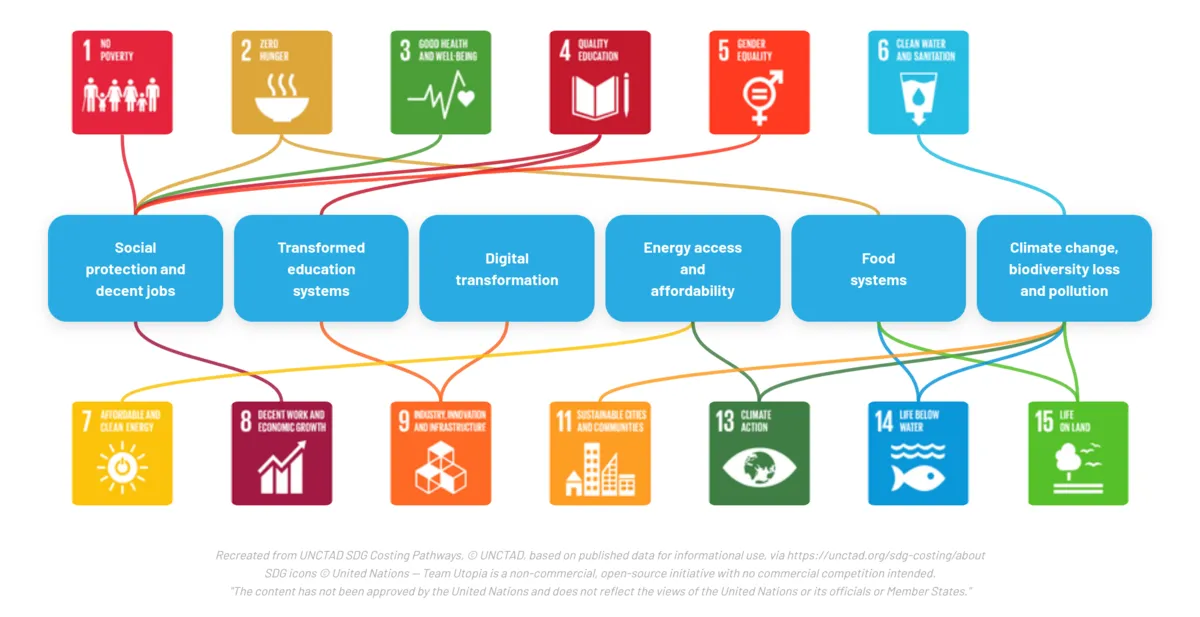
The above graphic shows how the UN tried to group their SDGs in six different pathways. Each SDG (colored box) that is connected to one of pathways (one of the blue rounded boxes) could be fixed if the corresponding pathway would be implemented.
The next graphic shows what amounts the UN estimated for each pathway to be implemented. The numbers displayed show annual costs until 2030 to reach the pathways. The dark green bars show the “business-as-usual” trajectory. They represent the projected or estimated spending that is likely to occur under current trends and policies — that is, if countries continue spending as they do today, possibly adjusting for economic growth and inflation. The light green bars represent the expected annual financing gap, or in other words: it’s the additional amount of spending needed per year to meet the pathways goals.
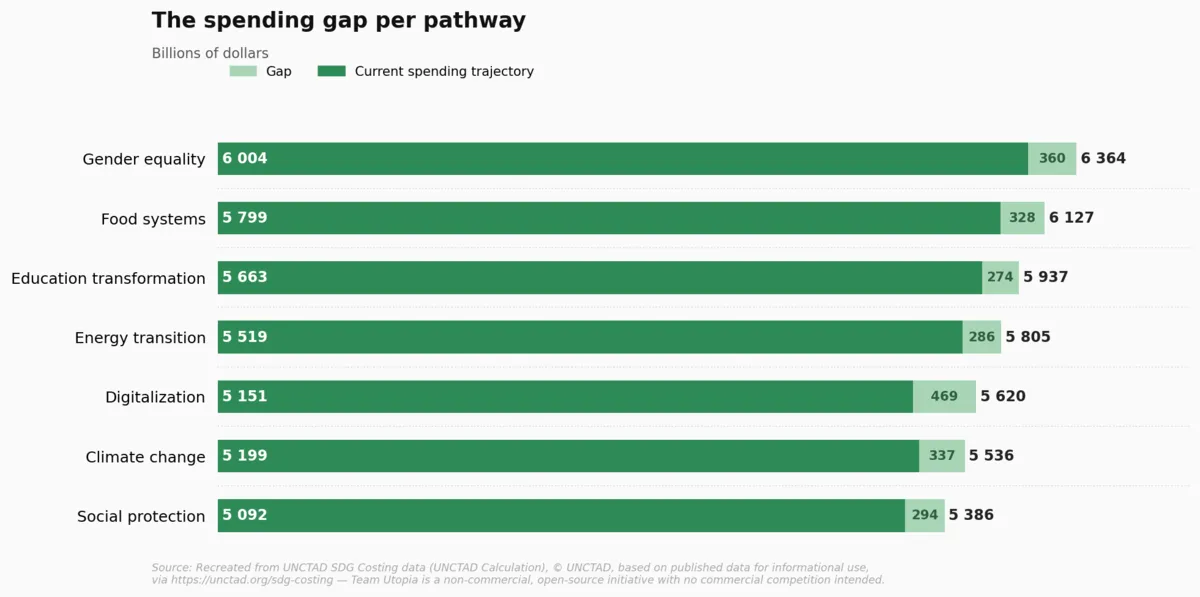
But how much money is that? What does 5 - 6 trillion dollar even mean and how much are a few hundred billion? To get a rough understanding about the numbers we can compare them to other gigantic numbers.
The World GDP (2024) was around 105 trillion US-Dollar. GDP stands for Gross Domestic Product, and it measures the total monetary value of all goods and services produced. This means each of these pathways individually represents around 5–6% of the total worlds GDP. If you combine them all together they represent about 39% of the whole worlds GDP.
Luckily the dark green bars represents spending that already happens in these areas. These spendings are already now core parts of all economies, and show us that we (governments, companies, private organizations and persons) already now spend about 37% of our GDP into the implementation of these SDGs, directly and indirectly, whether we know it or not.
The financing gap of about 2.34 trillion dollar annually represents about 2.2% of our GDP - still an unimaginable big amount of money, but if we look at other numbers it seems realistic and economically feasible, especially if we compare it to the cost of inaction (poverty, climate damage, instability).
We can also compare it to other big numbers to get a better feeling about it. For example the U.S. federal budget (2024) was about 6.3 trillion US-Dollar, which means the U.S. on it’s own spends each year about two and a half times the same amount than what it costs to finance the whole SDG financing gap. The total global military spending (2023) was about 2.4 trillion US-Dollar or in other words a little bit more than the total SDG financing gap.
If we look at the financing gaps for the single SDG pathways we can see that each financing gap represents about 0.26% to 0.45% of the whole worlds GDP, about 1/8 of all world military spending per year or roughly 5% of the entire U.S. budget.
Now since we have got a rough overview about what gigantic global scale problems can cost us, the next step would be to find out what amounts of money exist that could be relevant for global scale crowd-funding campaigns.
In general there are three main sources of money relevant for this:
Regarding 1. If we for example want to estimate how much money we could have available if normal persons would be willing to raise their private money in crowd-funding campaigns we just need to find out how many people exist world-wide and multiply them by the average income they get every year and then finally multiply it by a percentage of how many people are willing to donate and how many percent of their money they are willing to give. The below table shows an example calculation. It uses the numbers of the “International Energy Outlook 2023” published by the “U.S. Energy Information Administration” (EIA), a division of the U.S. Department of Energy. They provide public available data that they use to estimate the future of our energy sector and part of this data are estimations of the worlds population by region and also estimations of the disposable income per person for each this region. “Disposable Income” in this sense means money that people really have available after paying taxes and similar expenses. The numbers are estimations for the year 2025, but are given as 2015 US-Dollar PPP (Purchasing Power Parity), which means that their value reflect the U.S. dollar in the year 2015, but takes into account the different costs of living and inflation rates of countries. Since this study shows per capita numbers they reflect an average which includes all people of the population, also children, people in retirement, unemployed and sick people.
| Region | World Population 2025 | World disposable income per capita 2025 (in 2015 dollars per person (PPP) ) | Available money if 100% of the population contribute 100% of their income | Available money if 3% of the population contribute 1% of their income | Available money if 50% of the population contribute 0.1% of their income | Available money if 75% of the population contribute 5% of their income | Available money if 75% of the population in rich countries contribute 5% of their income and 75% of developing countries 0.1% | |
|---|---|---|---|---|---|---|---|---|
| Americas | 1,057,116,700 | $22,272 | $23,543,929,000,000 | $7,063,178,700 | $11,771,964,500 | $882,897,337,500 | $1,335,626,334,750.00 | |
| United States | 337,736,900 | $49,193 | $16,614,440,000,000 | $4,984,332,000 | $8,307,220,000 | $623,041,500,000 | $1,246,083,000,000.00 | |
| Canada | 40,464,700 | $28,073 | $1,135,976,000,000 | $340,792,800 | $567,988,000 | $42,599,100,000 | $85,198,200,000.00 | |
| Mexico | 130,409,400 | $15,608 | $2,035,396,000,000 | $610,618,800 | $1,017,698,000 | $76,327,350,000 | $1,526,547,000.00 | |
| Brazil | 218,938,400 | $11,582 | $2,535,710,000,000 | $760,713,000 | $1,267,855,000 | $95,089,125,000 | $1,901,782,500.00 | |
| Other Americas | 329,567,300 | $3,709 | $1,222,407,000,000 | $366,722,100 | $611,203,500 | $45,840,262,500 | $916,805,250.00 | |
| Europe and Eurasia | 922,975,600 | $20,755 | $19,156,579,000,000 | $5,746,973,700 | $9,578,289,500 | $718,371,712,500 | $1,158,889,604,250.00 | |
| Western Europe | 636,130,500 | $24,232 | $15,414,440,000,000 | $4,624,332,000 | $7,707,220,000 | $578,041,500,000 | $1,156,083,000,000.00 | |
| Russia | 142,651,200 | $16,287 | $2,323,418,000,000 | $697,025,400 | $1,161,709,000 | $87,128,175,000 | $1,742,563,500.00 | |
| Eastern Europe and Eurasia | 144,193,900 | $9,839 | $1,418,721,000,000 | $425,616,300 | $709,360,500 | $53,202,037,500 | $1,064,040,750.00 | |
| Asia Pacific | 4,358,249,960 | $9,145 | $39,855,345,000,000 | $11,956,603,500 | $19,927,672,500 | $1,494,575,437,500 | $417,506,283,000.00 | |
| Japan | 124,038,800 | $24,037 | $2,981,487,000,000 | $894,446,100 | $1,490,743,500 | $111,805,762,500 | $223,611,525,000.00 | |
| South Korea | 51,683,530 | $22,960 | $1,186,641,000,000 | $355,992,300 | $593,320,500 | $44,499,037,500 | $88,998,075,000.00 | |
| Australia and New Zealand | 32,517,630 | $32,360 | $1,052,273,000,000 | $315,681,900 | $526,136,500 | $39,460,237,500 | $78,920,475,000.00 | |
| China | 1,424,255,000 | $12,236 | $17,426,860,000,000 | $5,228,058,000 | $8,713,430,000 | $653,507,250,000 | $13,070,145,000.00 | |
| India | 1,456,118,000 | $6,308 | $9,185,837,000,000 | $2,755,751,100 | $4,592,918,500 | $344,468,887,500 | $6,889,377,750.00 | |
| Other Asia Pacific | 1,269,637,000 | $6,319 | $8,022,247,000,000 | $2,406,674,100 | $4,011,123,500 | $300,834,262,500 | $6,016,685,250.00 | |
| Africa and Middle East | 1,772,467,400 | $2,283 | $4,046,091,000,000 | $1,213,827,300 | $2,023,045,500 | $151,728,412,500 | $3,034,568,250.00 | |
| Africa | 1,485,950,000 | $1,703 | $2,530,474,000,000 | $759,142,200 | $1,265,237,000 | $94,892,775,000 | $1,897,855,500.00 | |
| Middle East | 286,517,400 | $5,290 | $1,515,617,000,000 | $454,685,100 | $757,808,500 | $56,835,637,500 | $1,136,712,750.00 | |
| World | 8,110,809,660 | $10,677 | $86,601,944,000,000 | $25,980,583,200 | $43,300,972,000 | $3,247,572,900,000 | $2,915,056,790,250.00 |
Source:
These numbers show us that only with normal people’s money we could raise tens of billion dollars if a few percent of the population donate a fraction of their disposable income. For example if 3% of the population contribute 1% of their income it ends up in about 26 billion dollar. If you manage to motivate a high percentage of the population you could reach numbers between hundreds of billions up to a trillion. For example if 30% of the population give 1% of their income, we could raise 259 billion dollar per year, if 50% of the population give 0.1% of their income we could raise 43 billion, if 75% of the population contribute 5% of their income it would end up 3.25 trillion (3,247 billion), if 75% of the population in rich countries contribute 5% of their income and 75% of developing countries 0.1% it adds up to 2.9 trillion (2,915 billion).
Another way to look at the available money from normal persons is to look at what normal expenses normal people pay day by day. By this we can estimate what money might be available. The following table shows prices for different products and services in different parts of the world.
| Region | World Population 2025 in million persons | Big Mac | iPhone (base model) | Coca-Cola (0.33 L) | Six-pack beer | 1 mo Netflix | 1 mo Spotify | 1-mo rent (1BR city centre) | Full tank gasoline (50 L) | 1 mo mobile plan | Uber 20-min ride | Restaurant visit (family of 4) | Cinema ticket (1 adult) | Pair of shoes (mid-range) |
|---|---|---|---|---|---|---|---|---|---|---|---|---|---|---|
| Americas | 1,057 | |||||||||||||
| United States | 338 | $6 | $799 | $2 | $9 | $18 | $10 | $1,800 | $50 | $50 | $25 | $150 | $14 | $85 |
| Canada | 40 | $6 | $740 | $2 | $10 | $18 | $10 | $1,400 | $55 | $45 | $22 | $120 | $13 | $90 |
| Mexico | 130 | $4 | $560 | $1 | $5 | $4 | $4 | $500 | $35 | $12 | $8 | $50 | $5 | $55 |
| Brazil | 219 | $5 | $650 | $1 | $6 | $4 | $4 | $400 | $45 | $8 | $7 | $45 | $6 | $60 |
| Other Americas | 330 | $4 | $600 | $1 | $5 | $5 | $5 | $600 | $40 | $15 | $10 | $60 | $8 | $65 |
| Europe and Eurasia | 923 | |||||||||||||
| Western Europe | 636 | $5 | $880 | $3 | $12 | $15 | $10 | $1,200 | $80 | $30 | $20 | $100 | $12 | $95 |
| Russia | 143 | $3 | $600 | $1 | $4 | $4 | $4 | $350 | $60 | $8 | $7 | $40 | $5 | $65 |
| Eastern Europe and Eurasia | 144 | $4 | $620 | $1 | $5 | $5 | $5 | $450 | $60 | $12 | $9 | $55 | $7 | $70 |
| Asia Pacific | 4,358 | |||||||||||||
| Japan | 124 | $5 | $980 | $2 | $9 | $6 | $5 | $900 | $70 | $40 | $30 | $90 | $12 | $85 |
| South Korea | 52 | $4 | $900 | $2 | $9 | $8 | $5 | $700 | $65 | $30 | $20 | $80 | $10 | $90 |
| Australia and New Zealand | 33 | $5 | $1,100 | $3 | $12 | $12 | $10 | $1,200 | $85 | $30 | $25 | $110 | $15 | $100 |
| China | 1,424 | $3 | $650 | $1 | $4 | $6 | $4 | $500 | $50 | $10 | $10 | $60 | $6 | $70 |
| India | 1,456 | $3 | $450 | $1 | $3 | $3 | $2 | $200 | $40 | $3 | $3 | $25 | $3 | $45 |
| Other Asia Pacific | 1,270 | $3 | $600 | $1 | $4 | $5 | $4 | $450 | $50 | $10 | $8 | $50 | $6 | $65 |
| Africa and Middle East | 1,772 | |||||||||||||
| Africa | 1,486 | $3 | $520 | $1 | $3 | $3 | $3 | $250 | $60 | $8 | $5 | $35 | $5 | $55 |
| Middle East | 287 | $4 | $700 | $1 | $5 | $6 | $5 | $600 | $70 | $15 | $12 | $70 | $9 | $75 |
| World | 8,111 |
Sources:
If we now use this table we can multiply these prices with the population numbers and make statements like
These numbers we can now use in the second step to understand whether or not it is realistic to finance global scale projects.
Regarding 2. A second possible source of money for crowdfunding could be the profit of companies. As a rule-of-thumb we can say that the profit produced by all companies world-wide equals about 15-20% of the world-wide GDP (15 – 21 trillion US-Dollar per year). Big international companies represent nearly half of this, about 9%, while the rest is represented by small to mid-size companies. This number is backed by the “Chapter 2: Coordinating Taxation Across Borders” of the report “Fiscal Monitor” that the International Monetary Fund (IMF) published in 2022 (Source : https://www.imf.org/en/Publications/FM + https://www.imf.org/-/media/Files/Publications/fiscal-monitor/2025/English/ch2.ashx)
Here they write that already only the big “Multinationals generated profit of 7.9 trillion US-Dollar in 2019 (9.2 percent of global GDP). Estimates, based on simplifying assumptions, suggest that a sizable share of multinationals’ profit (possibly reaching 60 percent) is excess profit.”
| Small Companies (Local businesses, <100 employees) | Mid-Size Companies (100-999 employees, regional players) | Mid-tier Multinationals (1k–9,999) | Large International Corporations (Fortune Global 500 level, multinationals) | |||||
|---|---|---|---|---|---|---|---|---|
| Region / Country | Number of companies (millions) | Avg annual profit per company | Number of companies (thousands) | Avg annual profit per company | Number of companies (thousands) | Avg annual profit per company | Number of companies | Avg annual profit per company |
| Americas | ||||||||
| United States | 31.7 | $45,000.00 | 625 | $2,756,800.00 | 625.00 | $1,443,200.00 | 139 | $4,800,000,000.00 |
| Canada | 1.4 | $38,000.00 | 32 | $2,343,750.00 | 32.00 | $1,156,250.00 | 11 | $3,200,000,000.00 |
| Mexico | 4.9 | $12,000.00 | 85 | $864,705.88 | 85.00 | $435,294.12 | 3 | $2,900,000,000.00 |
| Brazil | 6.2 | $14,000.00 | 125 | $1,052,000.00 | 125.00 | $448,000.00 | 5 | $3,100,000,000.00 |
| Other Americas | 5.8 | $15,000.00 | 95 | $757,894.74 | 95.00 | $842,105.26 | 2 | $2,600,000,000.00 |
| Europe and Eurasia | ||||||||
| Western Europe | 18.5 | $52,000.00 | 480 | $3,204,166.67 | 480.00 | $1,895,833.33 | 143 | $4,100,000,000.00 |
| Russia | 2.8 | $22,000.00 | 72 | $1,730,555.56 | 72.00 | $569,444.44 | 4 | $8,200,000,000.00 |
| Eastern Europe and Eurasia | 6.2 | $18,000.00 | 145 | $1,506,896.55 | 145.00 | $393,103.45 | 6 | $3,800,000,000.00 |
| Asia Pacific | ||||||||
| Japan | 3.8 | $42,000.00 | 148 | $3,448,648.65 | 148.00 | $1,351,351.35 | 40 | $3,200,000,000.00 |
| South Korea | 1.2 | $38,000.00 | 52 | $3,146,153.85 | 52.00 | $1,153,846.15 | 15 | $4,900,000,000.00 |
| Australia and New Zealand | 0.9 | $48,000.00 | 28 | $2,992,857.14 | 28.00 | $1,607,142.86 | 4 | $3,400,000,000.00 |
| China | 125 | $11,000.00 | 1850 | $1,024,324.32 | 1,850.00 | $675,675.68 | 128 | $4,500,000,000.00 |
| India | 63 | $7,500.00 | 780 | $705,128.21 | 780.00 | $294,871.79 | 11 | $3,600,000,000.00 |
| Other Asia Pacific | 30 | $9,200.00 | 420 | $890,476.19 | 420.00 | $309,523.81 | 8 | $3,500,000,000.00 |
| Africa and Middle East | ||||||||
| Africa | 44 | $6,800.00 | 420 | $492,857.14 | 420.00 | $357,142.86 | 3 | $2,800,000,000.00 |
| Middle East | 8.5 | $21,000.00 | 165 | $1,587,878.79 | 165.00 | $612,121.21 | 15 | $9,500,000,000.00 |
After seeing these numbers we can make statements like if
Regarding 3. Countries are also big potential players in funding global scale projects. Normally developed countries spend hundreds of millions of dollars each year into philanthropic projects, art projects, social projects.
Besides this we can compare big expenses of countries to get a better understanding what amounts they are able to spend if they are considering a problem really important.
The below table shows us what amounts countries are able to spend per person on some important topics.
| Region | World Population 2025 in million persons | Military spending (annual per capita) | Fossil fuel subsidies (annual per capita) | Bank bailout cost (2008 crisis, total per capita) | Healthcare spending (annual per capita) | Education spending (annual per capita) | Infrastructure investment (annual per capita) |
|---|---|---|---|---|---|---|---|
| Americas | 1,057 | ||||||
| United States | 338 | $2,989 | $95 | $1,494 | $12,914 | $3,127 | $1,200 |
| Canada | 40 | $765 | $145 | $225 | $5,782 | $2,890 | $950 |
| Mexico | 130 | $124 | $480 | $58 | $685 | $520 | $380 |
| Brazil | 219 | $96 | $125 | $75 | $984 | $1,235 | $420 |
| Other Americas | 330 | $180 | $220 | $90 | $1,250 | $890 | $450 |
| Europe and Eurasia | 923 | ||||||
| Western Europe | 636 | $1,245 | $185 | $1,850 | $5,890 | $2,450 | $1,180 |
| Russia | 143 | $1,007 | $850 | $120 | $895 | $678 | $520 |
| Eastern Europe and Eurasia | 144 | $420 | $320 | $145 | $1,450 | $980 | $560 |
| Asia Pacific | 4,358 | ||||||
| Japan | 124 | $442 | $78 | $350 | $4,567 | $1,289 | $780 |
| South Korea | 52 | $912 | $125 | $180 | $2,890 | $1,456 | $920 |
| Australia and New Zealand | 33 | $1,296 | $165 | $420 | $5,234 | $2,180 | $1,050 |
| China | 1,424 | $219 | $195 | $85 | $678 | $456 | $890 |
| India | 1,456 | $60 | $310 | $12 | $89 | $112 | $145 |
| Other Asia Pacific | 1,270 | $145 | $420 | $45 | $380 | $290 | $280 |
| Africa and Middle East | 1,772 | ||||||
| Africa | 1,486 | $45 | $280 | $18 | $125 | $180 | $120 |
| Middle East | 287 | $385 | $1,450 | $75 | $980 | $720 | $650 |
| World | 8,111 |
After seeing this table we can make statements like:
All in all if we look at the above numbers we can see that most of the problems that humanity faces today will require unimaginable big financial resources to solve them. But nevertheless all of these problems are not only technically solvable it’s also possible to finance them if we can mobilize a really big part of humanity to spend a small fraction of their wealth.
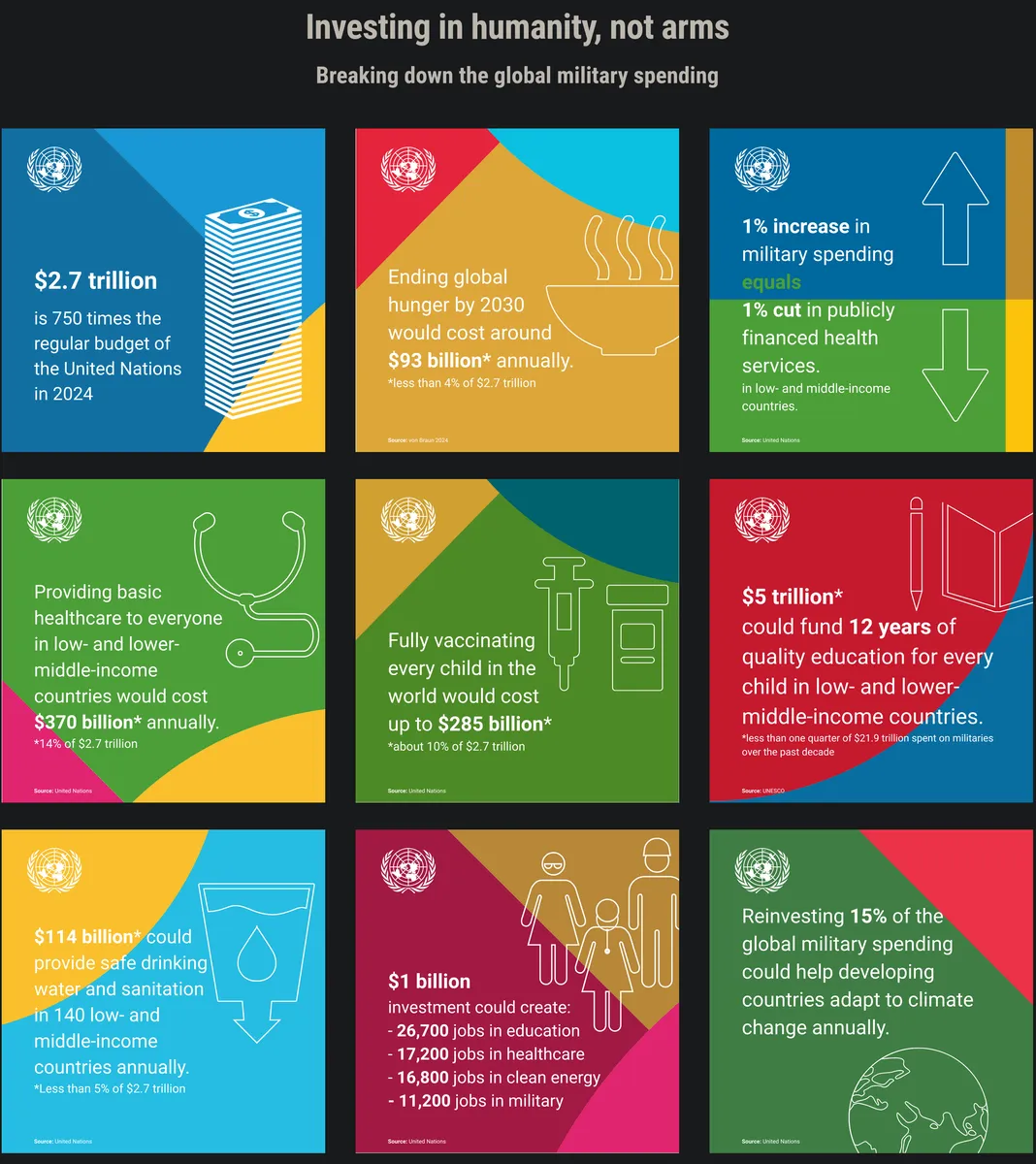
Or to say in the words of the UN: “A little over 10 per cent (285 billion US-Dollar)
\[of the annual military spending\]can fully vaccinate every child. With 5 trillion US-Dollar, (
\[a little less than the money we spend within two years for military purposes\]) the world could fund 12 years of quality education of every child in low- and lower-middle-income countries” (Source: https://www.undp.org/press-releases/record-military-spending-threatens-global-peace-and-development-new-un-report-warns)
“Reinvesting 15 per cent or 387 billion US-Dollar of the global military spending is more than enough to cover the annual costs of climate change adaptation in developing countries. It would also reduce emissions intensity: by some estimates, each dollar spent on the military generates over twice the greenhouse gas emissions of a dollar invested in civilian sectors.” (Source: https://www.undp.org/press-releases/record-military-spending-threatens-global-peace-and-development-new-un-report-warns)
If we look at the estimated costs and estimated 3 money sources of the above chapter it’s clear that some projects/problems will be way harder to get financed than others.
There are some “low-hanging-fruits”-problems like “Zero Hunger” that are “easy” to be financed. For example if 30% of population would stop buying 1 BicMac per month, this money would be enough to finance the yearly costs of the Zero Hunger SDG 2.5 times. The same is true if 1% of population stops buying 1 I-Phone per year, this would be enough to finance Zero Hunger 1.24 times, or if 10% of the population stops buying 1 coca-cola per week it would finance it 1.12 times.
If we would want to pay currently out-of-school kids more than minimum wage to motivate them to go to school this could be financed if normal people would donate the same money that it would cost if 50% of the population would buy a coca-cola per week or if 10% buy 5x Restaurant visits per year (family of 4).
Another good example for a low-hanging fruit is SDG5 - Gender Equality with a yearly cost of 10 billion dollar. This relatively modest goal could be achieved 86 times over if everyone donated just 1% of their net disposable income (after tax). Even if only 1% of people gave 1% of their income, we’d still cover 87% of the cost.
To reach SDG6 - Clean Water and Sanitation we have to invest 114 billion dollar per year. If all companies donated 1% of profits, we could cover 179% of the needs.
SDG7 - Affordable and Clean Energy will require 70 billion dollar annually, which could be financed 6 times if 50% of people donated 1%.
But besides these low-hanging fruits we also have problems / projects that will require us to “reach for the stars.” For example it will require 2.5 trillion dollar per year (2500 billion) to reach SDG1 - No Poverty. This is nothing that can be solved by just a few people giving a few dollar per year. Indeed we would need 60% of the whole worlds population to give 5% of their income - every year - to finance this goal. Another massive project would be to buy back enough nature to reach the UNs 30x30 goal (30% protected areas by 2030). This would cost us about 1.2 trillion (1175.5 billion) dollar, which could only be financed if 75% of the population would donate 1% of their income for 2 years. Or if we focus on the richer countries: 50% of all people in developed countries - which are 8% of all people on the planet - giving about 1800 dollar as a one-time payment results in the same amount. Switching 100% of all consumable goods away from single-use-packaging to multi-use-packaging would cost us about 4.1 trillion (4113 billion) dollar (one-time investment). If we would want to raise this money we would need to motivate 30% of the population to give 5% of their income for 3 years, or spend two years of our world-wide military spendings, or motivate all companies world-wide to donate 1% of their profits for the next 20 years. The same is true if we would want to switch our energy infrastructure to 100% renewable and pay it off in one big payment it would require about 172 trillion (172000 billion) dollar - which is more than the worlds total GDP - about two times of all the net income that all the people on the planet earn per year or about 10 times the profit of all companies world-wide.
The above examples reveal that small-scale goals (under 100B dollar annually) are remarkably achievable through modest individual contributions, while massive infrastructure transformations require either sustained commitment or significant corporate/government participation.
So what does that mean for us? Are really massive global-scale utopian projects un-achievable because it’s not realistic to fund them? Not really! It’s definitely true that it’s not realistic to reach these numbers just by a few percent of the population donating a few percent of their income or savings. The solution seems to be that you have to make some more clever financing plans.
For example if we want to switch 100% of all consumable goods away from single-use-packaging to multi-use-packaging this would cost us about 4.1 trillion. But if we implement this in a clever way, actually all of the money could get paid back to the funders within about 7 years. How is that possible? We can see this money not as a gift from the donors to the society, but as a interest free credit to produce these multi-use-packaging containers. Producing companies (e.g. food-companies, beverage-companies, …) can buy these multi-use containers for the same price as what they paid before for the single-use containers. But since the multi-use containers can be used multiple times they don’t have to be produced again and again. Still the producing companies have to pay this price each time they want to use the container and by this they will pay off the production cost step-by-step. Nothing changes for the customer and nothing changes for the producer and still over the course of a few years they will totally finance this project and all the people who donated money will receive back 100% of their money,
The same is true for switching to 100% renewable energy. It is not necessary to fund 100% of the total amount up-front, because once some of the first parts of the infrastructure are successfully build, they will produce surpluses which can then help to pay-off the rest of the infrastructure that is not yet build. We actually don’t even need the donors to “donate” their money, again we could think about something like a interest free-credit that finances the first years of the project and that we will pay back the costs by selling the electricity to the same prices than what it costs now. With such a financing plan the amount required drops from 172 trillion (total) to 4 trillion per year over 20 years, which is about the same cost than what it costs if 50% of humans fill their 50 liter gasoline car-tank 1.6 times per month. By year 20, the first power plants pay for themselves and start funding the next ones. By year 30, electricity costs drop by 30-50% because there’s no profit margin, no interest payments, just energy at cost. By year 40, the entire planet runs on clean, affordable energy owned by the people who built it. By year 70 all the credit-money is paid back.
Even if we look at our “Buy-Back Nature 30x30” - project it might be possible to find “smarter” ways of financing. Here it will be harder, because protected nature normally does not produce any profits that could be used to pay back the investment of the funders. Nevertheless it’s not impossible. Of course it would be the best if the funders could just raise the money and buy the nature straight away without expecting any pay-back, but if we find out that this is not realistic we could still think about things like issuing and selling carbon certificates. Protecting land preserves carbon sinks and biodiversity. These can be certified and sold to companies or countries offsetting their footprints. If we assume that about 50% of this land is carbon-relevant (actively sequestrating emissions), 30% of the possible certificates might get realistically sold, the sequestration rate is about 4 tons of CO₂ per hectar per year (conservative global average for carbon-relevant land) and the price is between 20 to 80 dollar/t, and we have 25 years left to sell such certificates (before we want to reach global net zero) we could reach a payback of about 19% to 100% of the 1.2 trillion dollar cost.
In the end, the numbers show something powerful — we already have everything we need to build a better world. If each of us, along with businesses and governments, contributed just a small share of what we already spend every day, we could fund real, lasting change. Together, we can turn what seems impossible into a global effort for a fairer, cleaner, and more hopeful future.
From common sense point of view it’s actually pretty simple. It’s only about the simple questions : “Do we want these changes for humanity and our planet or not?” If we want them, it’s also clear that we will implement them at some point in history and if we implement them, it’s also clear that we will find some way to pay for them. If we know that we anyway will pay the bill in the end - why not doing it now? It’s as simple as that. If the roof of your house is leaking and you don’t start fixing it because you don’t want to pay the price and you hope that the problem will solve itself in the end, if you only wait long enough, then you will only end up with an even bigger expense. After some time of ignoring your problem, you don’t only need to repair the leak in your roof but now also need to repair the wet inside of your house. The costs won’t go away and the problem also won’t go away. The only two things that happen if you ignore things that in the end anyway have to be done are 1. the problem get’s worse and 2. the price you need to pay will be higher. Do we want clean water for everyone? Do we want free education for everyone? Do we want to end all kinds of hunger and poverty? Do we want to win the fight with climate change? Do we want to remove all that trash from our environment and stop extinction of more and more animals and plants? From common sense point of view the concrete numbers of cost are actually not really relevant. We in the end will pay whatever it will cost, because not fighting hunger, poverty, climate change, … simply is no option for humanity and the sooner we start to work on these problems the sooner solutions will get cheaper. If we decide to do these things we will find a way to make them become reality and we will also find money for this.
The next chapter will show some ideas that could be implemented as utopian projects within Team Utopia. Some of them are low-hanging fruits and easy to finance and implement while others are really utopian ideas that will need more innovations, investments and commitment than we can even imagine now. In the end all these ideas will need to run through the whole cycle of ethic, legal and scientific checking and then will need a detailed planning, cost and time evaluation. In this sense the below ideas are just that - ideas. Their sense is to open up a discussion about what kind of projects are possible to implement within Team Utopia.
Below you will see a short overview

Education changes everything.
One of the most prominent reasons, why people especially in developing countries are missing to get basic or even more advanced education is money. People usually leave the school and start working very early whenever they need the money they can earn more urgently than the education.
But what if we simply turn around the game. What if going to school or university would not cost money but pay you a solid amount of money. What if it would be economically more profitable to go to school or to get an degree in an interesting science than starting to work at a very young age. How would our world look like if education would be a guaranteed and free, even better a - paid - service for every human of the world?
How many more Einsteins, Da Vincis, Curies, and Mozarts are still hidden in countries where free and good education is still not widely available? And how could our world look like if all the available talents are found and supported?
So let’s make up the numbers and think about it in more detail. How could such a project be implemented? The first and most urgent problem to solve would be to provide basic “primary school” education, which means learning the basics of reading, writing, basic mathematics and maybe some basics of science, arts/music and sport at ages ranging around 5 to 11 years old. Referring to UNESCO Global Education Monitoring Report (Source : https://uis.unesco.org/en/topic/out-school-children-and-youth) 251 million kids worldwide are not in school today in 2023, 71 million kids of them were in primary-school age. So what would it cost if we would want to pay all these kids to go to school? To have parents of families living in poverty sending their kids to school instead of to work the school-payment has to beat the working salary. As young kids often work in illegal mines or production facilities, it’s not uncommon that they earn less money than the typical minimum wage in their country. This means, paying kids the countries minimum wage would most probably be a reasonable motivation for many families to send their kids to school. Unfortunately this is not the complete truth. We also have to consider that sending kids to school also brings additional opportunity costs like transportation, books, pencils and food that make it less attractive to decide for education vs. work. To also include this in our thoughts it would be helpful to not only pay minimum wage, but to pay a multiple like 1.5 or 2 times minimum wage and by this make it a no-brainer decision for parents of all social classes.
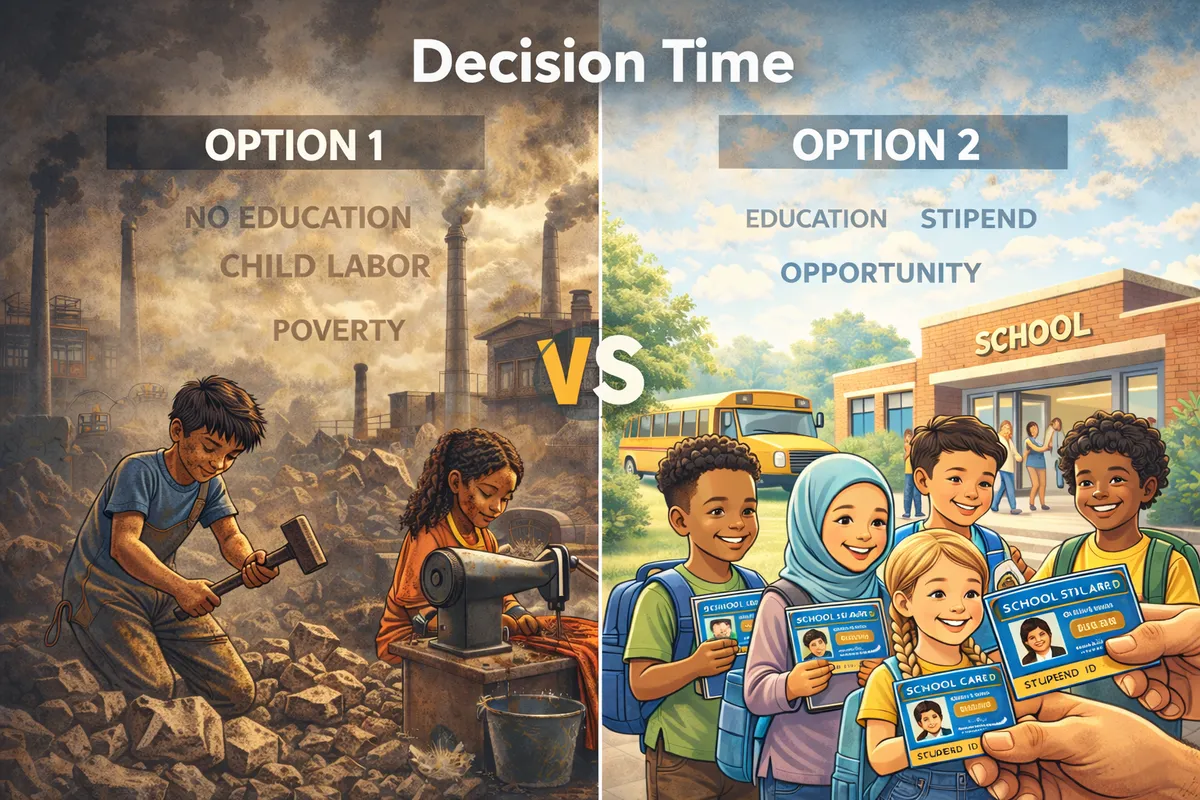
If we now assume a total of 64 million out-of-school kids in primary education age and a “suggested motivating payment” of 1.5 times the typical minimum wage of the corresponding region, we can find out that we will need a total of roughly 62 billion US-Dollar per year to financially support all these millions of kids. Which is less than thousand US-Dollar per year, per child.
| Region | Out-of-School Primary Kids (approx.) | Typical Minimum Wage (USD/day) | Suggested Motivating Payment (USD/day) | Annual Cost (USD) |
|---|---|---|---|---|
| Sub-Saharan Africa | 32 million | $2.00 | $3.00 | $19.2 billion |
| South Asia | 14 million | $3.00 | $4.50 | $12.6 billion |
| East Asia & Pacific | 6 million | $5.00 | $7.50 | $9.0 billion |
| Middle East & North Africa | 5 million | $6.00 | $9.00 | $9.0 billion |
| Latin America & Caribbean | 4 million | $7.00 | $10.50 | $8.4 billion |
| Rest of World (conflict areas) | 3 million | $4.00 | $6.00 | $3.6 billion |
| TOTAL | 64 million | — | — | $61.8 billion |
Is that a lot of money? Of course it is - especially if you compare it with your monthly paycheck. But what if I tell you that we in 2023 alone spend 2.24 trillion US Dollar worldwide for military expenses and the future looks like we will spend even more. In other words only 2% of the worlds military budget would be enough to finance this project and the military budget in the end is payed by normal peoples tax payments. The money is there - it’s just a question of what we want to use it for.
The above calculation can also be done for the 120 million kids worldwide that don’t have access to secondary school and because of this don’t have a chance to learn things like grammar of their own language, history and politics of their own and other countries, basics of a first foreign language, normal-life mathematics like percentage, interest or probability calculations, basics of sciences like physics, chemistry, biology.
If we would invest another 150 billion US Dollar per year it would be enough to allow all these kids to get a more than very basic primary education and have the chance to go to a secondary school. How could our world look like if every child in the world would understand the basics of science, politics and one to three languages? How could that contribute to solving the problems we have and how could everyone benefit from it?
It is in our hands - we have the money available to even finance such a project. It’s just a matter of priorities and decisions.
| Region | Out-of-School Secondary Kids (approx.) | Typical Minimum Wage (USD/day) | Suggested Motivating Payment (USD/day) | Annual Cost (USD) |
|---|---|---|---|---|
| Sub-Saharan Africa | 50 million | $2.00 | $4.00 | $40 billion |
| South Asia | 25 million | $3.00 | $6.00 | $30 billion |
| East Asia & Pacific | 10 million | $5.00 | $10.00 | $20 billion |
| Middle East & North Africa | 10 million | $6.00 | $12.00 | $24 billion |
| Latin America & Caribbean | 8 million | $7.00 | $14.00 | $22.4 billion |
| Rest of World (conflict zones) | 7 million | $4.00 | $8.00 | $11.2 billion |
| TOTAL | 120 million | — | — | $147.6 billion |
While some people still think it is not possible to power our energy-demands 100% by renewable energy, current scientific studies actually show us that it indeed is possible.
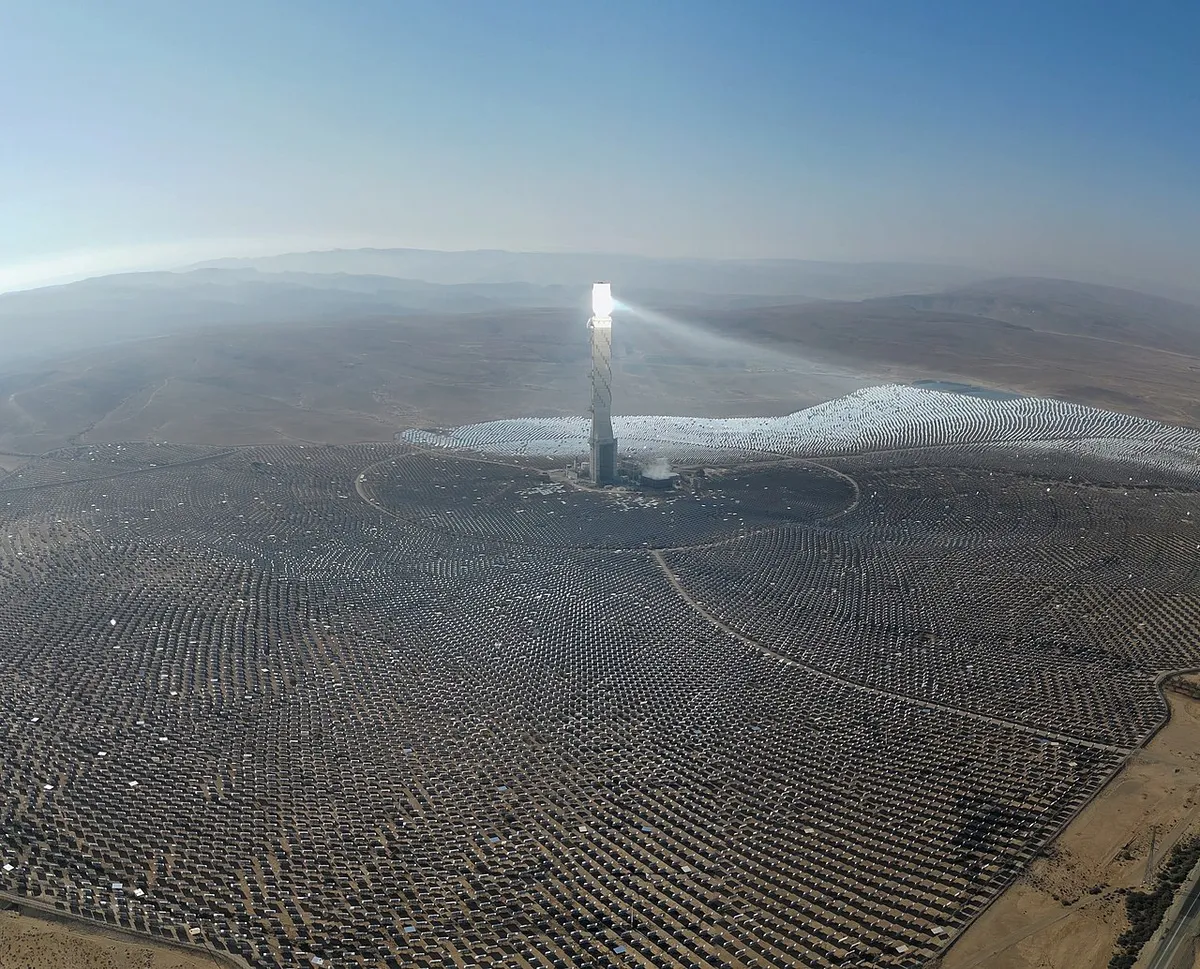
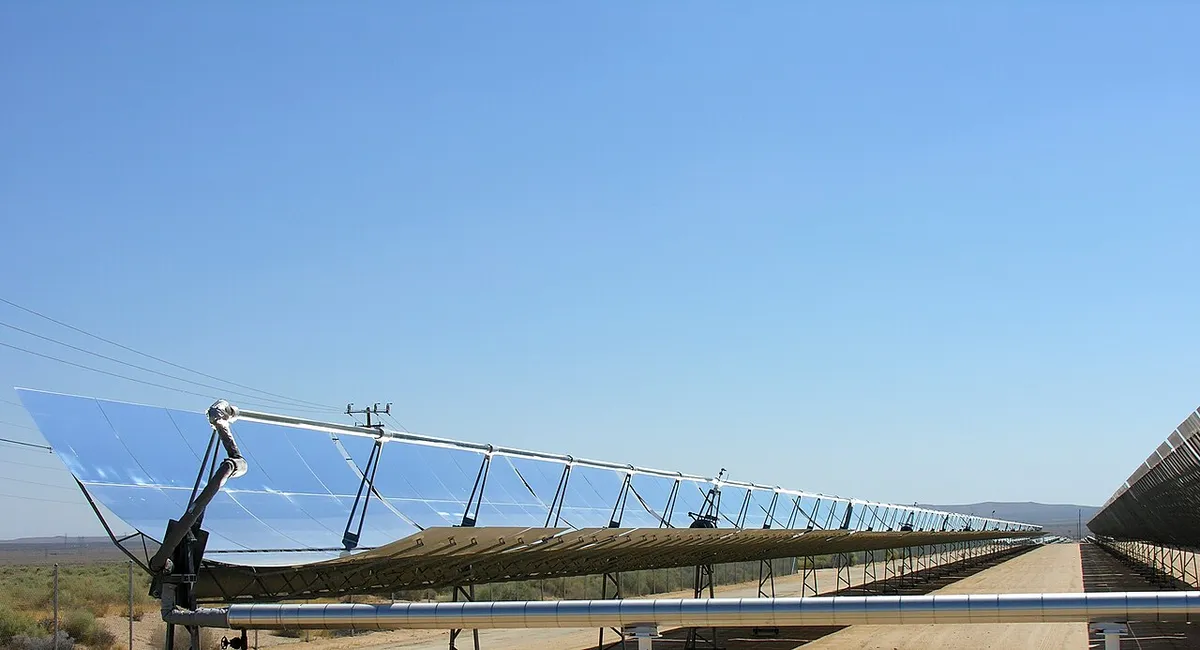
This utopian project wants to bring together all the entities, people and money to build a completely renewable energy infrastructure for the whole world. There are already now different projects and ideas that each could provide enough renewable energy to power the whole planet - if deployed in big scale. Our goal is to scale these projects into really gigantic dimensions and have a combination of the already existing solutions that in total will provide us with a diverse and resilient energy supply. To implement this change Team-Utopia wants to collect the ginormous amounts of money that will be needed for this. After this a sub-entity of Team-Utopia will start to work together with the already existing projects and plan, build, put into operation and maintain the energy infrastructure. For this we will hire a lot of people and provide new job-opportunities in most countries in the world. Since this project will be 100% open-source and non-profit we will be able to sell the energy at lower prices than profit-based energy-producing companies. Also all results and information that we produce in the process of this project will be released open source, which means every other human is free to use and copy it, which gives us the chance to spread the idea faster and maybe even speed up our switch away from fossil fuels.
But what is the difference between this project and already ongoing projects? This projects aims to bring energy-supply back into the hands of the people. From our point of view critical infrastructure should not make single companies or single people rich, but provide a important service for affordable prices to everyone. Just imagine an energy infrastructure that is owned by the population, an awesome, impressive energy infrastructure that is build the right way, not because it’s making profit, but because the owners are convinced to do the right thing and to invest in their and their children’s future. By getting normal people into the boat of producing energy, by using normal peoples money and by giving results and the produced energy back to exactly these people for low, affordable prices we will bring this important infrastructure back to what it should be - not a surplus-producing industry, but a service from the people for the people.
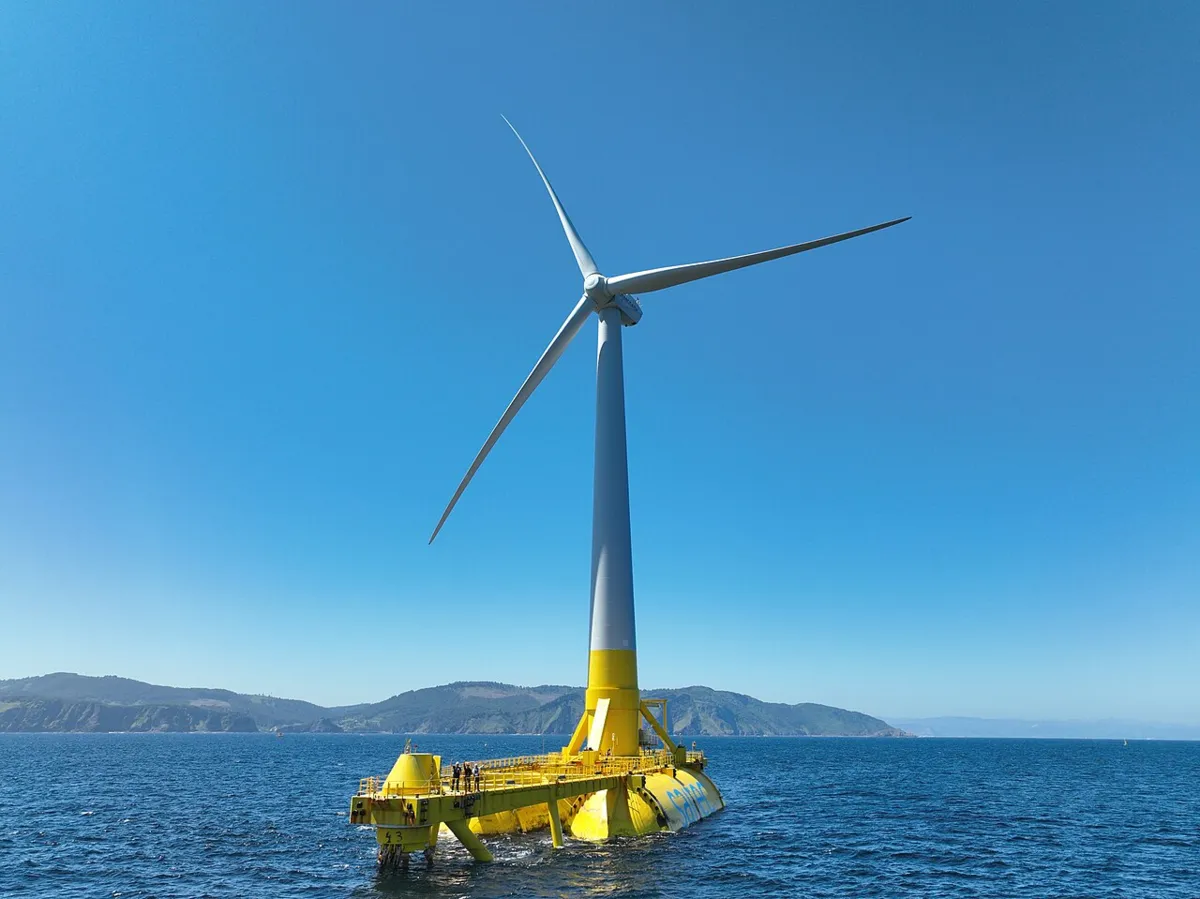
So how could a 100% renewable energy production look like? For this we first have to gather some main figures. At the moment humanity has a total electric energy usage of roughly 30,000 TWh / year of which a little less than one third is produced by renewable energy. (Source: https://www.iea.org/data-and-statistics/charts/global-electricity-generation-by-source-2014-2027 ) Roughly 50-60% of this energy is used 24/7 as so called base-load, while the rest is going up and down depending on things like weather, time of the day, season in the year, …
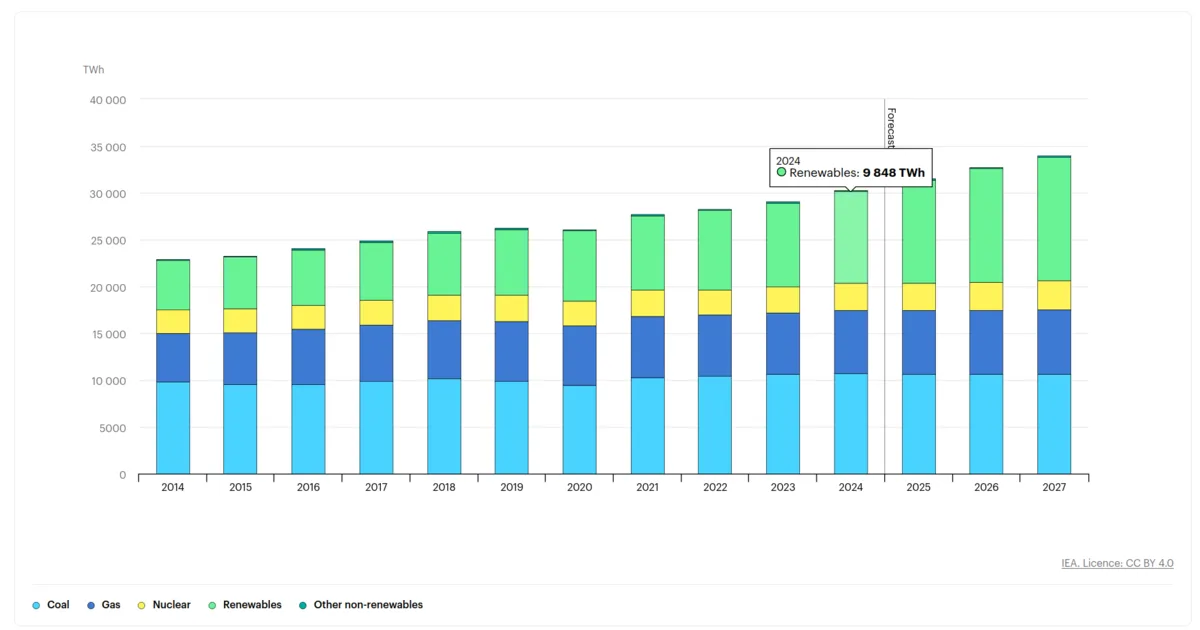
Since this project aims to provide clean energy not only now, but also in the future, we have to consider two more things:
With both these things in mind estimations are that the global electricity demand will be ~68,740 TWh/year in 2050, which means our electricity demand will more than double in the next 25 years. (For more information also look into the following table that lists such estimations and compares them)
| Source | Projection (TWh/year) | Assumptions | Notes |
|---|---|---|---|
| IEA World Energy Outlook 2022 (Net Zero Scenario) | 62,200 TWh/year | 100% renewable energy, major energy efficiency improvements, global electrification, economic development in poor countries | This scenario assumes a 100% renewable energy transition with global energy efficiency measures and increased electricity demand in developing countries. |
| McKinsey Global Energy Perspective 2023 | 52,000 - 71,000 TWh/year | 100% renewable transition, electrification of transport, industry, buildings, with faster growth in emerging economies | Estimates vary based on regional electrification rates and energy consumption patterns. Poorer countries experience significant energy demand growth. |
| Enerdata EnerBlue Scenario (2022) | 70,000 TWh/year | 100% renewable energy transition, with a 3% annual growth in global electricity demand, and significant development in emerging economies | This scenario projects strong electricity demand growth, especially in emerging economies due to electrification and improved living standards. |
| International Renewable Energy Agency (IRENA) 2021 Report | 70,000 TWh/year | Full transition to renewables, with emerging economies increasing demand for electricity due to electrification | This report assumes full global electrification, particularly in emerging economies, and significant renewable energy deployment. |
| BloombergNEF 2021 Outlook | 80,000 TWh/year | Assumes electrification of sectors like transport, industry, and residential heating, all powered by renewables | Similar to IRENA, but includes more aggressive electrification scenarios and global renewable energy adoption. Focuses on developing economies’ growth. |
| Average | 68,740 TWh/year |
Calculated as the average of the projections listed above. | The average is computed by considering the middle range of estimates (52,000 TWh/year and 71,000 TWh/year) from McKinsey and taking the other values directly. |
While 68,740 TWh/year sounds like a lot, it is totally feasible to create this energy completely with renewable energy and technology that already exists today. At the moment we have three already existing technologies that could each on-their-own fulfill our complete energy demand, if they would be deployed in big-scale dimensions. In theory Utility-Scale Solar Photovoltaic could power our 2050s energy demand more than a hundred times. If we consider only 2% of the worlds land area being usable for Solar Photovoltaic energy we could theoretically produce two times our current worlds energy and 80% of our future demand in 2050. If we would put Photovoltaic only in places with very high sun exposure, like for example into the Sahara Desert we could already power the worlds futures energy demand of 2050 if we would cover 1.25% of this desert with solar panels. The same is true for Concentrated solar power a technology that uses mirrors to concentrate the sunlight. This concentrated sunlight produces heat, which can be used to power a steam turbine. While photovoltaic and wind-turbines only work when sun or wind are available concentrated solar power can work 24/7, because it is possible to store the generated heat in molten salt tanks which can hold the heat for many hours and power turbines even if the sun is not shining. Concentrated Solar Power (CSP) has the technical potential to power the world nearly 80 times. In fact it would be enough to cover 2.7 percent of the Sahara desert with CSP to power the whole world of 2050. Wind energy is another player that could cover all our energy demands. Onshore Wind could power the world more than 5 times, but it of course also brings many problems in land-use change, populations acceptance and environmental-concerns. Offshore Wind especially the new generation of floating off-shore wind-turbines which can be used in areas with multiple hundred meters of water depths are able to power our 2050 demand 4.8 times. And if we consider that possibly in the future this technology can be used in deeper and deeper areas of the ocean this number might be scale-able into unbelievable dimensions. The fact that Offshore Wind can be installed far out in the ocean, avoids “Not In My Backyard” (NIMBY) opposition and other land use and social restrictions, while having much stronger and more consistent winds (= higher capacity factors) and much larger space available.
Besides solar and wind related technologies there are still potential opportunities in Deep Geothermal Energy and Wave/Tidal Energy which are both not yet ready to be deployed big scale, but which could theoretically produce many many times the worlds energy demand in the future. Especially since both technologies Deep Geothermal Energy and Wave-Tidal Energy can be used literally at any place in the world.
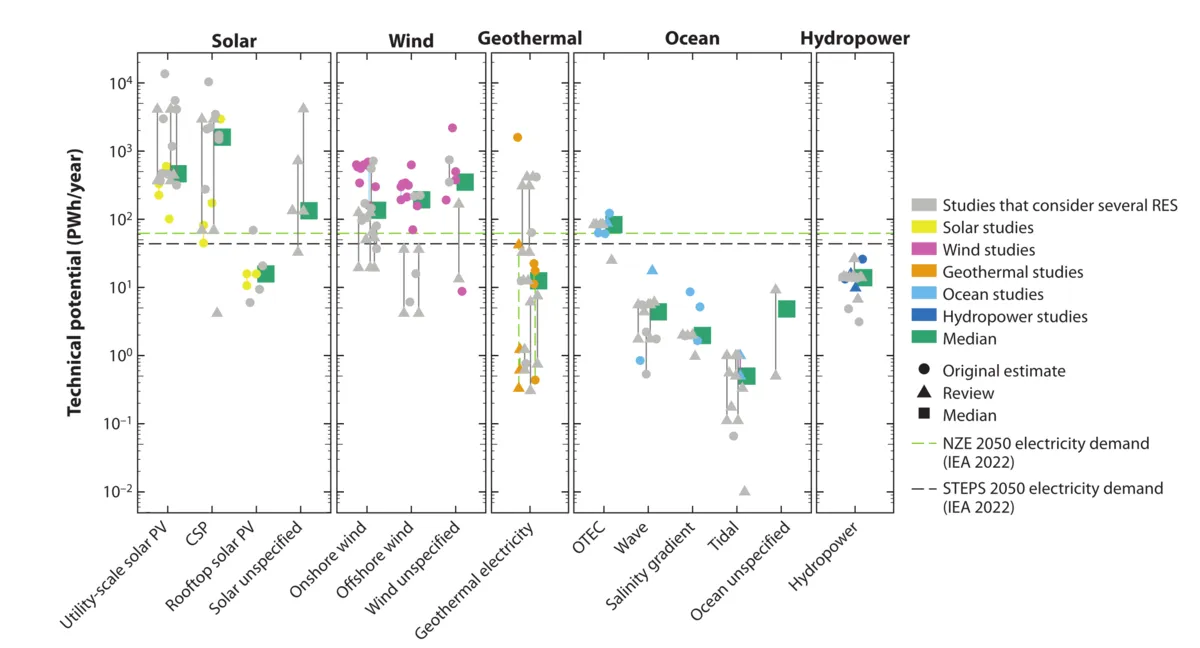
| Technology | Low Estimate Technical Potential (TWh/year) |
High Estimate Technical Potential (TWh/year) | Average Technical Potential (TWh/year) |
How many times could this power us in 2050 (assuming 68,740 TWh / year) |
|---|---|---|---|---|
| Utility-Scale Solar PV | 101,000 | 13,600,000 | 6,850,500 | 99.7x |
| Rooftop Solar PV | 6,000 | 69,000 | 37,500 | 0.55x |
| Concentrated Solar Power (CSP) | 4,170 | 10,400,000 | 5,202,085 | 75.7x |
| Onshore Wind | 19,300 | 717,000 | 368,150 | 5.4x |
| Offshore Wind | 4,170 | 626,000 | 315,085 | 4.6x |
| Hydropower | 3,130 | 26,400 | 14,765 | 0.21x |
| Geothermal | 306 | 1,590,000 | 795,153 | 11.6x |
| Wave | 534 | 17,500 | 9,017 | 0.13x |
| Tidal | 10 | 1,000 | 431 | 0.0063x |
| Ocean Thermal Energy Conversion (OTEC) | 24,900 | 123,000 | 81,200 | 1.18x |
| Salinity Gradient | 972 | 8,610 | 908 | 0.013x |
| Total | 164,000 | 27,200,000 | 13,682,000 | 199.1x |
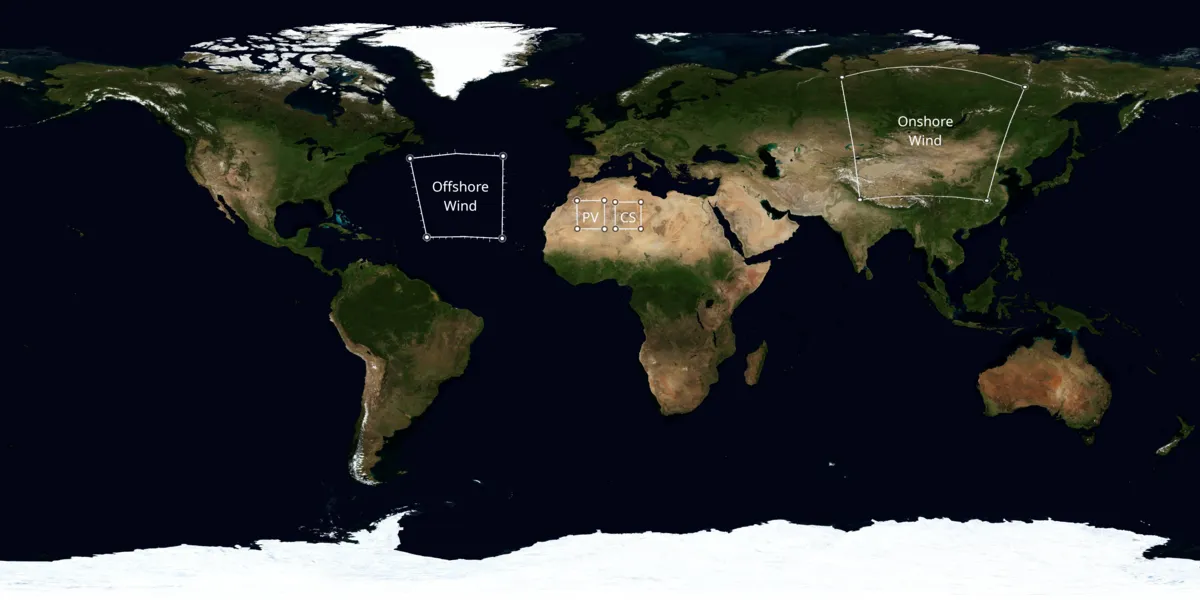
The future of course will look very different. Not one big plant of one technology will power the whole world, but a a mix of all technologies spread over the whole planet - also considering the benefits of each location - will do the job. By this on one hand we also ensure that all countries in the world can participate and benefit in this global-scale project. On the other hand this reduces risks and electric grid installations, because not all the energy production is based on only a few plants, but on hundreds of plants all over the planet. In such a scenario hydro -, concentrated solar - and conventional geothermal power can produce the base-load energy that we need 24/7 every day. On top of this a mix of wind-energy and photovoltaic can power the intermediate and peak-load. While the weather usually is more sunny, when the wind is not strong and the wind usually blows stronger when the sun is not shining much, these two technologies are actually not as intermittent as they often seem. If you combine both technologies and additionally improve our grid to a much smarter and more internationally connected grid and add short-term and seasonal storage solutions, their intermittency is nearly no problem at all anymore. This means if we put our most clever engineers and a lot of money to work, we can reach 100% renewable energy and this only by using already existing technology. Scaling Solar PV - , Concentrated solar -, Wind - and in smaller dimensions also Conventional Geothermal - Energy to big dimensions it will be enough to reach this goal.
If we don’t consider Biomass energy a renewable energy source, a potential energy mix for 2050 could look as follows.
| Energy Source | Share (%) | TWh/year (2050) | Current TWh/year (2023) | Growth Factor (×2023) | Cost per GW ($B) | Total Cost ($T) |
|---|---|---|---|---|---|---|
| Solar PV | 35-45% | 24,059 - 30,933 | ~1,500 | 16 - 21× | $0.8 - $1.0B | $19 - $31T |
| Concentrated Solar Power (CSP) + Storage | 5-10% | 3,437 - 6,874 | ~60 | 57 - 115× | $3 - $5B | $10 - $34T |
| Offshore Wind | 25-30% | 17,185 - 20,622 | ~430 | 40 - 48× | $3 - $4B | $52 - $83T |
| Onshore Wind | 10-15% | 6,874 - 10,311 | ~2,100 | 3 - 5× | $1.2 - $1.8B | $8 - $19T |
| Hydropower | 10-15% | 6,874 - 10,311 | ~4,300 | 1.6 - 2.4× | $2 - $5B | $14 - $52T |
| Geothermal Energy (Conventional) | 2-3% | 1,375 - 2,062 | ~0.3 | 4.6 - 6.9× | $2 - $4B | $3 - $8T |
| Battery & Pumped Hydro Storage | Variable | Used for short-term & seasonal storage | - | ~10× (Estimated Growth) | $0.4 - $1.0B | ~$10T (for storage infrastructure) |
| Green Hydrogen (for industry & seasonal storage) | Variable | Enables decarbonization of hard-to-electrify sectors | - | Huge Expansion Needed | $2 - $5B | ~$10T (for electrolyzers & infrastructure) |
A 100% renewable energy system is technically possible, but it requires an unprecedented expansion of solar, wind, and storage infrastructure. The investment is large (110 - 233 trillion US-Dollar), but it eliminates fossil fuel costs, ensures energy security, and decarbonizes the global economy which is urgently needed to reach our global goals to fight climate change.
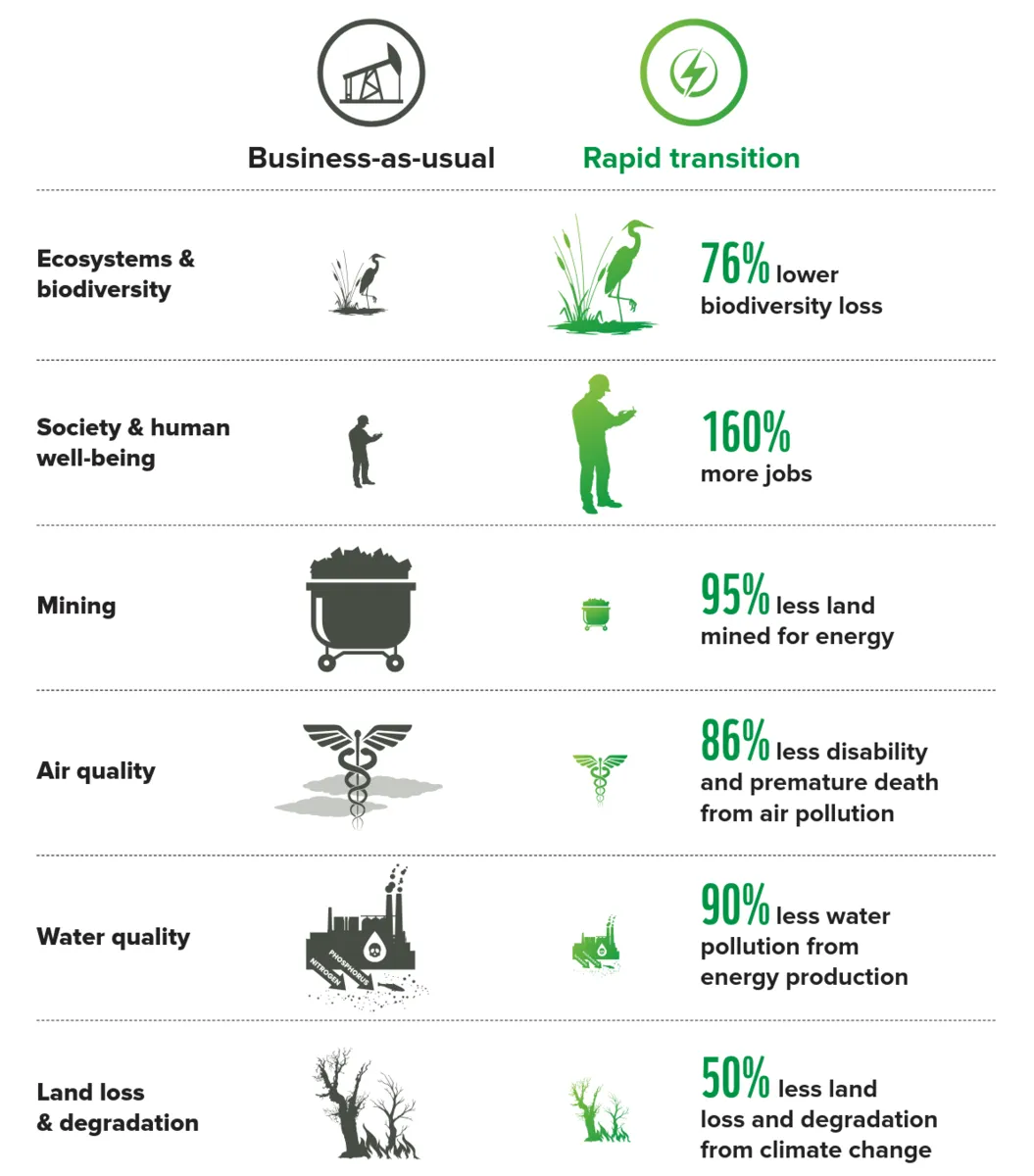
So how could Team-Utopia help here? Could we just crowd-fund the money needed by normal people, build the infrastructure and gift it to humanity? Unfortunately this is not any realistic, the amounts of money are just too big and even if every human would be willing to contribute 100% of their disposable net income it would need 2-3 years to finance such a project - which is unfortunately just unrealistic.
But we are here to dream - so let’s dream for a bit and let’s think about our energy-infrastructure as our house/apartment. Many people live in rental apartments or rental houses, because they can’t afford to buy their own place to live. This means they will pay some rich real-estate investor that bought the place with the help of a credit and after their life-time, they will have paid more or less the price of what it would have cost them to buy the real-estate, but still they don’t own the place, they gave away the whole money to the now even richer owner of the real-estate. This shows us that these persons actually would have enough money available to pay-off such a place for living, but they don’t have enough money available to also pay the additional interest rates to the bank. If there were no interest rates these persons could have bought the apartment / house and could from the moment of pay-off on live for free in their personally owned place.
The same is true for our energy infrastructure, we pay big energy corporations which are owned by rich investors to provide us energy. It is like paying rent, we pay them to receive their service, but we are not happy with their service, not happy with their future plans and not happy with their prices and actually if we would have the money upfront - that we anyway pay over the years, we could have bought the infrastructure on our own and would own it after a few decades.
So what does this mean for our energy infrastructure example? If we could get an interest free credit - that we pay back by providing energy to the same or lower prices as today - we could build an energy-infrastructure which is exactly how we like it - 100% renewable - and bring the ownership of our energy-infrastructure back to the normal people. Plus even more motivating after some decades we could have energy for free or at least for relatively low prices, because everything is paid-off and we just need enough to keep everything maintained and adjust it to the future needs. And the good thing is this interest-free credit doesn’t even need to be able finance the whole project, it only has to be an initial funding to get everything rolling, because after some years the first power-plants will go online and help us finance building the rest of the infrastructure. Or in other words if we manage to finance the first years of this project with a interested free credit, the infrastructure will pay it-self off automatically and after some decades we have 100% renewable infrastructure that is completely owned by the normal people.
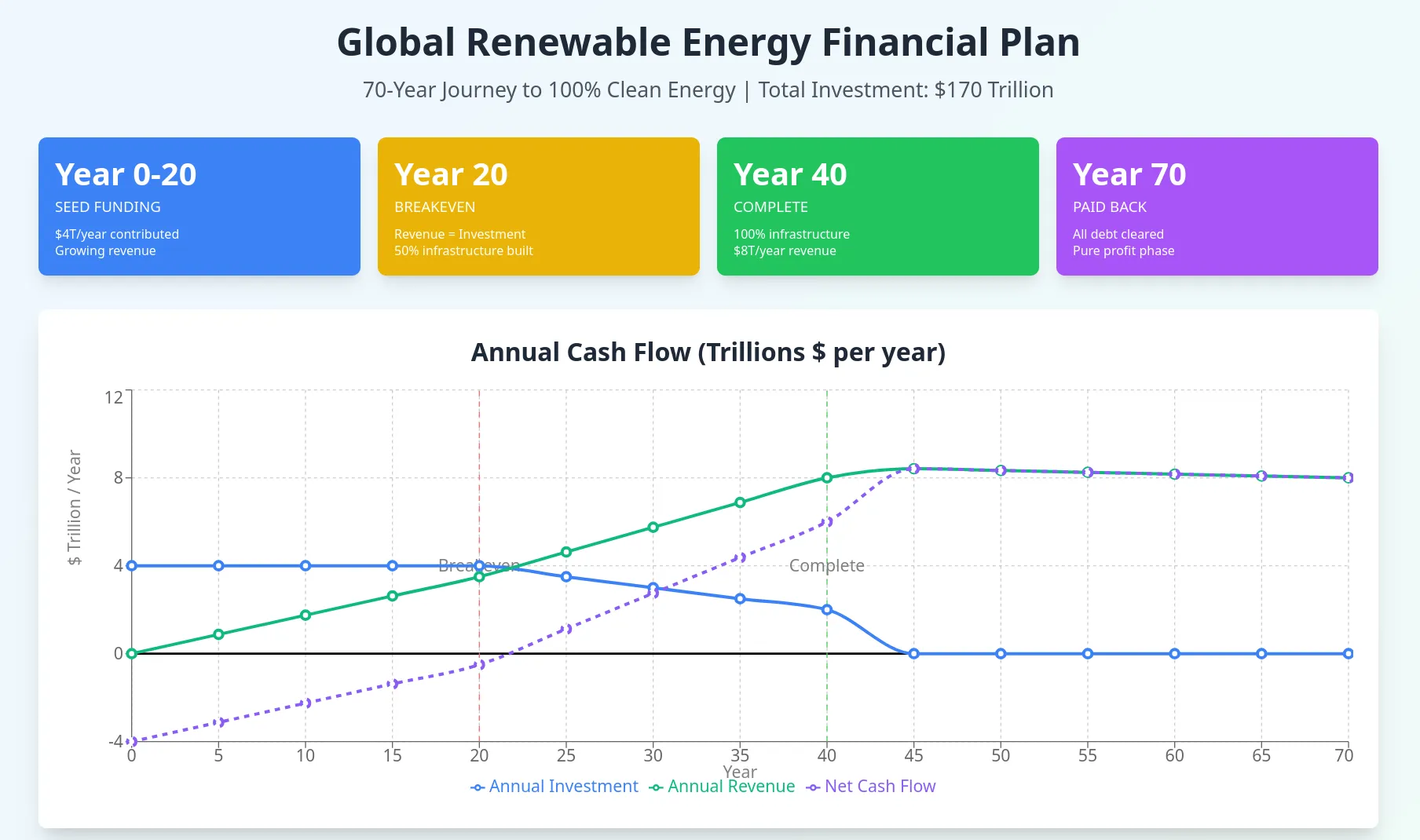
A concrete plan could look as follows: If we could collect 4 trillion dollar each year over the next 20 years, which is about the same cost than what it costs if 50% of humans fill their 50 liter gasoline car-tank 20 times per year- 1.6 times per month, we could seed-fund the project. By year 20, the first power plants pay for themselves and start funding the next ones. By year 30, electricity costs drop by 30-50% because there’s no profit margin, no interest payments, just energy at cost. By year 40, the entire planet runs on clean, affordable energy owned by the people who built it. By year 70 all the credit-money is paid back. Why could this work when nothing else has? Because we cut out interest payments that typically double infrastructure costs. Because renewable energy is nearly free to operate once it’s built. Because every person who contributes gets cheaper electricity for life, creating an unstoppable economic incentive. The choice is simple: keep paying energy corporations forever, or invest once in infrastructure that serves humanity for generations. Critical infrastructure shouldn’t make billionaires. It should serve people. Join the movement. Power the planet. Own your future.
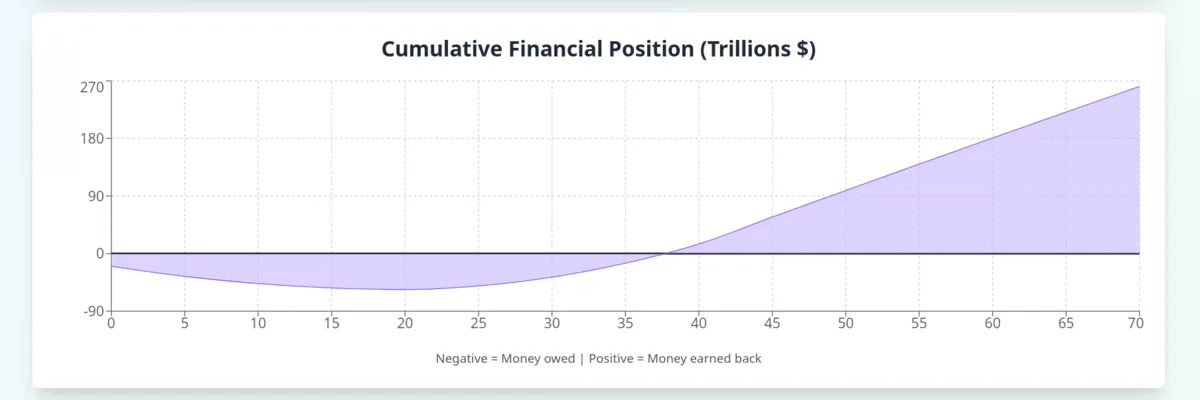
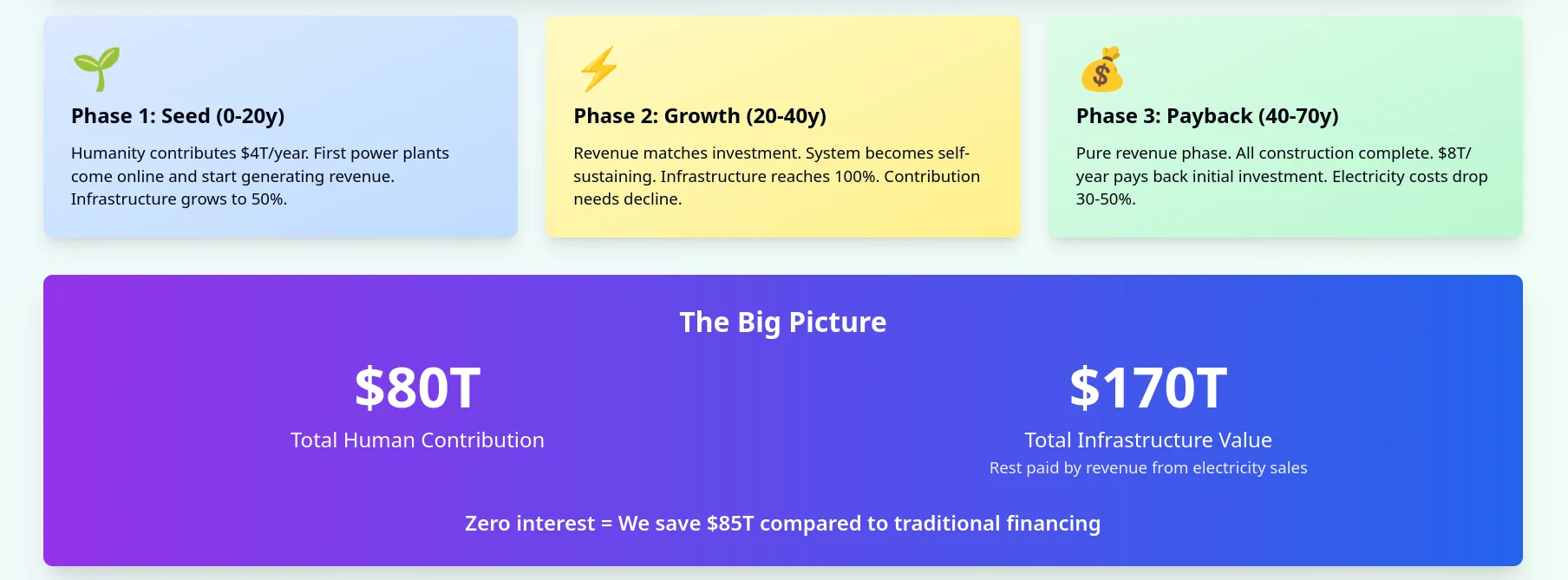
Besides paying children to go to school it’s also important to have enough schools, teachers and a high quality school system available. We already now have basic primary schools available in most parts of the world, but there are still some areas where it is not possible to find school infrastructure within reasonable distance. Besides this we are still missing a high standard of education in many of these schools. More often than not, small schools (especially in the rural areas) are missing a high quality curriculum and well-educated teachers.
So how could Team Utopia help here?
What if Team Utopia could set up an international team of education experts that are representing all parts of the world and that together work on a standardized education framework. This framework could include a standardized curriculum, books, exercises, homework and tests for all the basic sectors of education : language, mathematics, science and arts / music. Besides the knowledge that it could provide for school-kids it could also provide standardized coachings/trainings for teachers, which often also never had the chance to experience more education than primary and secondary school. All these educational resources of course have to be translated in all languages and have to be provided at no cost and free for everyone to use. By this, schools which are not so well equipped with money to buy good educational resources or teachers that would love to get some help to provide a better learning experience for their students could just fall back to this educational framework and use it all for free. In a second step - if required - Team Utopia could develop this educational framework to a franchise-like school standard. This could include concrete standards on how to build school buildings. Since its way cheaper to design and plan a school building once and repeatedly build it again and again the same way, this could help especially developing countries to reduce the costs of building new schools and bring education in regions which are currently lacking education infrastructure. Also it could provide in the long-term a complete educational system which not only includes educational resources but also standards of how to structure the educational career of a child and provide a internationally known and accepted degree. This could include guidelines on how many years of school are needed, what kind of topics each child should learn to get a final degree and what requirements have to be met to reach this international degree.
One of the most important factors of such a school franchise would be that it has to be 100% open for national requirements. Since education is a very important and fragile topic most countries probably wouldn’t want that anyone besides themselves can decide what their children should learn and what not. Giving the right to decide on what their future citizens should learn away to an external organization could easily feel like a existential threat to the countries culture, language, religion and political world-view. To avoid any such issues Team Utopia has to make it very clear from the beginning that all they offer is help for people and schools that want help and that this project doesn’t have any interest to force their world-view and educational system to anyone who doesn’t want to use it. This is also a reason why it would probably be wise to only offer education in the basic topics like reading, speaking, calculating, social interaction, articulating through art and not offering resources for topics such as politics and religion. These kinds of topics are probably best teached by each country on it’s own. Another possible way would be to offer courses and educational resources that compares all kinds of cultures, religions, political world-views and teaches on how to critically read texts and consume media and interpret who is acting from which interests, but to make it clear that each school is totally free to use only what ever educational resources they want. If they only want to use mathematics resources, that’s fine. If they want to take it all and even use the internationally accepted degree that’s also fine.
The second most important principle of this project would be that is totally free to use. Creating these educational resources, standards and structures will be a pre-paid service. The team of educational experts will be paid by the crowd-funding money that is raised in the Team-Utopia platform before it’s started. This will include creating a complete curriculum, with all it’s educational resources, books for the students to read, ideas for the teachers to teach the topic in class, homework for the kids to do at home and tests (including solutions) for the teachers to judge the students learning success. Schools will not need to pay any license-fees or anything to use all this, because it was already paid in advance.
Besides providing an educational framework this project can also use the positive sides of the franchise-concept and provide access to cheap educational goods like books, paper, pencils and other educational goods like whiteboards, tables or chairs. Since ordering goods in high quantities can significantly reduce the costs, this could help especially financially not so well equipped schools in developing countries. For very poor countries it is maybe even imaginable that they can apply at Team Utopia to get some of these goods for free.
So now talking about numbers, what could all that cost? Providing a educational framework at first could actually be surprisingly cheap.
If money is a more critical subject than time we could setup a team of 50 persons that could develop a full primary school curriculum within 3-5 years.
The development would run in multiple phases, first focusing on the Mathematics and Languages in the first two years. In the third year content for the basic sciences will be added and in the fourth year content for social studies. After that everything has to be pilot-tested, the feedback has to be integrated and it has to be rolled out globally. The translations of the developed curriculum will be outsourced and this will be done in parallel to the content development. In the first years they will start with 4 of the mostly used languages and will scale this up to 20+ languages in the end.
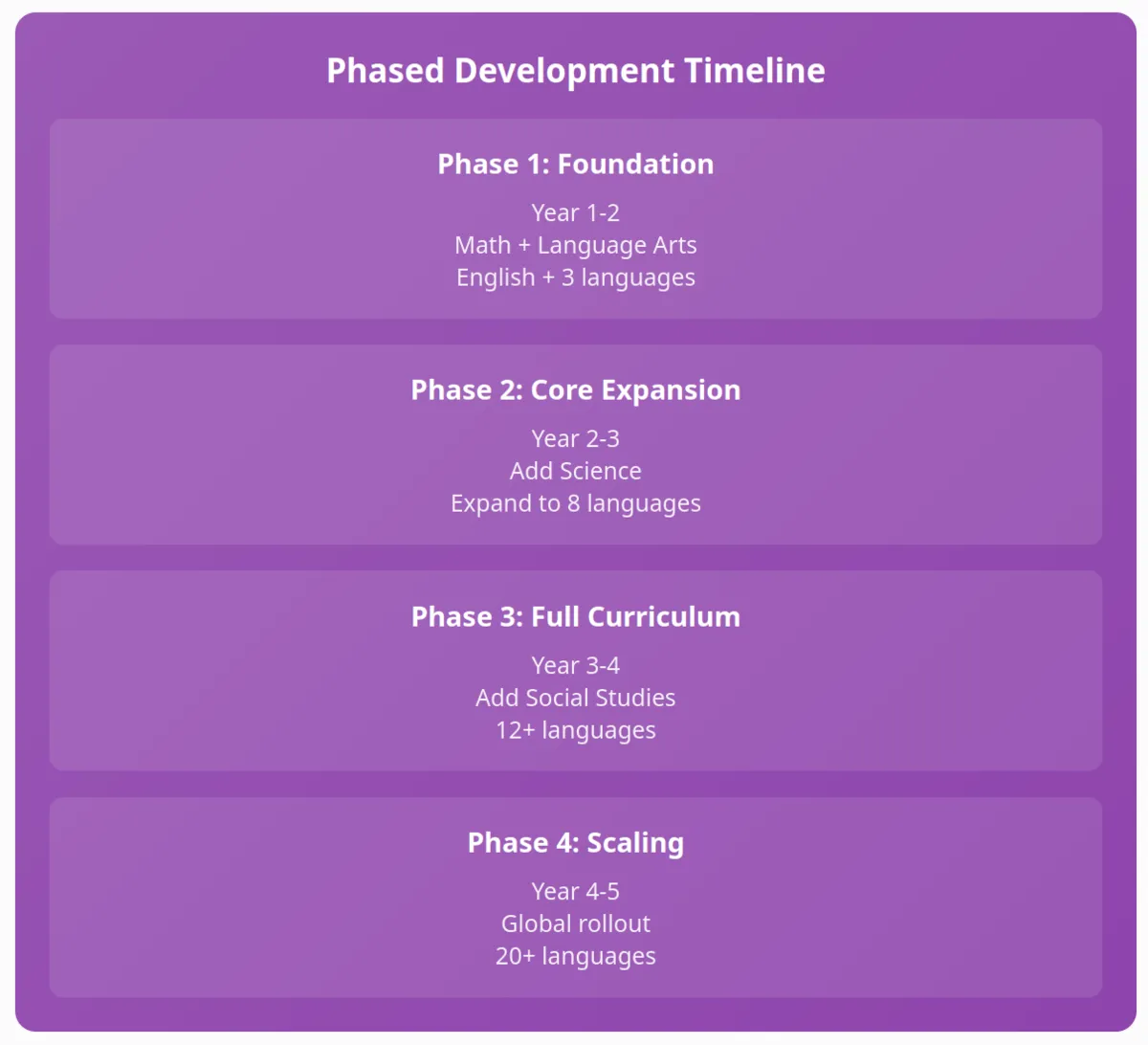
The following picture shows a potential team-structure for a 50 person team. The whole project could cost around 15 to 25 million US-Dollar.
If we would now take the Team-Utopia approach and scale this to a global-scale project and imagine that an international team of educational experts of maybe 200-400 people could work on this curriculum we could get the whole result in around 1-2 years. Such a global international team, could on one hand represent all regions of the planet, ensuring cultural/regional adaptations and would on the other hand significantly increase the quality and quantity of the curriculum’s content. The cost of course also will increase significantly to around 45 - 70 million US Dollar if we assume a 200 persons team-size or 80 - 120 million with 400 persons working on the project. Having such a big global team enables the project to work on different Subject Areas and Classes/Grades in parallel and even work on translations and infrastructure topics within the team without the need of outsourcing.
Now after talking about primary education how does it look like for secondary education. Also here we could do exactly the same thing.
A secondary school curriculum of course is much more complex. Secondary school not only is many more years long, it also includes much more subjects to study, which are much more complicated than in primary school. To reflect this complexity it might be necessary to work one year longer with a 400 person team and to have many more subject-specialists like for example “Mathematics-Specialists”, “Chemistry-Specialists”, “Literature-Specialists”, “Health-Education-Specialists”, subject specific “Grade-Level experts” working in the team. But still with a team of 400 persons and a budget of 120 - 180 million US-Dollar it could be possible to develop a totally free and open-source curriculum for everybody.
Everyone knows this old rusty machine of our grandparents or our grand-grandparents that seems to last forever. It seems to be designed to work as long as possible and to be easily repairable in case of a problem. Looking at our currently available products it seems like their design does not have longevity and repair-ability in mind but rather cheap costs of production and a short lifespan. This short lifespan creates the need to buy the same product again and again every time it breaks again after a few years and this keeps the production running and our factories busy. But since we live on a planet with limited resources we can ask the question if there are maybe some products that should work forever or at least for a very long time and that are able to be repaired easily by everyone for an even longer time. Maybe for some products we can consider them to be in a stage where all fundamental functions are developed and working and most consumers are not interested in any new function. In this project Team Utopia aims to end the planned obsolescence for products that could easily run for a hundred years and where most people would not miss a new version, because already 20 years ago the product could do everything they wanted. We want to develop and produce simple everyday household-items in a completely non-profit, ever-lasting, easily-repairable and open source way. This means that the design-principle number one will be longevity - e.g. how can we produce a washing-machine that still works in 200 - 300 hundred years. Besides this another main goal will be that the whole product has to be modular and simple with the possibility to easily understand its main components and to replace potentially broken parts, to make sure that the machine keeps on running. To achieve this, every existing information of the product will be published open-source. This on one hand enables people to understand and repair the product and on the other hand enables companies to copy the idea and produce the same product themselves. Since the production of these products is not profit oriented we can produce longer lasting, higher quality products for maybe even cheaper prices.
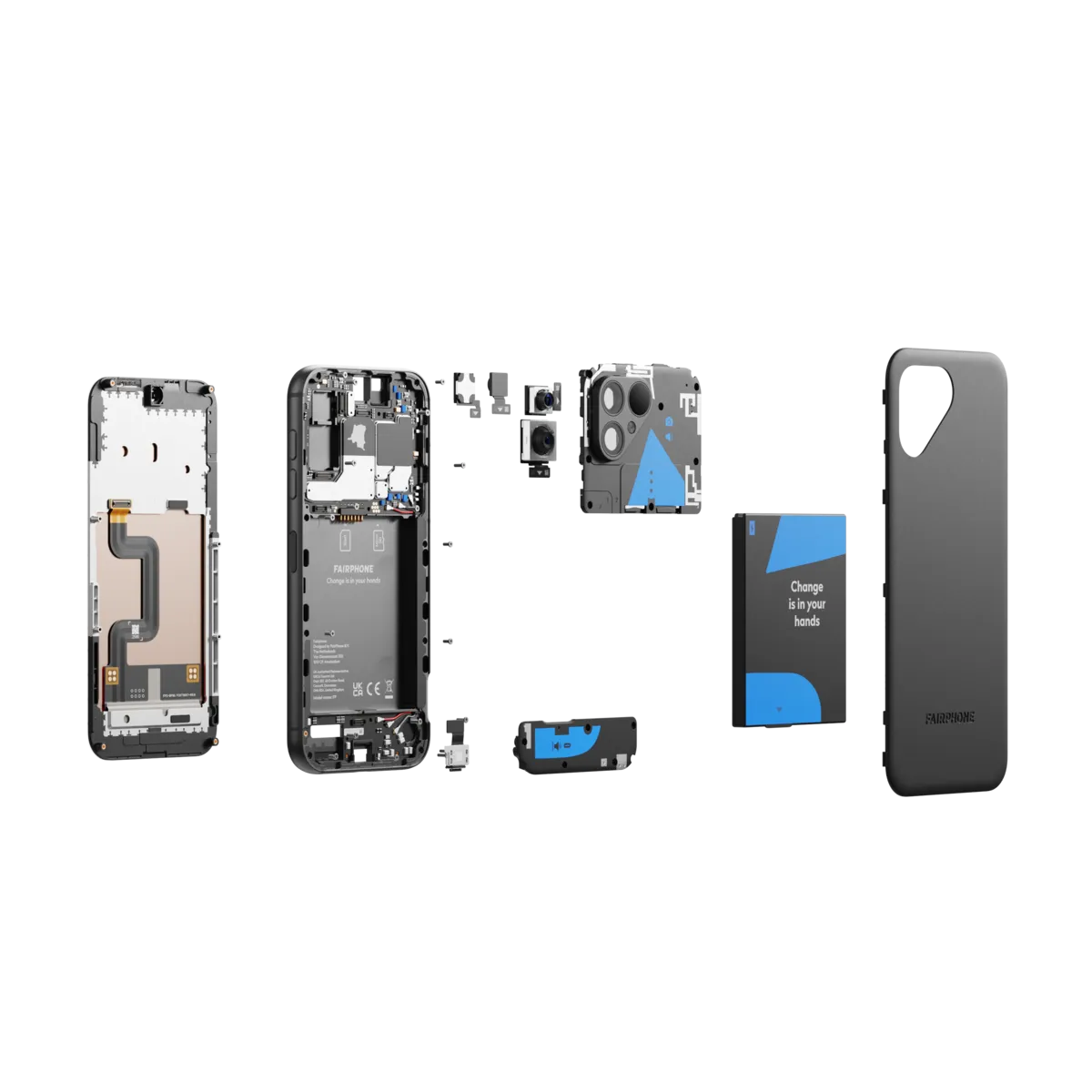

Some products that could be potentially predestined for such a project could be:
Some people might say that it is not making the world better if all the people that work for companies that produce these kinds of products might potentially loose their jobs. And this is of course true. Producing products in a way that they only need to be bought once or twice in a lifetime instead of maybe ten times, might destroy the market for companies that produce such products with less longevity and people who are working for such companies might in such a scenario loose their jobs. While we are not trying to sugarcoat this potential loss of jobs we are also very convinced that in the long run companies that are now market-leaders in producing such goods will find ways to produce other products. Maybe - if we are lucky - these companies will use their competence, knowledge and workforce for solving some of the urgent problems of humanity. Maybe these people will not even loose their jobs but find new jobs in the same companies or new jobs in other companies that replace the old companies. Maybe in the end all these people are the missing workforce to stop climate change or end hunger? If we release these people from producing the same products again and again and again and use their knowledge to do something more meaningful then maybe even the loss of these jobs can make the world a better place in the end.
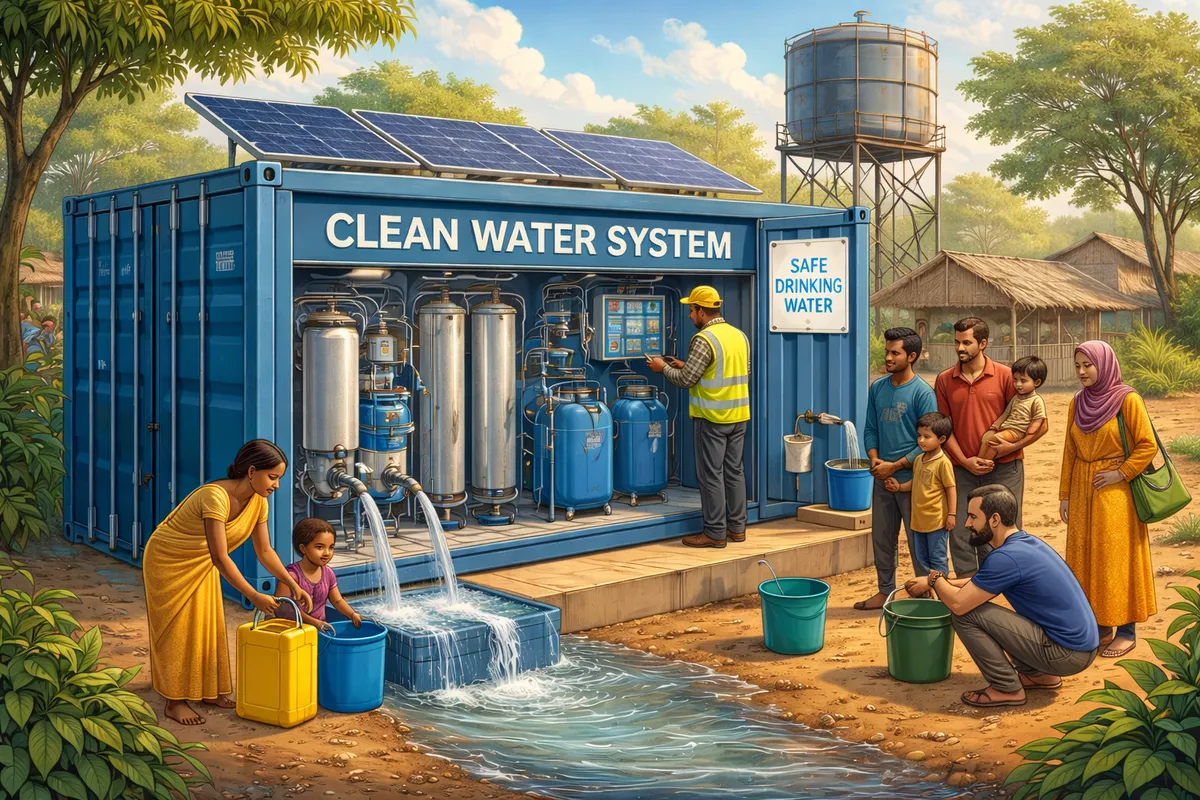
There is a reason why many cultures call water “the source of life”. Without water we can simply not exist. Up to 60% of the human adult body is water and after not drinking water for about 3 days the human body will die of dehydration. Besides the non-availability of water the contamination of water imposes the risk to infect with diseases such as cholera, dysentery, typhoid fever, and hepatitis A. “Unsafe drinking water is a driving factor behind the more than 1.5 million people who die every year from diarrhea, most of them infants and small children.” (Source : WHO - State of the world’s drinking water https://www.who.int/publications/i/item/9789240060807)
But is unsafe drinking water still a relevant problem today? As the United Nations summarize it in their Sustainable Development Goals (SDGs) in “Goal 6: Ensure access to water and sanitation for all” - humanity in fact made great progress in the last decades in this regard, but we also still have a lot to do to reach this goal until 2030 and the current funding seems to be inadequate. (Source: UN : https://unric.org/en/sdg-6/)
“In 2020, 74% of the world’s population used safely managed drinking water, up from 62% in 2000. Despite this progress, there are wide geographical disparities, and 2 billion people still do not use safely managed drinking water. The world is not even close to being on track to meet the SDGs by 2030. " (Source : WHO - State of the world’s drinking water https://www.who.int/publications/i/item/9789240060807)
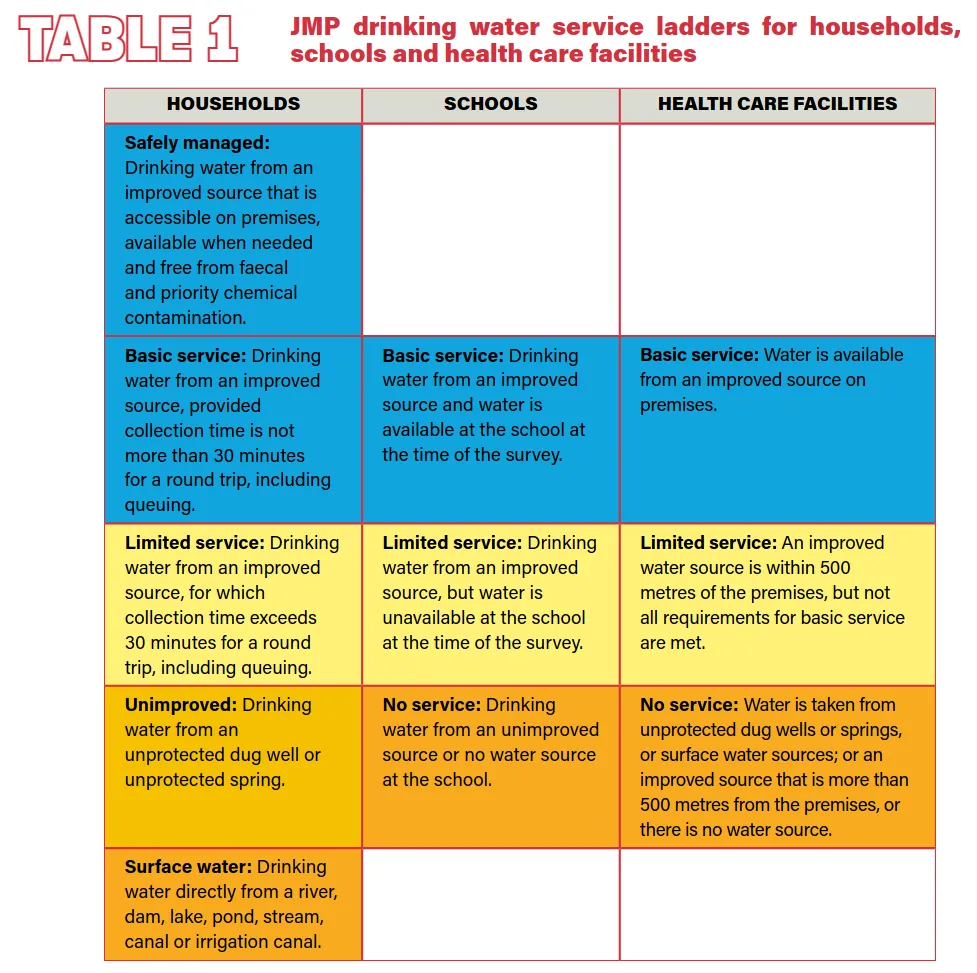
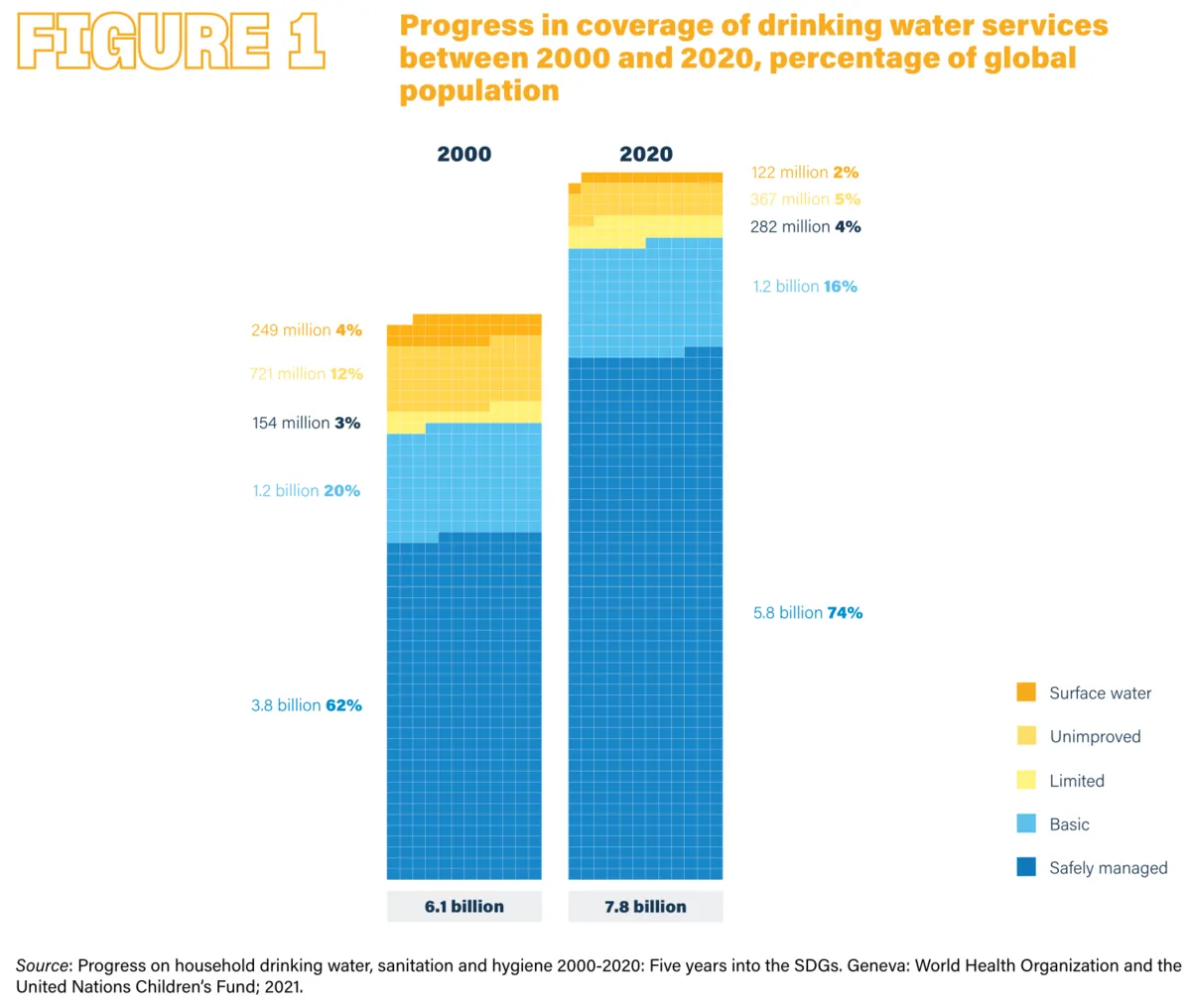
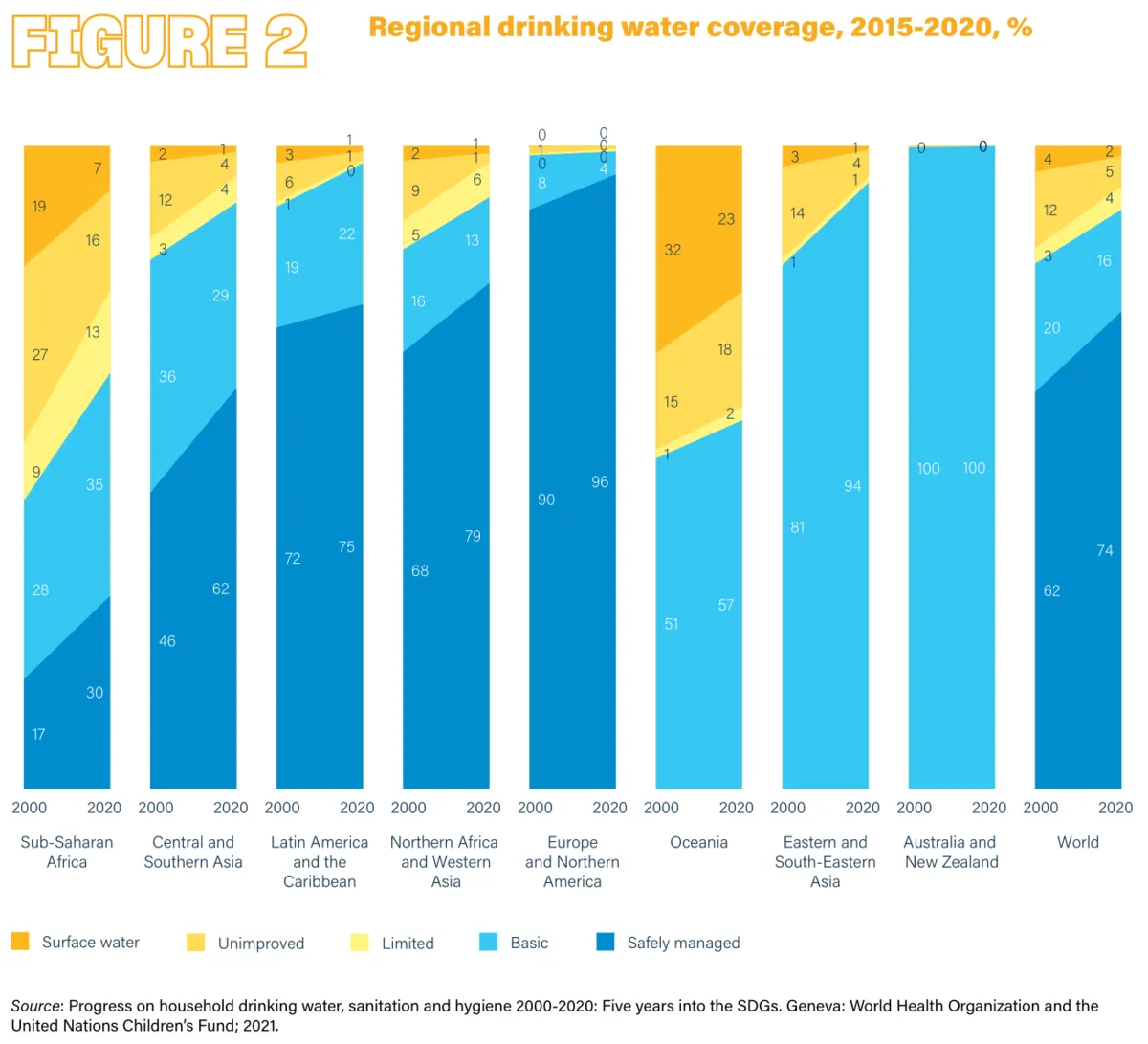
So what is missing to reach clean drinking water and sanitation for all?
In 2016 a study estimated the cost to be US-Dollar 37.6 billion per year between 2015 and 2030, a total of US-Dollar 564 billion, if all users transitioned directly to safely managed drinking water services. The cost of operation and maintenance is in addition to these costs, and is estimated to be US-Dollar 42 billion annually, or a total of US-Dollar 635 billion between 2015 and 2030. (Source : WHO - State of the world’s drinking water https://www.who.int/publications/i/item/9789240060807)
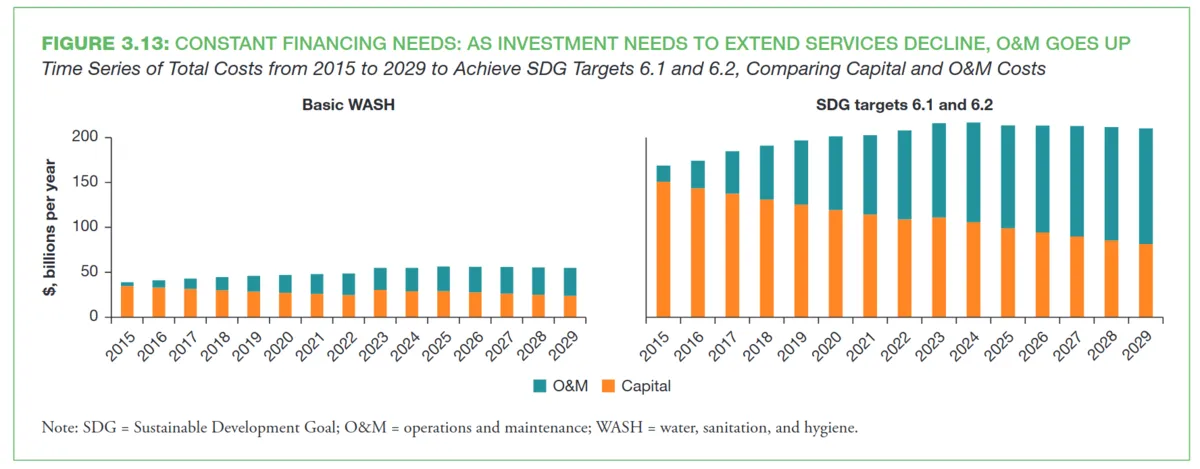
And how could Team Utopia help solving this problem?
According to the WHO the funding and financing of building clean water, sanitation and hygiene infrastructure currently is mostly paid by first the households (61%) that pay taxes and fees on water usage and second by the government (25%) of the corresponding country. Only 14% are funded / financed by external sources such as oversees development aid which are described to be often “intermittent and sporadic”.
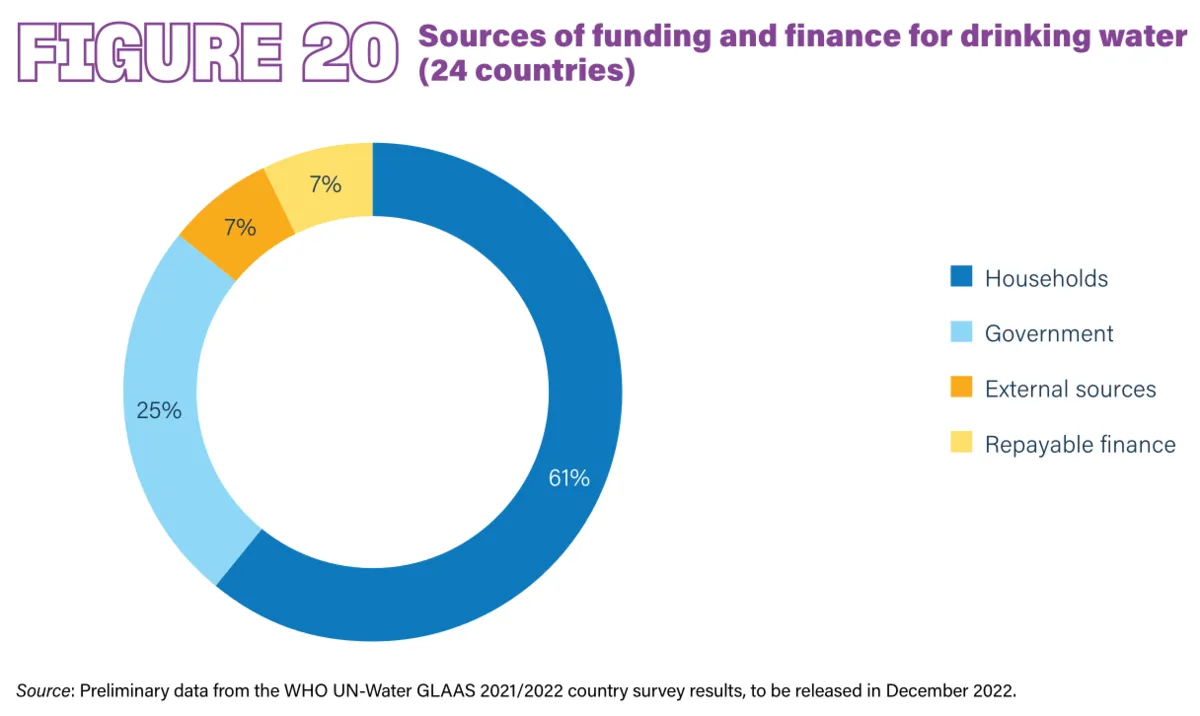
But since exactly these households are mostly living in poor and financially unstable environments, we cannot simply assume that they will have the amounts of money available that are needed to solve this problem.
Instead we could also think about this problem from the other side. If we would be able to fund the money needed to provide this infrastructure already in advance by a global large-scale crowd-funding project and use the money to produce dwells, purification-hardware, piping- and water-storage-systems and finally end user clean water-, sanitation- and hygiene-infrastructure in a totally non-profit but large scale industrial scale, we could have a realistic chance to reach SDG-6
Team Utopia could offer the platform to organize a global fund-raising and create a team of experts, scientists and engineers that could develop cheap, long-lasting and easy to repair infrastructure. Water treatment and sanitary infrastructure are not rocket-science, but like most products in the world, no one has ever tried how cheap we could produce them if we would not want to make profit. In a second step this infrastructure could be produced world-wide in an industrial scale and distributed and installed in the needed areas, which would also be covered by the fund-raising. The goal should be to offer the use of this infrastructure to the population for the same or lower prices that are normal in their country. Since the production and installation is already paid by the global fund-raising and the infrastructure will be operated with a financially non-profit target, the usage prices only need to cover the operation and maintenance costs. By this it should be possible to lower the overall costs for the end-user.
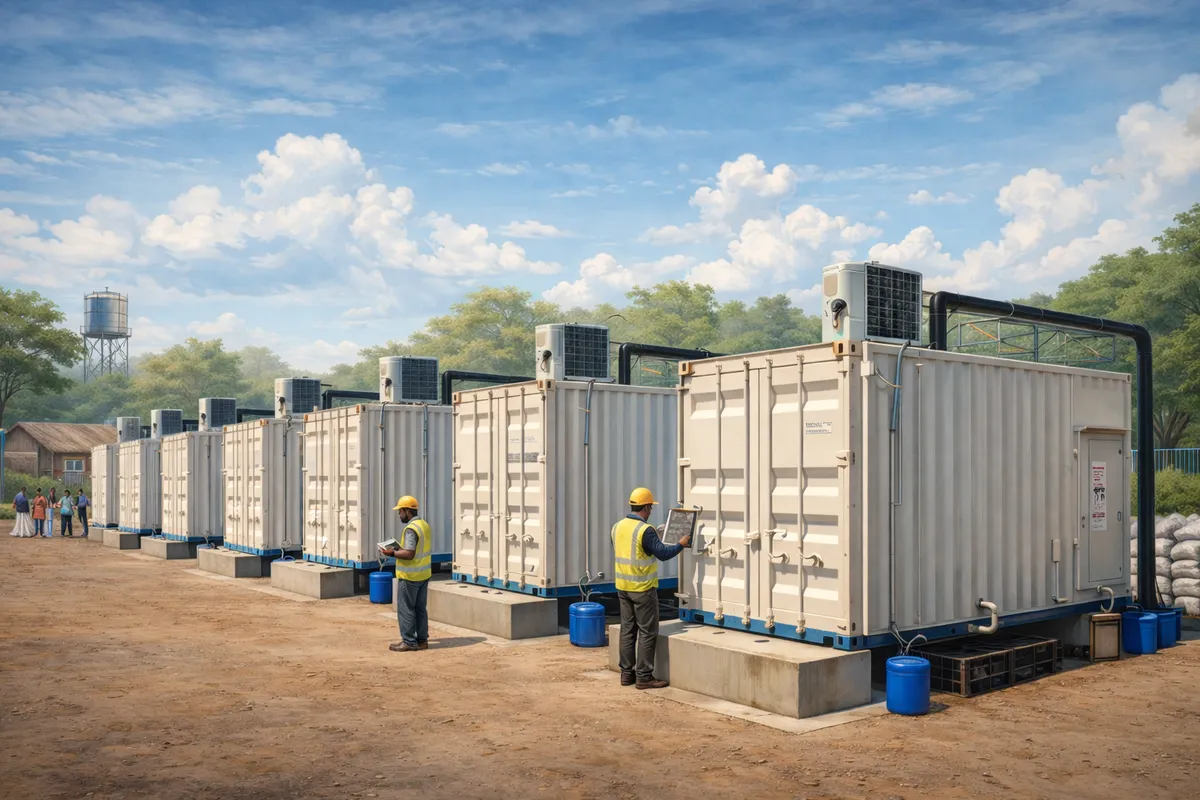

Humans at some point in history decided that they would pack products into a so-called “packaging”. Packaging on one hand intends to prevent damage to the product on its way from the production facility to the end-user and on the other hand it offers the producing company a way to advertise the product, to make it look different and distinct in comparison to the products of other competitors. At the beginning of the history of human-made packaging we packed most our products in natural materials like leaves or leather from animal skins, then later in either textiles, wooden or metal boxes or cardboard. Since plastic established itself in the mid 19 hundreds as a dominant material in many aspects of daily life we began to pack more or less everything into either plastic or cardboard.
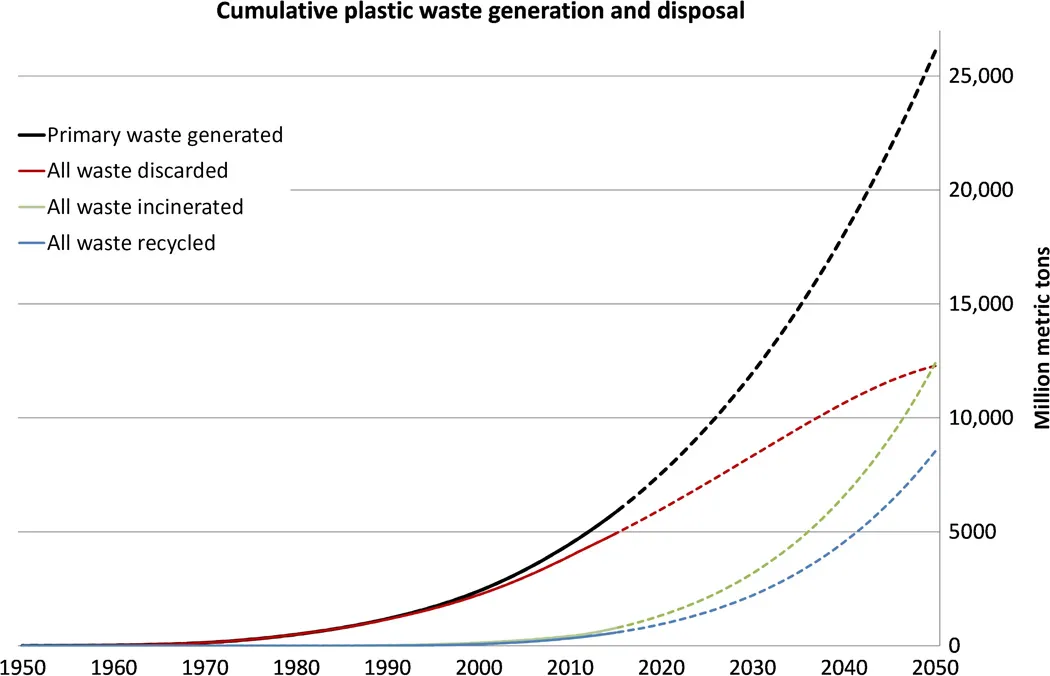
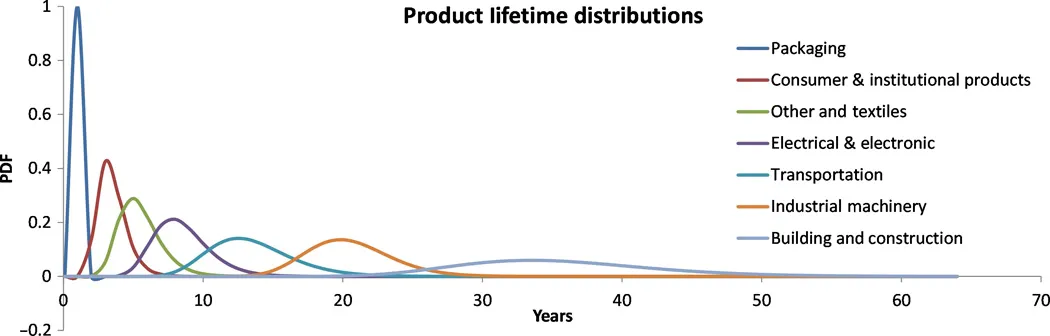
Since the triumph of plastic in the 1950s we produced more than 9 billion tons of plastic (Source: https://www.science.org/doi/10.1126/sciadv.1700782), more than one ton for every person living on the planet at the moment. This also means we’ve produced roughly 10-13 times more plastic by weight than the total bodyweight of every human born during the same time (since 1950). Already now we have 1 ton of plastic polluting our oceans for every 3 tons of fish existing and it is estimated that by 2050 we will have more tons of plastic trash swimming in our oceans than fish (https://www.ellenmacarthurfoundation.org/the-new-plastics-economy-rethinking-the-future-of-plastics). According to a study of 2019 we produce 142 million tons of plastic trash every year only because of packaging. And while globally only about 9% of our plastic trash is recycled, we can assume that most plastic used for packaging cannot even get recycled because it’s either contaminated or too low quality.
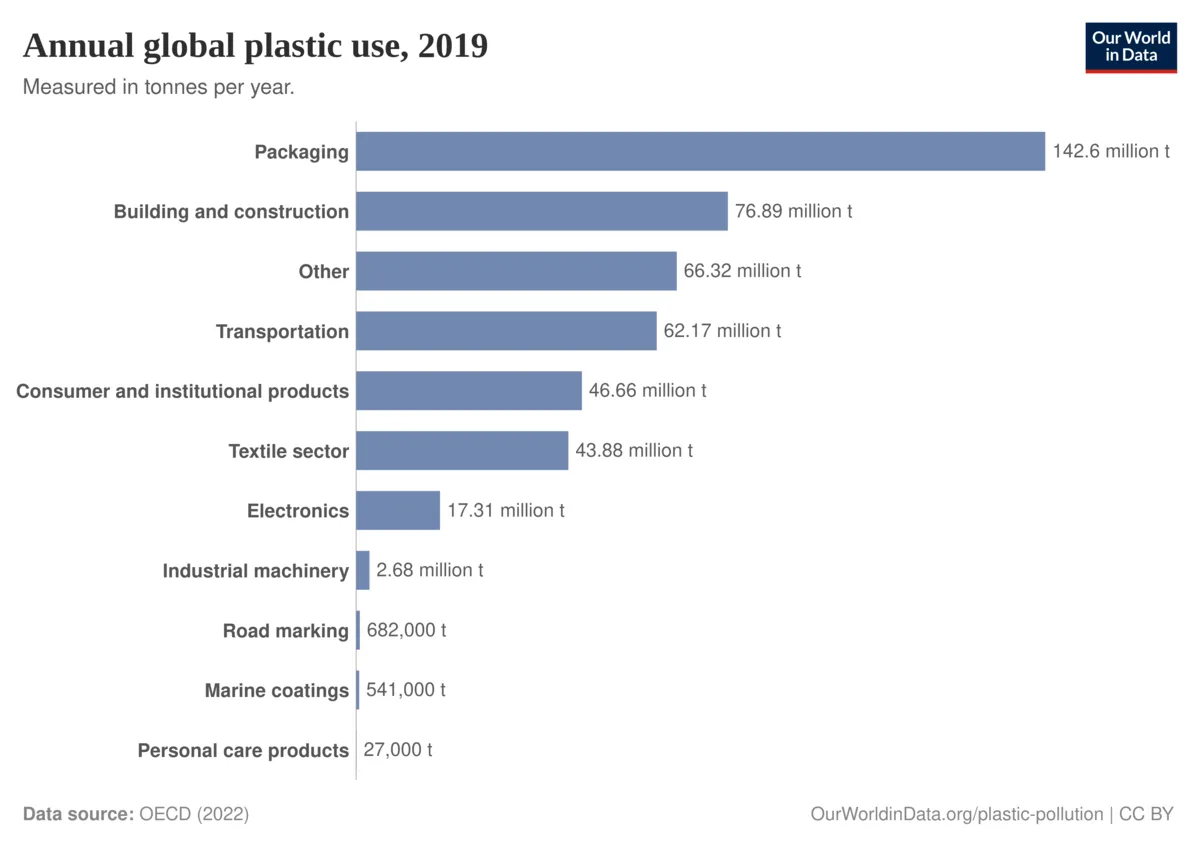
This is because most plastics can only be “down-cycled” into lower-quality products. Cheap low-quality plastic (like plastic bags or low-quality packaging) or in general dirty and contaminated plastic and cardboard cannot get recycled at all. Every time you recycle something, you lose quality and quantity. Also when you recycle paper, the fibers get shorter and weaker - you can only do it about 5-7 times before they’re unusable. Plastic degradation is even worse. Even aluminum, our recycling success story, loses some material in each cycle due to oxidation and contamination. To make it even worth recycling still seems to be a topic of the very rich and developed countries. But even in these countries over 88% percent of all plastic trash is either put into big holes and covered by soil (a.k.a. “Landfills”), burned (a.k.a “Trash incinerators”) or “mismanaged” (a.k.a. thrown out of the car-window or dumped into the forest).
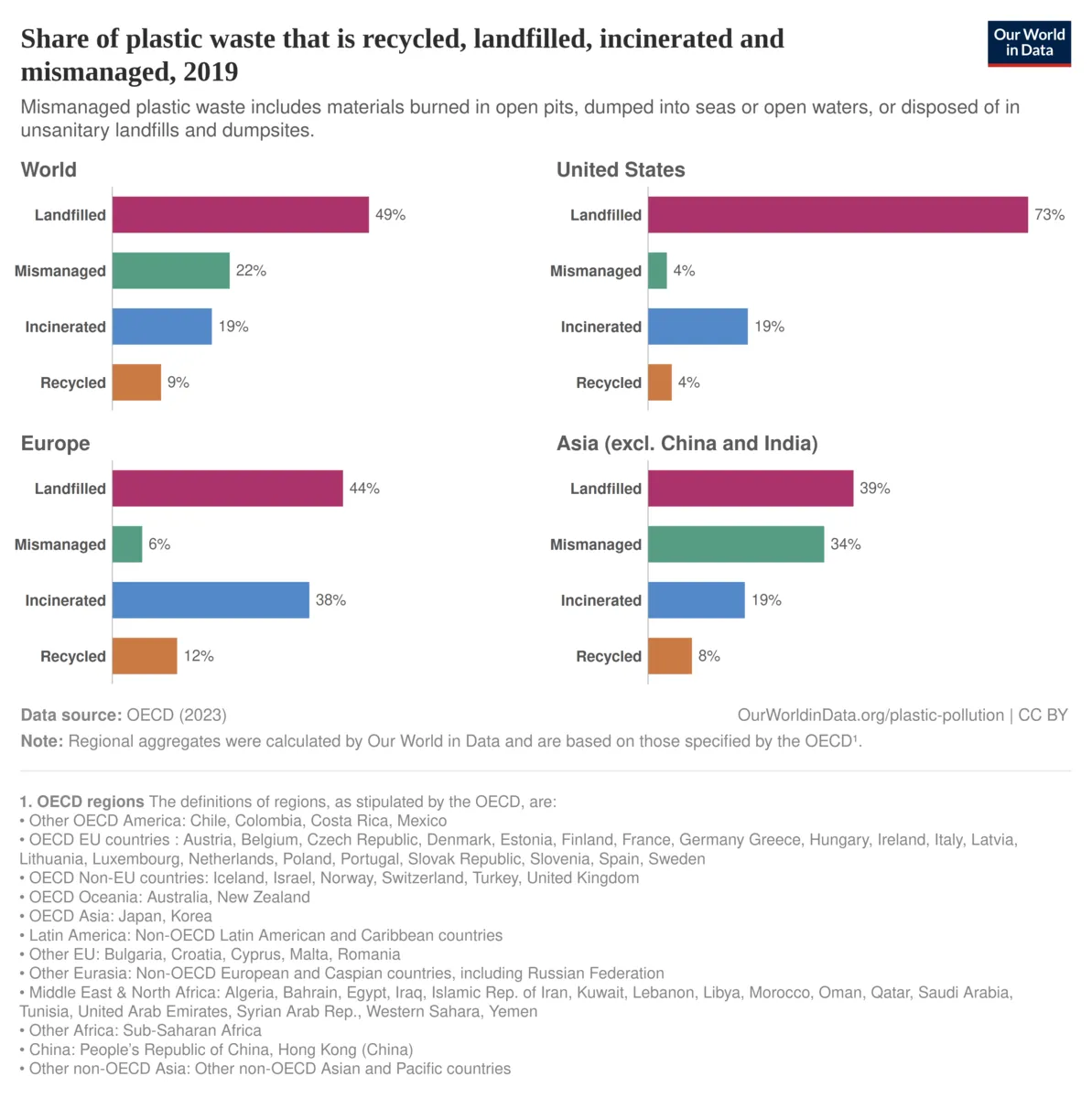
When we think about the trash and recycling problems our world has today, it is hard to be optimistic that we will ever find a solution to solve this. Our best bet at the moment is to try to recycle as much trash as possible, for the chance that we one day - maybe, hopefully - reach a circular economy which can reuse most of the resources it needs from recycled old resources. Unfortunately humanity is not even anywhere close to reach this goal in the next century and as said before it will never be technically possible to recycle 100% if we continue to use the same materials, which loose quality and quantity after every recycling cycle.
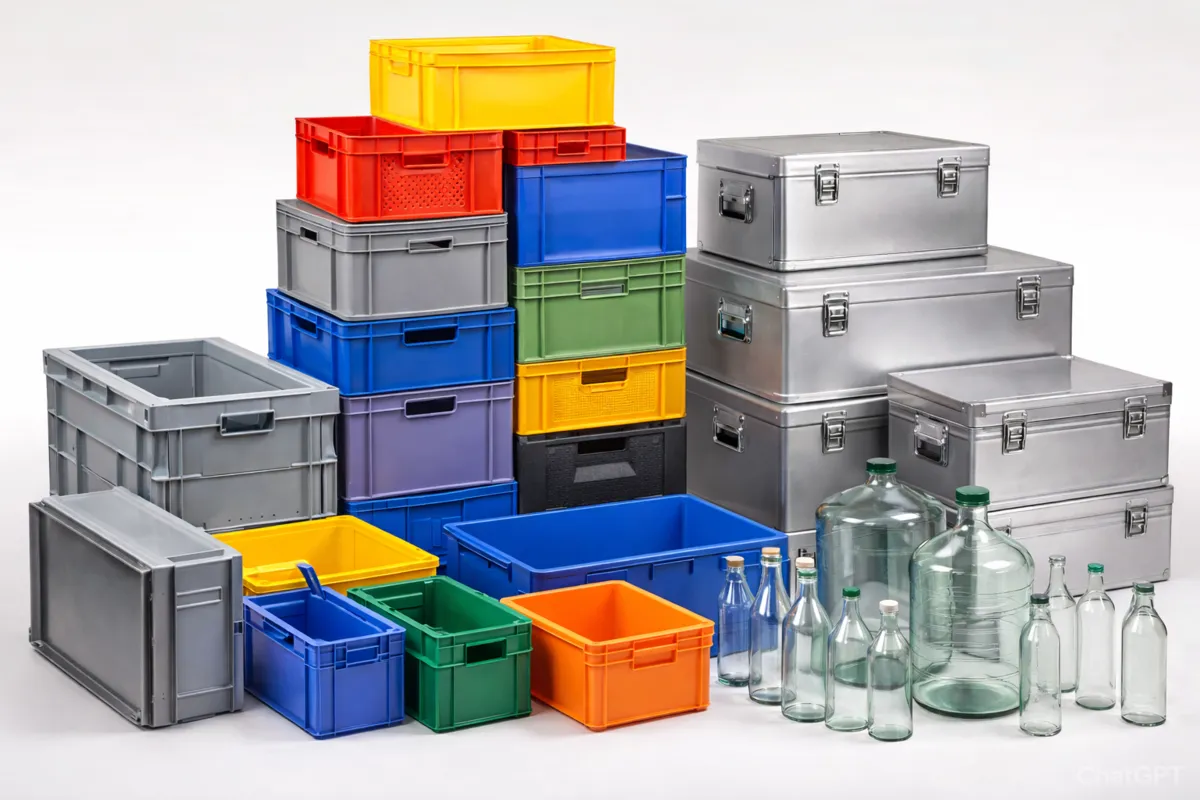
So what does that mean for our trash problem? Is recycling stupid and useless? No, definitely not - we have to start recycling everything we can, everywhere in the world, if we want to have at least a small chance to reach a society that is a little bit circular. But this can never be the only solution. If we keep using the same materials for packaging, we will also in 50 years still need to burn all these products that are of such low quality that they are not even suitable for recycling. Or as a study published in the “Science” magazine summarizes it: “Recycling delays, rather than avoids, final disposal.” (Source: https://www.science.org/doi/10.1126/sciadv.1700782 )
But what could be a real solution to solve this problem?
Team Utopia is a about crazy and utopian ideas. It is about removing all the real-life-constraints from your thoughts and after doing this thinking in a totally unconstrained way about how we could make this world a better place. So let’s do exactly that for thinking about one-time-packaging trash.
What if we tell you, that as of today it would be 100% possible to switch completely away from one-time packaging every-where and forever. Without any additional costs we could stop producing one-time packaging trash and introduce a world spanning deposit system for reusable packaging containers - a system that replaces EVERY one-time packaging container/wrapping/box/bottle/bag with something that either lasts for ever or at least for many many years or can be recycled with nearly no material loss.

So how could that work? - As said before Team Utopia is about thinking in a totally unconstrained way. First of all we remove the money-constraint from our thoughts. We assume that Team-Utopia could raise enough money to pay the production of all multi-use containers that we would need. This means we would need to produce a couple hundred of billions of reusable bottles for all kinds of beverages, 1-2 trillion of reusable food-, personal-care- and cleaning/household-product-packaging containers, a couple of hundred billions of packaging-containers for durable goods and trillions of delivery-/shipping boxes and shopping bags.
As a second step we remove the profit-constraint. Most investors at this point would probably ask why we are assuming that we could motivate enough people to spend their money into such a project and they would ask the question what benefit these people would have from funding such a project with their own private money. And of course they are not wrong to ask these questions. The money that we need for such a project would be about 4 trillion USD - 5 percent of all humans disposable net income (money after taxes and others) for one year, or thinking more long-term 0.25% of all humans disposable net income over the next 20 years, or in other words: about one-and-a-half times the amount that we spend each year for worldwide military expenses - an unimaginable big amount of money. But what if we now tell you that every cent of this money could be paid back to the funders after less than 10 years. This is possible because this money actually is not an investment, but an interest free credit. A credit that pays the production of the multi-use-containers and that is paid back by the producing companies that buy the multi-use containers from Team-Utopia for the same price that it would cost them to buy a single-use packaging container nowadays. After a couple of reuse cycles in which the producing company every time paid the price for a low quality single-use container but received a high quality multi-use container the paid amount will reach the production cost - break-even is reached and the producing company successfully paid back all the money that was needed to initially produce this multi-use-container. Most multi-use packaging containers are of course much more expensive than their equivalent single-use container, but they mostly reach break-even after about 10 to 30 uses. Additionally to this if we look on a time-frame of one year we will need much less multi-use containers than we would need single-use containers - because single-use containers are just that - used only one single time - while multi-use containers can be used several times per year. In our current world every time when you buy a package of cheese we need to produce one new single-use packaging container/packaging for this cheese, but with a multi-use packaging container this container can be used again after about two weeks when you have successfully eaten the cheese. This means that the amount of multi-use containers needed will be even smaller and the payback period even shorter than what we might first assume.

So now to make it all complete let’s remove the last constraint from our thoughts - power. Let’s remove the assumption that companies actually have the power to decide what products we want to use. This power never really was in the hands of companies. They can only sell, what the majority of people wants to buy. Let’s realize this for a moment and give this power back to the people. In our current world you would be correct if you would say that a single non-governmental-organization could never convince market-leading companies like Coca-Cola or Nestlé to switch to a different kind of packaging. But if we would now assume that this project was first organized and financed by billions of people, a big percentage of the worlds population and a even bigger percentage of their potential customers and second it does provide a solution that does not even expect any more financial costs for the producing companies, we could imagine that this group of people has enough power and media-attention to “convince” even the biggest company to join this project to not be the only company that is avoided by all these people.
So how could such a project work in reality? First of all we have to make a plan which includes a complete scientific analysis on
After this plan is created it is time to get as much media attention as possible, raise all necessary money and implement it step by step over the course of the next years and decades. After a couple of years we should be able to replace (and pay off) all beverage and food packaging containers. After maybe 5-10 years all packaging of all consumable goods and all delivery packaging. And after maybe 50-60 years all packaging items worldwide.
To have a first idea about the feasibility of such a project Team-Utopia created a first small study that estimates the above mentioned figures for all consumable goods. Consumables are the products that have the highest production quantities, shortest life-time and the highest turnover rates per year - hence they are most probably the place to start this project and they can give us a good outlook about the overall feasibility. If we can fix this problem for the giant amounts of consumable goods that we produce every year, it should be possible for all packaging categories.
As the below figures show we are currently producing 7.5 trillion (7500 billion) packaging items every year to pack all our consumables world-wide. The numbers we see here are derived from studies that either estimate the yearly per-capita consumption of each product-category or that estimate the total consumption per product-category.
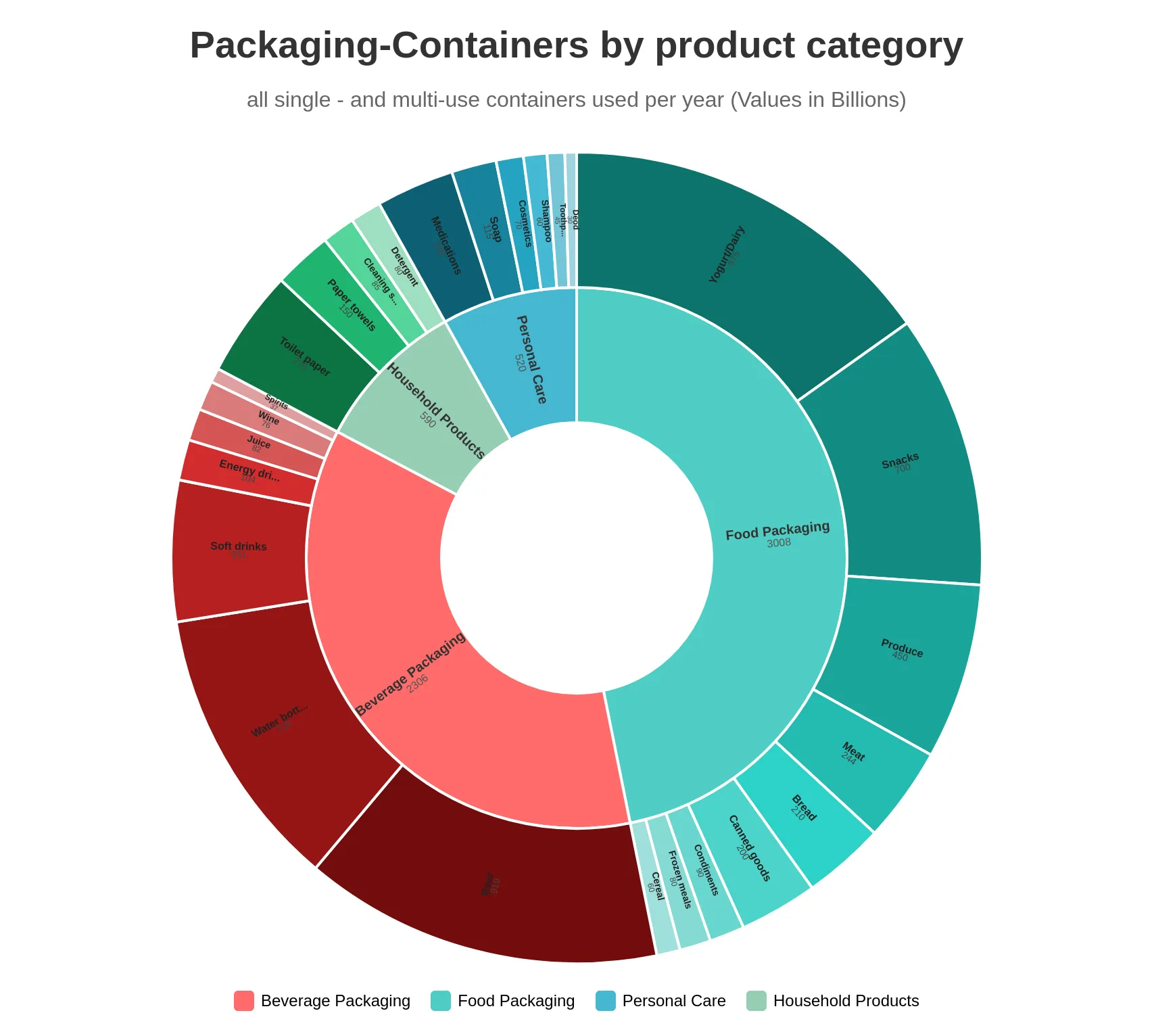
Since these studies mostly offer data in kilogram or tons and liter or billion liters we had to divide these numbers by the average container size per product category to get the number of total packaging containers. In many of these product categories, we have to consider that there are many sub-categories with very different container sizes, which creates the need to also estimate the distribution of all products to the sub-categories. For example we cannot simply assume that every dairy product needs 1 liter of milk for production. If we want to get a realistic number of total dairy-products produced, we have to consider that all sub-categories like for example milk, yogurt, cheese, cream exist in different sizes. And even after considering all this, we still have to take into our calculations that besides the normal-retail-size packaging there is also things existing like bulk-size packaging (e.g. for food-service companies).
After taking all these things into account for each consumables we will end up with total numbers of products produced per year. This total numbers produced per year also tell us how many packaging containers were needed to pack all these products - on packaging container for each produced product.
Of course not all these packaging containers need to be replaced, because already now - not many, but some - of the products are packaged in multi-use containers. The below chart shows exactly that.
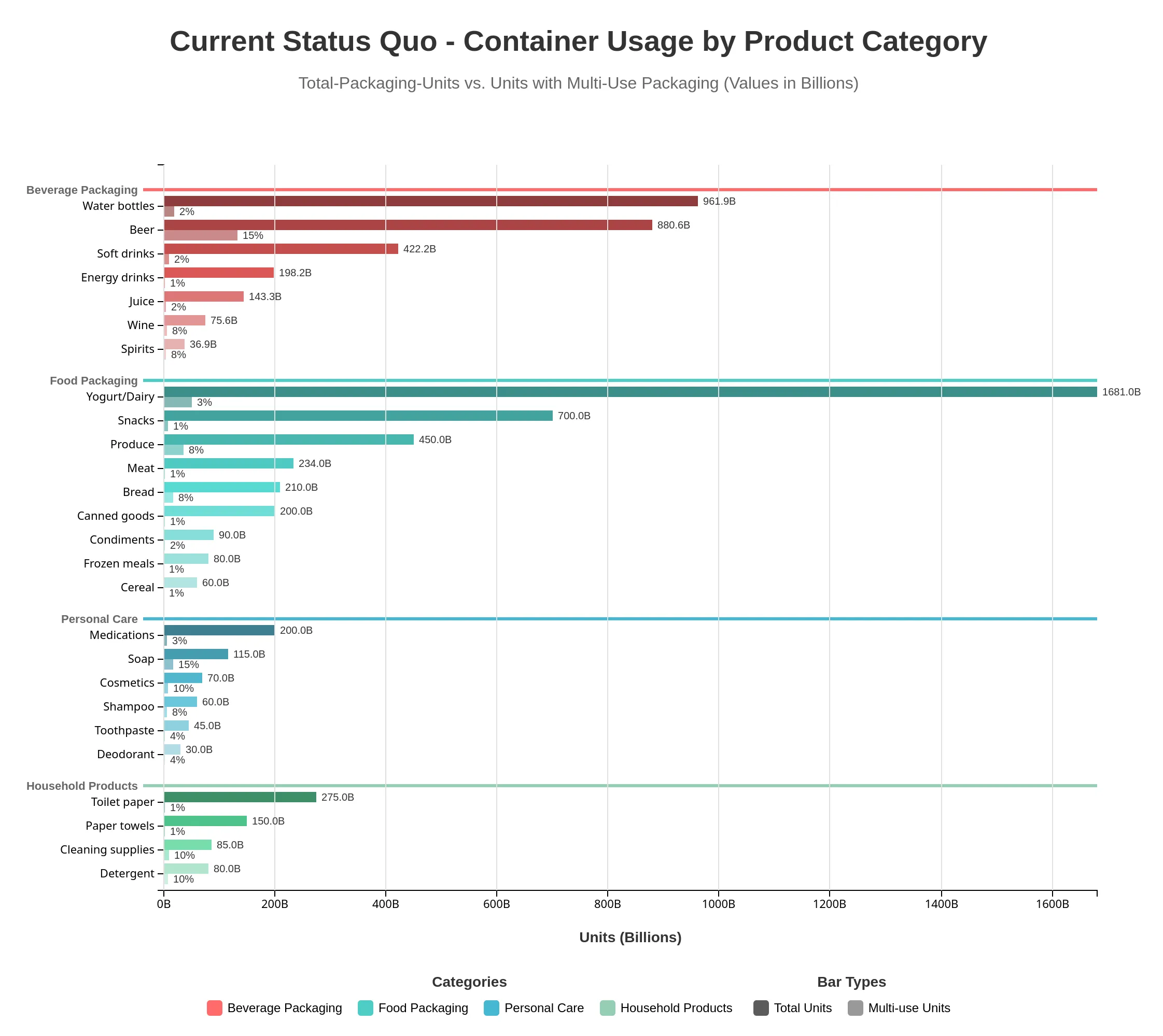
Also it is important to consider how the consumption is distributed over different parts of the world, because supply-chains are not equally fast and this has to be considered during the calculation of how many multi-use containers are needed to replace the existing single-use containers.
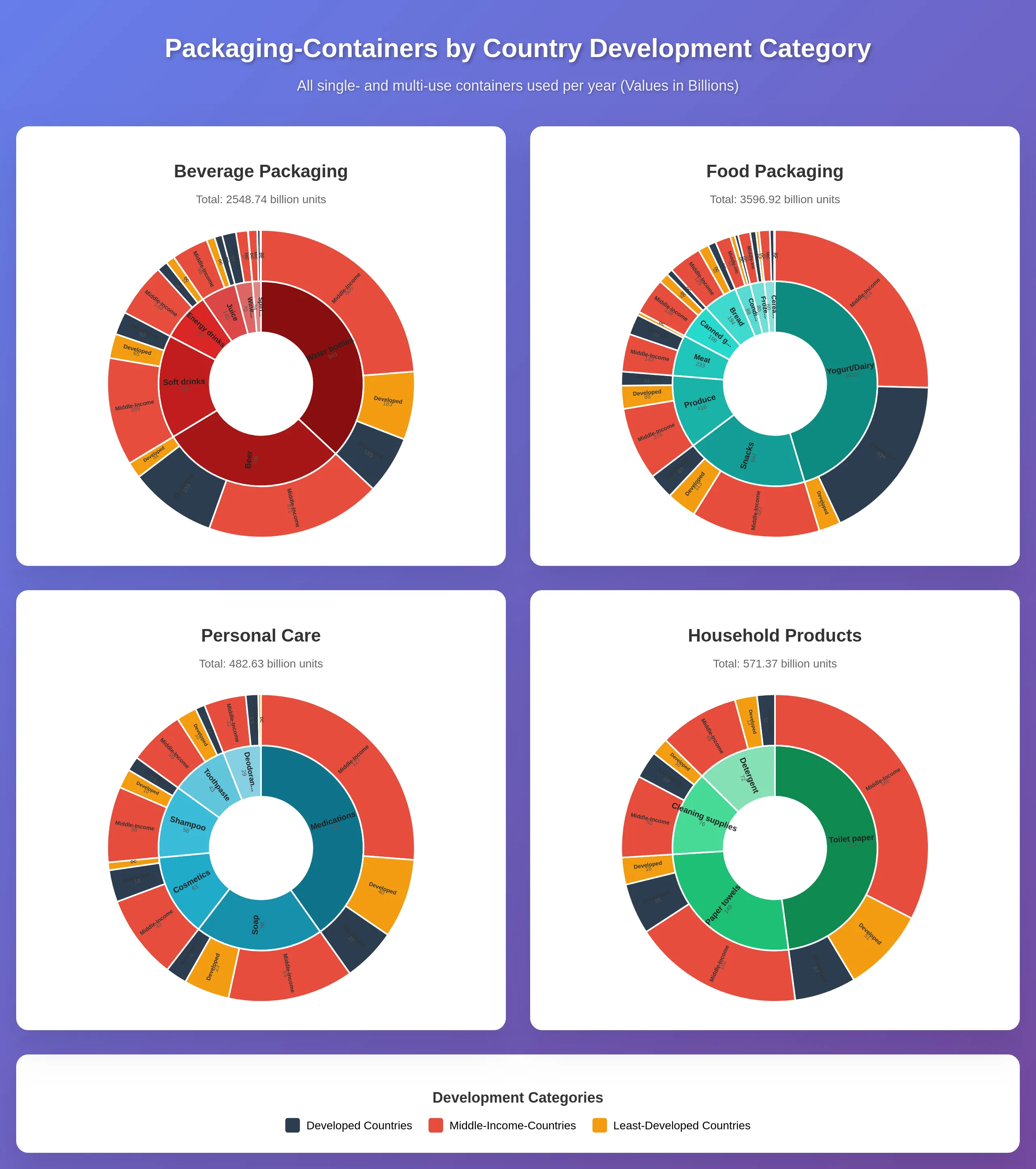
The next part of the study uses these numbers as a basis to calculate predictions on how many multi-use containers are needed to replace single-use containers. In other words what do we need to switch and what will it cost?
Since these calculations are more complex then they seem it’s better to not look at all product categories at once, but to start with an easily understandable example: beer consumption
Based on the WHOs report “Global Health Observatory (2025)” which is processed by “Our World in Data” (Source: https://ourworldindata.org/alcohol-consumption) we know that world-wide every person consumes on average 44.71 liter of 4%-beer per year. If we assume that most beer-bottles have a size of either 0.5 or 0.33 liter we will get an average beer-bottle size of 0.415 liter. For this bottle size we can calculate that everyone in the world on average consumes about 107.74 bottles per year. Developed countries have the highest per person consumption with a yearly average of 86.53 liters or 208.5 bottles per person, while middle-income countries consume less than 50% of that - 41.73 liters / 100.55 bottles and developing countries consume only a small fraction of that 15.3 liters / 36.86 bottles.
| Average Consumption per Person, per Year | |||
|---|---|---|---|
| In Liters of Pure Alcohol which was consumed as Beer | In Liters of 4% Beer | In 415ml Bottles of 4% Beer | |
| Developed Country | 3.46 | 86.53 | 208.50 |
| Middle-Income Country | 1.67 | 41.73 | 100.55 |
| Least Developed Country | 0.61 | 15.30 | 36.86 |
| World-Wide | 1.79 | 44.71 | 107.74 |
If we now multiply these average bottle-numbers with total number of people living in each country-development-category, we will find out that we world-wide consume about 881 billion 415 ml beer bottles every year, 275 billion in Developed Countries, 554 billion in Middle-Income-Countries and 52 billion in Least Developed Countries.
| World-Wide | Developed Countries | Middle-Income Countries | Least Developed Countries | |
|---|---|---|---|---|
| Population Distribution % | 100 % | 16% | 67% | 17% |
| Population (billion) | 8.23 | 1.3168 | 5.5141 | 1.3991 |
| Total consumption of 415ml beer bottles per year (billions) | 880.57 | 274.55 | 554.44 | 51.57 |
To account for the fact that some countries already now use multi-use bottles for beer we have to multiply these numbers by the factor of how many multi-use packaging containers are already used today. While some countries in Europe still have a strong reusable bottle system for beer bottles, most countries in the world consume beer out of single-use cans or bottles and some countries like for example the U.S. even switched back from a system of 86% reusable-glass bottles (1986) to a market with about 4% (now) reusable beer bottles (Source: https://www.container-recycling.org/index.php/refillable-glass-bottles/53-facts-a-statistics/glass/428-the-decline-of-refillable-beverage-bottles-in-the-us). In a worldwide average about 15% of all beer is bottled in multi-use containers which tells us that 85% of the beer bottles - in total 749 billion bottles per year - are still bottled in single-use containers.
Now we know how many single-use beer bottles/containers are produced every year and we can also estimate what this costs, if we multiply this number with the average cost of a single-use bottle.
$$748.48 \text{ billion single-use-bottles/year} × 0.08 \text{ US\$ / bottle} = 59.88 \text{ billion US\$/year}$$749 billion bottles multiplied with 8 cent (USD) production cost per bottle results in 60 billion USD - the amount of money that is needed - EVERY YEAR - to produce single-use beer bottles/cans.
In the next step we have to estimate what number of bottles would be needed if we could return and reuse every bottle after usage. To estimate these numbers we can use tools from the world of mathematical statistic like “Littles Law” or “Monte Carlo simulation”.
For this we need to know “how many products are consumed per day” and how “long it takes them to do a full turnover cycle” of
Since these numbers are different in developed-, middle-income- and least-developed countries we have to do separate calculations for each region in the world. The below example will show a calculation of a developed country.
We already now know for developed countries that each person on average consumes 177.23 single-use bottles per year (85% of 208.50 415ml bottles/year/person) or 0.75 bottles per day
$$λ = 177.23\text{ bottles/person/year} ÷ 365 \text{ days} = 0.4855 \text{ bottles/person/day}$$Now it is time to estimate the number of days it would take a multi-use beer bottle to do a full turnover cycle. Below we will show three scenarios for this:
Scenario A - Optimistic (W = 14 days):
Scenario B - Realistic (W = 21 days):
Scenario C - Conservative (W = 35 days):
According to Little’s Law, we can now estimate the average number of beer bottles needed in the system at any time
Little’s Law, proven by John Little in 1961, states that for any stable system:
$$L = λ × W$$Where:
This means for
This means if we assume that a whole turnover cycle takes 35 days we would need to have 17 bottles existing for every human existing in every developed country at any given time.
To verify these numbers we now use a “Monte Carlo simulation” that uses random sampling to model complex systems with multiple sources of uncertainty. It runs thousands of scenarios to estimate probability distributions of outcomes. For this it uses the same numbers as above but does not assume that each bottle behaves exactly the same, but simulates some kind of random behavior. For this it runs through all 365 days of a year - 10.000 times and calculates random numbers for both “how many products are consumed per day” and how “long it takes them to do a full turnover cycle”. These random numbers are based on the average numbers we used before, but they consider a statistical standard deviation, which means on one day the person maybe drinks no beer on another day the person drinks three bottles of beer. The one bottle takes 40 days to get returned but the other bottle takes only 28 days. While simulating each day differently for 10.000 years we can get much more realistic numbers in a system with many uncertainties.
After doing such a simulation the below table shows us that in a conservative 35 days scenario, 22 bottles per person would be enough to have enough bottles available 99% of the time.
| Scenario A - Optimistic (W = 14 days) | Scenario B - Realistic (W = 21 days) | Scenario C - Conservative (W = 35 days) | |
|---|---|---|---|
| Number of simulations | 10,000 | 10,000 | 10,000 |
| Days per year | 365 | 365 | 365 |
| STATISTICAL SUMMARY | |||
| Mean | 8.33 bottles per person | 12.06 bottles per person | 19.50 bottles per person |
| Standard Deviation | 0.48 bottles per person | 0.57 bottles per person | 0.86 bottles per person |
| Minimum | 7.13 bottles per person | 10.47 bottles per person | 16.68 bottles per person |
| Maximum | 12.06 bottles per person | 20.49 bottles per person | 27.20 bottles per person |
| Median | 8.25 bottles per person | 12.00 bottles per person | 19.46 bottles per person |
| PERCENTILE ANALYSIS | |||
| 50th percentile | 8.25 bottles per person | 12.00 bottles per person | 19.46 bottles per person |
| 90th percentile | 8.97 bottles per person | 12.77 bottles per person | 20.56 bottles per person |
| 95th percentile | 9.25 bottles per person | 13.06 bottles per person | 20.90 bottles per person |
| 99th percentile | 9.85 bottles per person | 13.78 bottles per person | 21.75 bottles per person |
| SERVICE LEVEL RECOMMENDATIONS | |||
| 90% reliability | 9 bottles per person | 13 bottles per person | 21 bottles per person |
| 95% reliability | 10 bottles per person | 14 bottles per person | 21 bottles per person |
| 99% reliability | 10 bottles per person | 14 bottles per person | 22 bottles per person |
This also tells us that we would have 1% of the time - which means 3.65 days per year not enough bottles available. In real-life this might be acceptable for beverage containers, but since we want to be on the safe side with this calculation, we round this result up a bit and follow the rule-of-thumb Littles-Law-estimation + 50%
So where do these numbers lead us? We now know that each year currently 208.5 beer bottles are produced for each person in a developed country. 177.23 of these bottles are single-use bottles and need to be replaced by multi-use-bottles. We also know that we would need to have 26 multi-use bottles available to match the beer-bottle consumption of this person. This means that we need 7 times as many single-use bottles than we would need multi-use bottles - even in a conservative scenario. And this also means that if this multi-use bottle is 15 times more expensive than the single-use bottle we would need to use it 15 times to pay it off completely.
This leads us to the conclusion, that all beer-bottles that are needed for people in developed countries could be paid off after 2.16 years
$$\frac{177.23\text{ single-use bottles}}{25.49\text{ multi-use bottles}} = 6.95\text{ usages of each multi-use bottle per year}$$$$\frac{1.2\text{ US\$ per multi-use bottle}}{0.08\text{ US\$ per single-use bottle}} = 15\text{ usages needed to reach break-even}$$
$$\frac{15\text{ usages needed to reach break-even}}{6.95\text{ usages of each multi-use bottle per year}} = 2.16\text{ years to reach break-even}$$
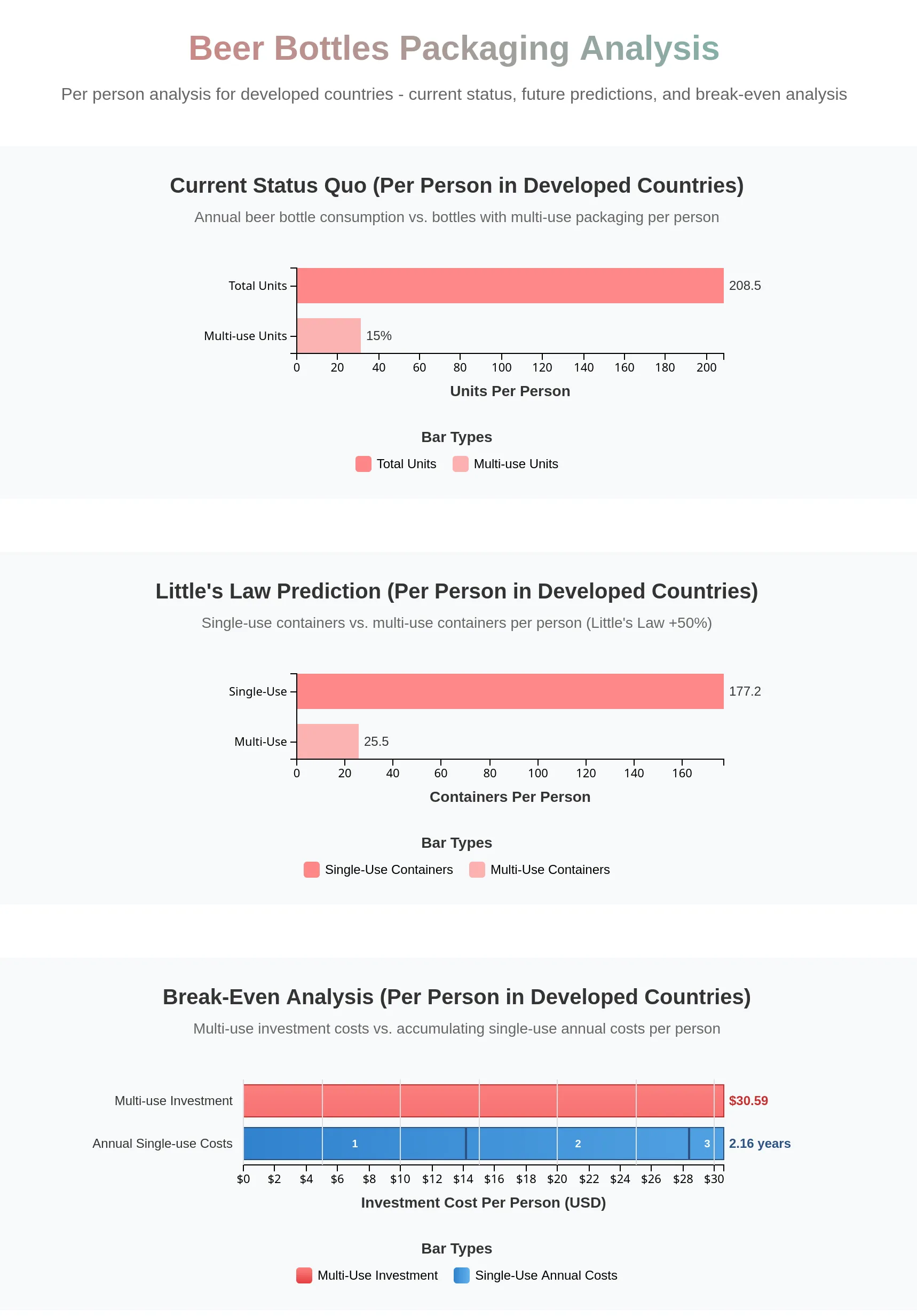
Or if we now consolidate all the different numbers of all regions in the world we can see that after 4.25 years the cost of switching to reusable beer-bottles could be paid off completely. After this time-period the bottles are basically free and can be reused without any additional cost.
| Conservative Turnover-Cycle Time in days | Beer Bottles / day / person | Little’s Law (Bottles needed / person) | Monte Carlo Simulation (Bottles needed / person) |
Little’s Law + 50% (Bottles needed / person) |
|
|---|---|---|---|---|---|
| Developed Countries | 35.00 | 0.4855 | 16.99 | 22.00 | ==25.49== |
| Middle-Income Countries | 49.00 | 0.2342 | 11.47 | 15.00 | 17.21 |
| Least-Developed Countries | 69.00 | 0.0858 | 5.92 | 8.00 | 8.88 |
| Price Single-Use | Price Multi-Use | Break-even after uses | Single-Use needed / person / year | Multi-Use needed / person / year | Usages of Multi-Use per year | Break-even after years | |
|---|---|---|---|---|---|---|---|
| Developed Countries | 0.08 | 1.2 | 15 | 177.23 | 25.49 | 6.95 | 2.16 |
| Middle-Income Countries | 0.08 | 1.2 | 15 | 85.47 | 17.21 | 4.97 | 3.02 |
| Least-Developed Countries | 0.08 | 1.2 | 15 | 31.33 | 8.88 | 3.53 | ==4.25== |
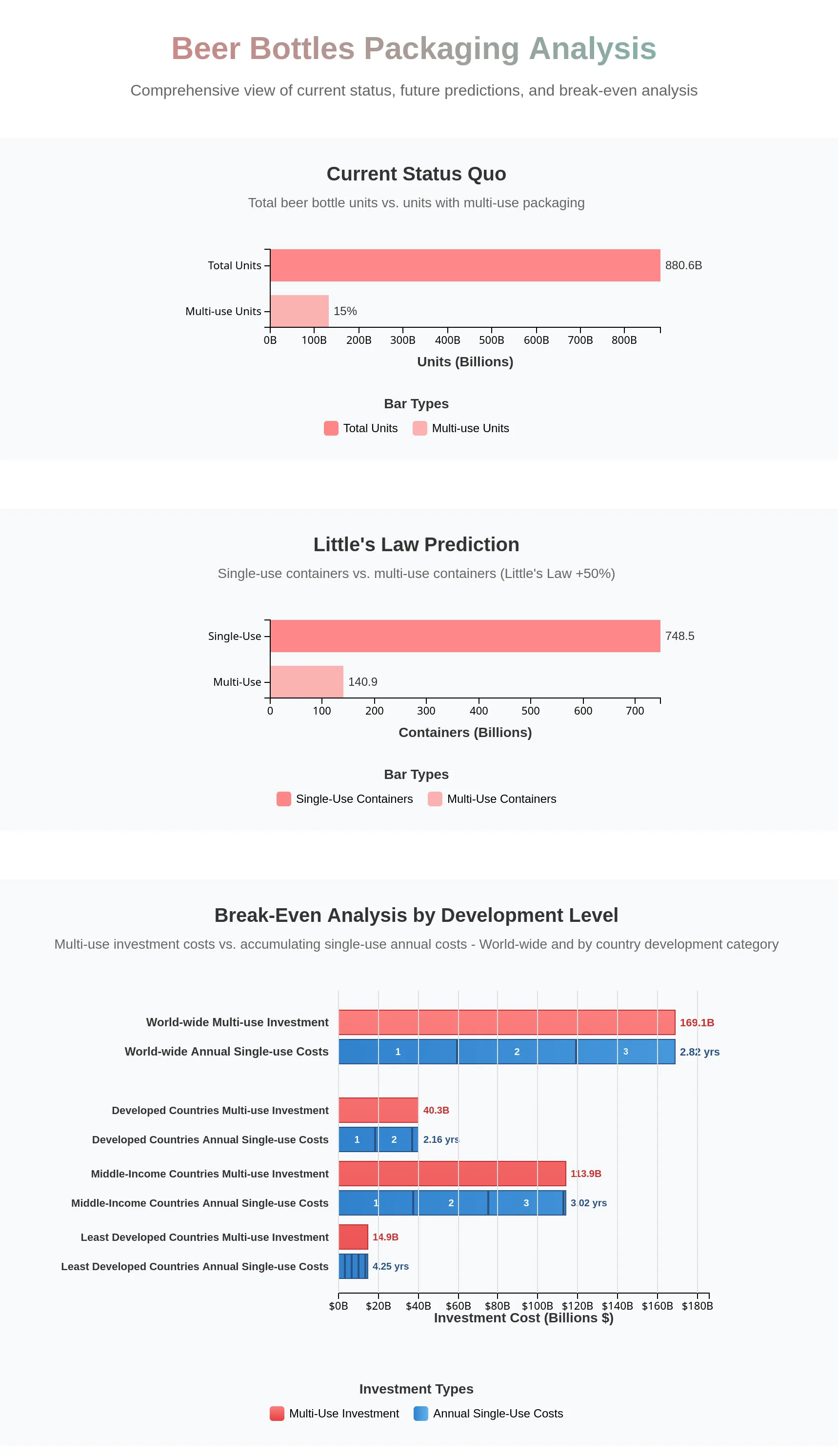
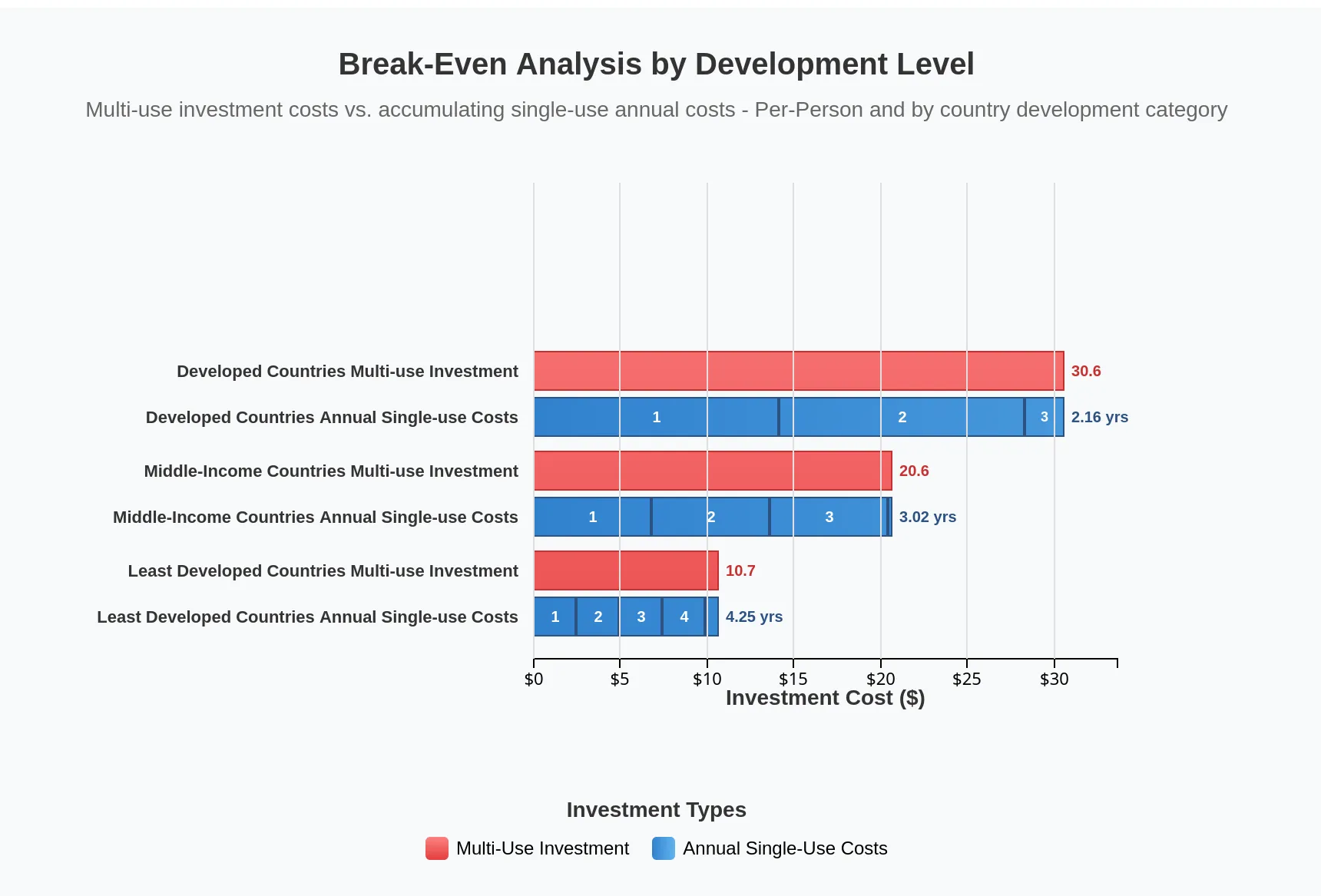
In reality of course also reusable containers can break after a few hundred uses, but if we produce them in the right materials we can recycle these broken ones without creating too much trash (For example glass and metal can get recycled basically limitless without quality loss and some high-quality plastics are also close to reach this). For example glass bottles can crack after a few years and plastic- or metal-meat containers will loose quality after some hundred or thousand uses and also about 10% of all container might maybe get lost because they get not returned by the customer. But all this can be solved if the producing companies continue to pay after the break-even point of these containers is reached. There is no need to give these containers away for free after they are paid off. If they continue to pay the same amount that they pay now for single-use containers even after all multi-use containers are paid off, this could even pay all the replacement costs for broken containers and also all the cleaning and logistic costs that are needed to keep the deposit system running.
Now since we have have gone through that whole beer example it is time to come back to the big picture. The result of our study is that all consumables could be switched to multi-use containers. The higher the turn-over rate of the product the less multi-use containers are needed to make it work. This also means that for products such as canned goods, medications, condiments, which all have really long turn-over times we might need the same amount or even more of multi-use containers as we now need single-use containers per year. This is because these products sometimes stay at the customer for months before a new product is bought. But even for these products in the end the total number of containers will still be less because single-use containers are produced every year again and again while for the multi-use containers at one point will have enough containers available and only need to replace the broken or not returned containers.
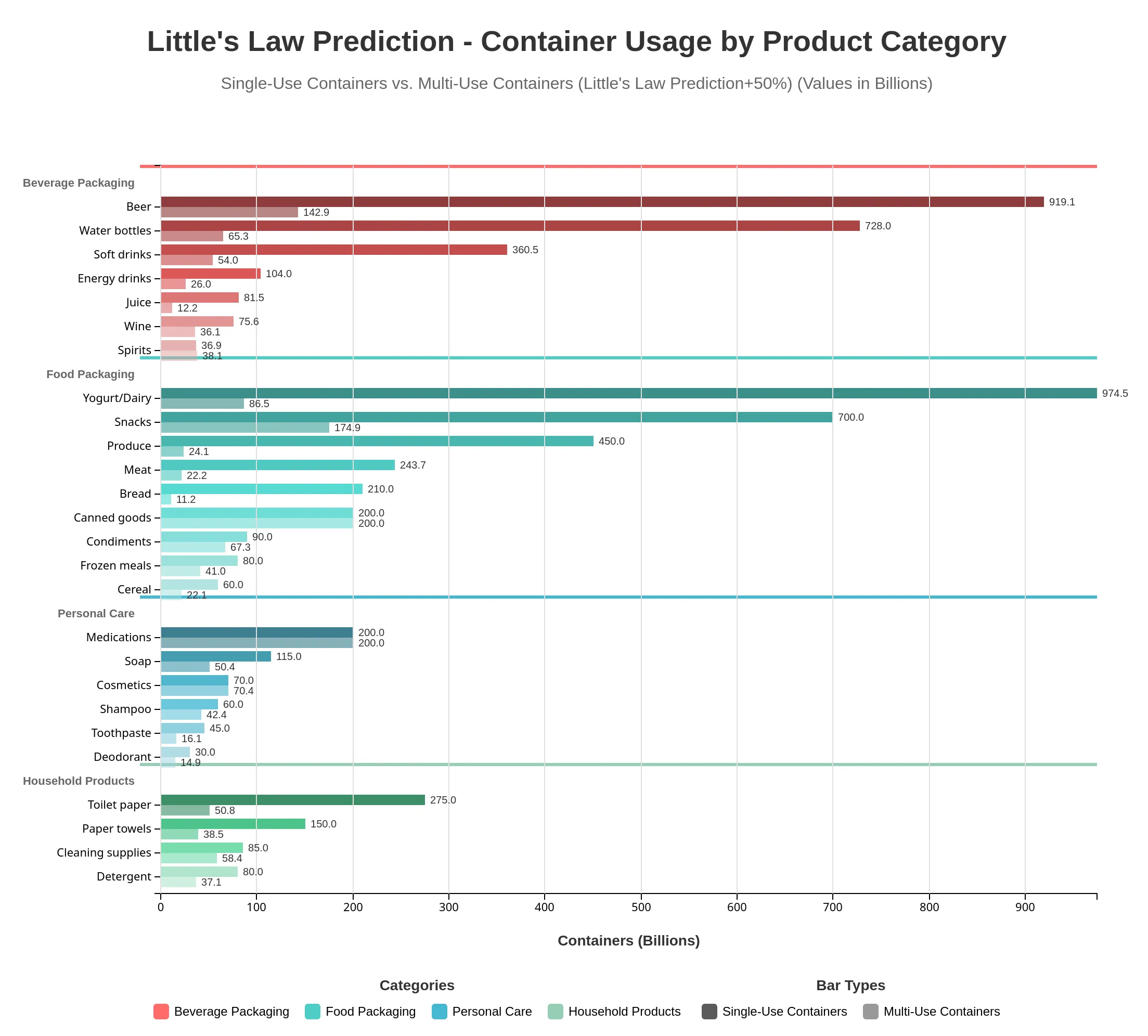
If we now take these numbers and do the same calculations like we did before for beer bottles, we will find out that we producing single-use containers every year again will in the end cost the same and even more than what it costs to produce high-quality multi-use containers. This is true for all product groups that we analyzed. While some products with high turn-over rates reach even already after two other three years, other categories need multiple decades, but all of them will finally pay off the costs after some time.
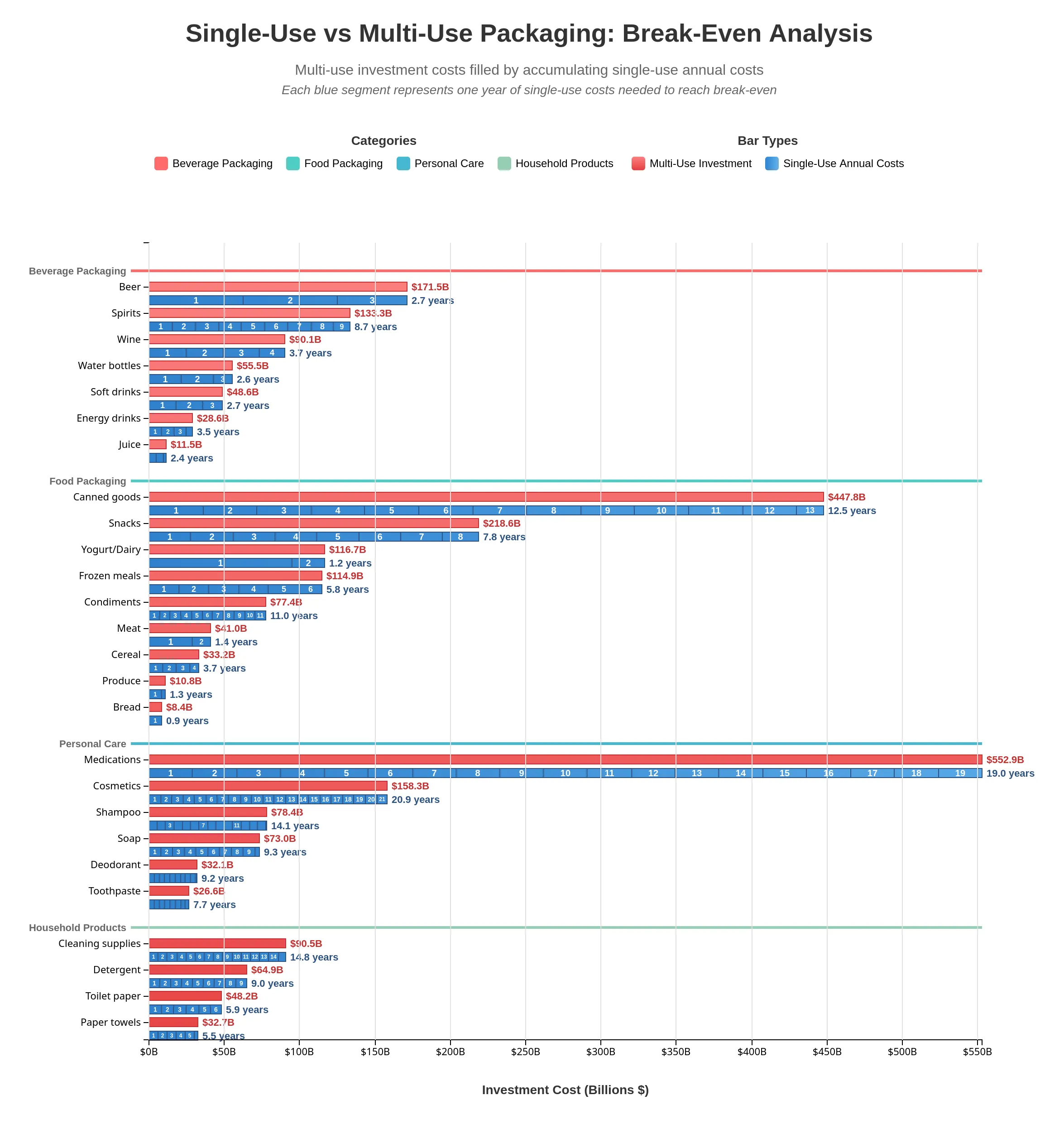
We also found out that there are significant differences in the needed time to reach break-even in different parts of the world. The less developed the region of the world is the slower are the production and supply-chain processes. This has a negative impact on the turn-over cycles and requires much more multi-use containers than in more developed countries. The more multi-use containers are needed the longer it will take to pay them off and to reach break-even. This means less developed countries need longer to reach break-even than more developed countries.
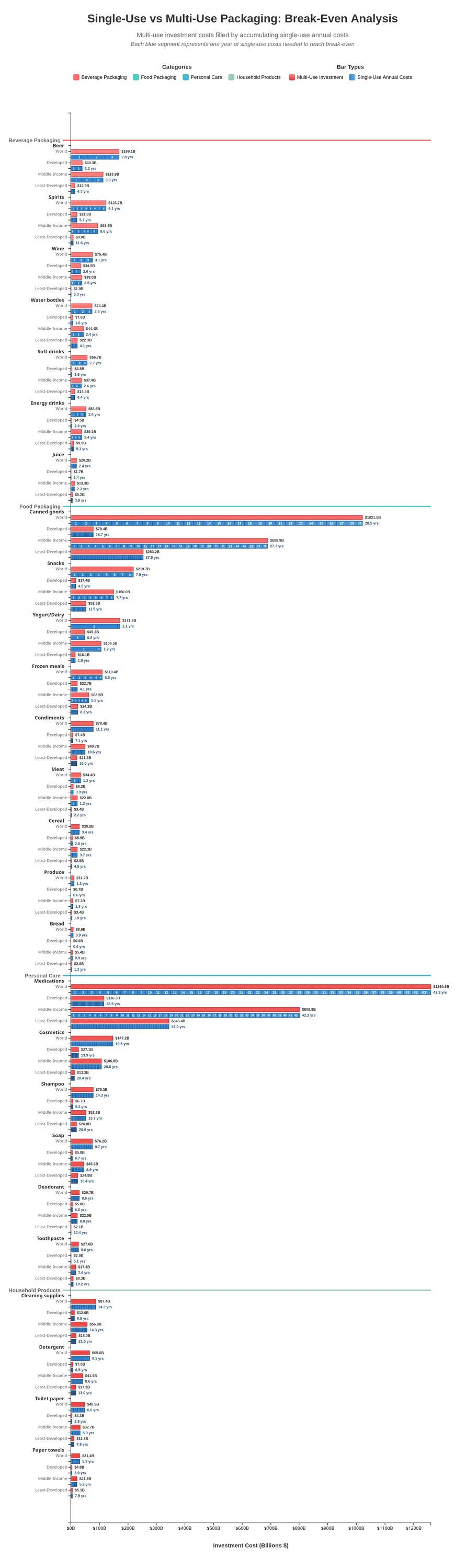
Finally we can also challenge one other thought, if we see all the products as one big project we could actually finance the payment of the products with longer turn-over cycles by the already paid off products with faster turn-over cycles. Once the water and beer bottles are paid off, they can help us paying off the canned goods and medications. The same is true for the different regions of the world. Since the developed and developing countries will reach break-even much faster than the least-developed countries they can help each other during the financing period. With this in mind we can speed up the financing period by nearly 50 years and reach an overall break-even for all product categories in all regions of the world within 8 years.
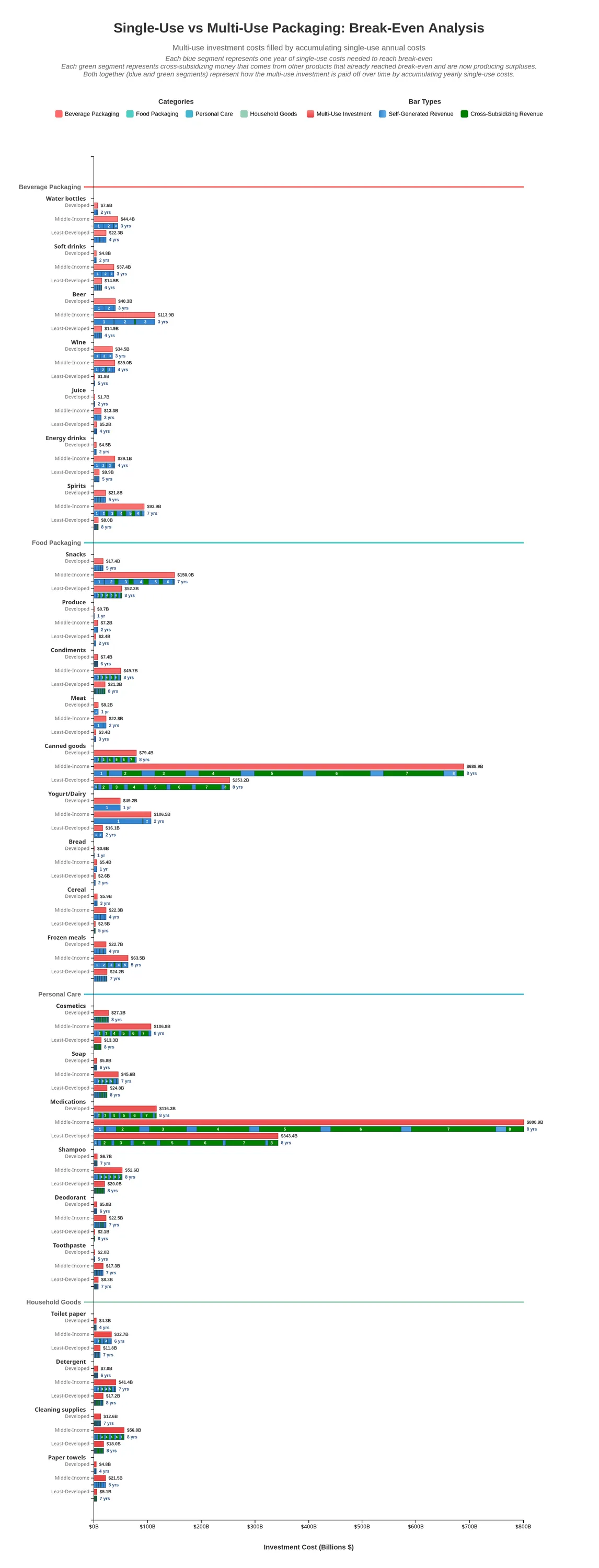
So what if we would now find out that actually all technologies to have such seasonal storage are already existing today?
As of today we are able to do the full electricity -> hydrogen -> electricity loop with a efficiency of 14 - 42% and for the next 25 years this is expected to improve to an overall efficiency of 40-75%.
| Scenario | Electrolysis Efficiency | Storage/Transport Efficiency | Fuel Cell Efficiency | Total Efficiency |
|---|---|---|---|---|
| Local Storage (Compressed H₂) | 65-77% | 85-90% | 35-60% | 19-42% |
| Long-Distance Transport (Liquid H₂) | 65-77% | 60-70% | 35-60% | 14-32% |
| Ammonia as Carrier | 65-77% | 75-85% | 35-60% | 17-39% |
Besides hydrogen-storage we already now have hybrid heat storage that can store heat-energy over months. These super-well insulated heat-storage-systems are mostly build a couple of meters below the surface and are particularly efficient if they are only used for storing and providing heat-energy. Since most energy consumed - especially in countries that are in need of seasonal energy storage - is heat energy, a combination of lithium batteries (for short term (1-2 days) electricity storage), hydrogen-storage (for long-term seasonal electricity storage) and heat-storage (for long-term seasonal heat storage) could provide an all-round solution that is technically possible now and could be deployed large-scale if we put a lot money into this technology.
The technology is already existing now, the only problem is that it’s not yet financially affordable, especially not for normal persons who are producing renewable energy, for example with rooftop solar power. But what if we close this affordability gap and reach a point where small communities could afford to build such seasonal storage systems. What if we would not need to rely on gigantic country owned storage systems but build small-/community-scale seasonal storage systems that are close to the people that produce the energy in one part of the year and use it in the other part of the year.
So how could we do this? As of today there are already companies existing that offer house-hold size seasonal hydrogen storage solutions for ~ 100.000 - 200.000 US-Dollar . Mostly these storage systems are still really small (about 1-3 KW peak power of electrolyzer and fuel-cell and about 300-1500 kWh storage capacity) but still so expensive that even people in a developed countries with a over-average income are not really able to buy such a storage system.
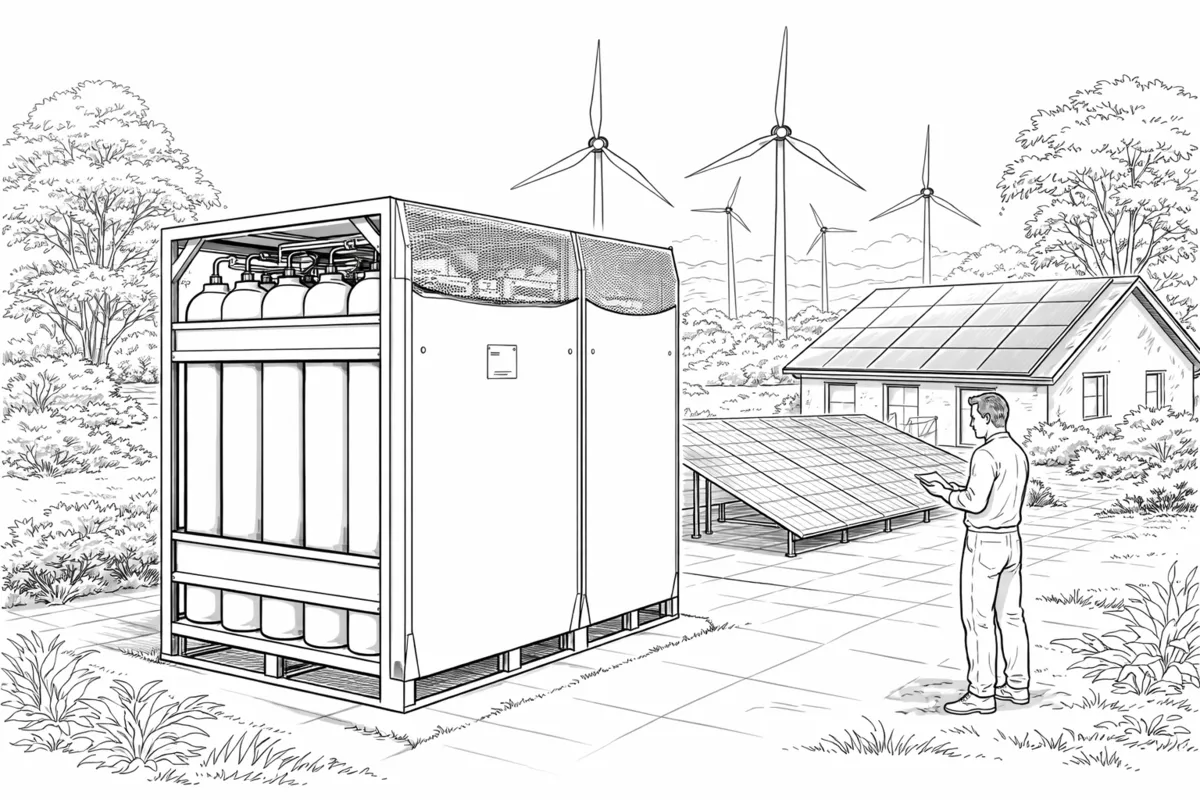
Our answer could be three-fold:
How could the numbers of such a project look in reality?
For an example calculation we will assume an average household in a country with clear seasons and intermittent renewable energy supply over the months. This household
If this household had 15.5 kW peak-load of solar-panels (Photovoltaic) on it’s roof and a hydrogen storage available this solar would be enough to fully power the house without any need to get any electricity from the grid. If we now look into the future and assume that this household produces also all it’s heat over electric heat-pumps, it would need in total about 18 kW peak load of solar to be fully self-sustained. This calculation assumes of course that a hydrogen and a heat-storage is available and both are filled in the months of surpluses. Besides this there would also be the alternative to use the solar-panels (PV) only for electricity generation and use solar-thermal collectors for heat generation. In the end both options might work equally good and this option might even be a little cheaper, but for the sake of simplicity we will assume an all-electric-setup that uses solar-panels (PV) for both electricity and heat-generation.
| Scenario label | PV (kW / household) | Short note — what PV must supply |
|---|---|---|
| Electricity-only, seasonal H₂ backup | ≈15.5 kW | PV sized so summer surplus → H₂ (30% RT) covers winter electricity deficits. Heat is not supplied by PV in this scenario. |
| ==PV → HP in summer → seasonal heat store + H₂ for winter electricity (both used)== | ==≈18 kW== | ==PV must supply both: summer electricity to run the heat pump for full heat (12 MWh_th) and the summer electricity that will be converted to H₂ to cover winter electricity — hence larger PV.== |
| All-electric heat — HP runs in winter (real-time) | ≈35.5 kW | PV must cover “normal” electricity (backed by H₂ storage) plus heat-pump electrical demand produced in winter (no seasonal thermal charging) — the most PV-intensive electrification option. |
| PV for electricity + Solar-thermal collectors for heat | ≈15.5 kW PV + ~24 m² collectors | PV sized as the electricity-only H₂ case (15.5 kW); heat provided by direct solar thermal collectors + seasonal thermal storage (collector area ≈24 m² to supply 12 MWh_th/yr). |
Over the course of a year the electricity production of the solar power could look as follows, big surpluses during summer and big deficits in the winter
| Month | Electricity demand (kWh) | Heat demand (kWh) | Electricity generated by PV solar (kWh) | Surplus / Deficit |
|---|---|---|---|---|
| January | 833 | 1,500 | 450.0 | −383.0 (deficit) |
| February | 833 | 1,500 | 720.0 | −113.0 (deficit) |
| March | 833 | 1,500 | 1,260.0 | +427.0 (surplus) |
| April | 833 | 500 | 1,800.0 | +967.0 (surplus) |
| May | 833 | 500 | 2,250.0 | +1,417.0 (surplus) |
| June | 833 | 500 | 2,340.0 | +1,507.0 (surplus) |
| July | 833 | 500 | 2,340.0 | +1,507.0 (surplus) |
| August | 833 | 500 | 2,160.0 | +1,327.0 (surplus) |
| September | 833 | 500 | 1,620.0 | +787.0 (surplus) |
| October | 833 | 1,500 | 1,080.0 | +247.0 (surplus) |
| November | 833 | 1,500 | 630.0 | −203.0 (deficit) |
| December | 833 | 1,500 | 450.0 | −383.0 (deficit) |
Looking only at the “normal” electricity need (no heat), this means that such a household would produce in total a surplus of 8186 kWh and a total deficit of 1082 kWh. 60% of the summer-surpluses can directly power the electrolyzers to fill the hydrogen-storage. The rest of the surpluses (40%) will be used to power heat-pumps to fill up the heat-storage also already in the summer.
From here on now we can run a small simulation calculation which tells us how the surpluses in each month are used to fill or empty the two seasonal-storage’s. By this we can also see how big each storage has to be for one such household.
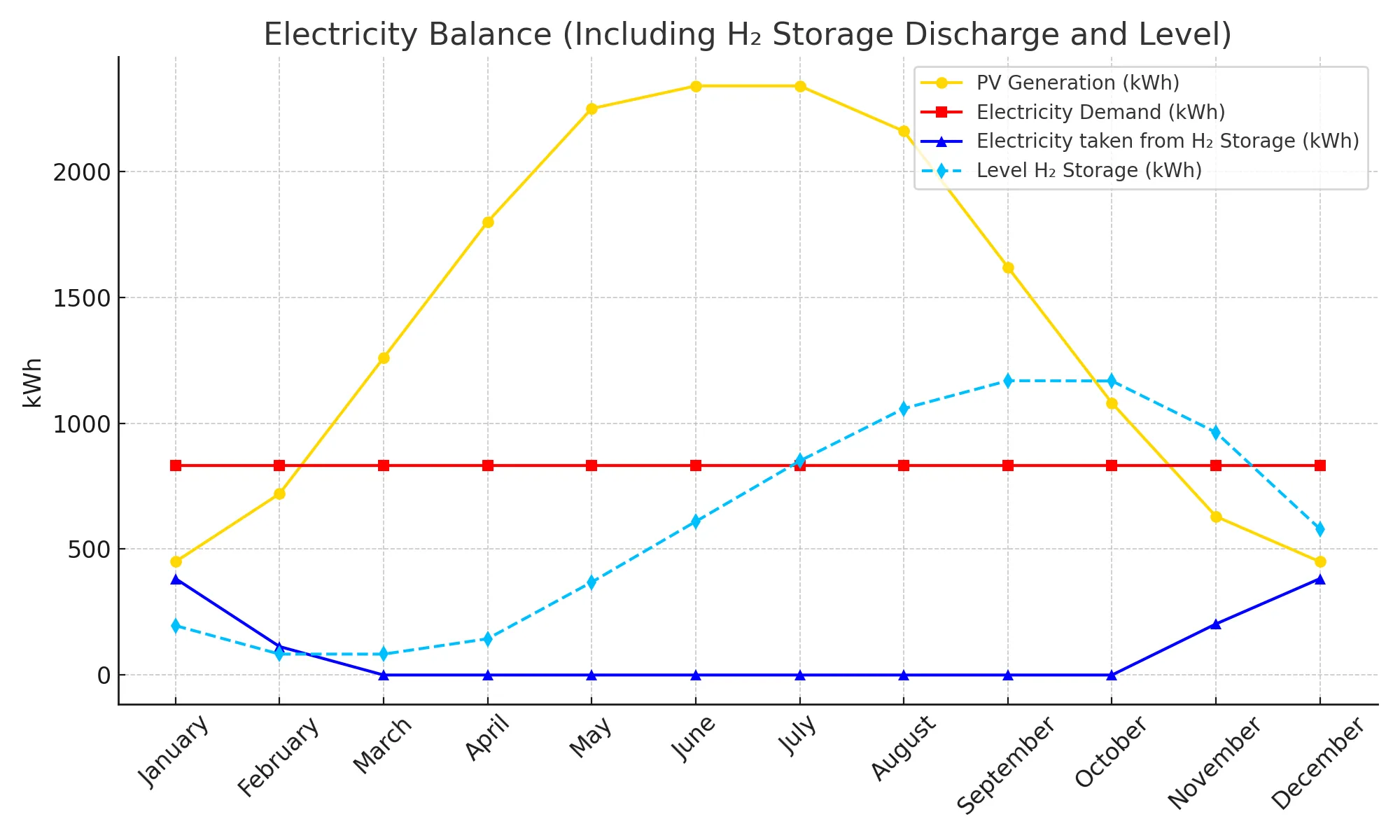
The table shows how PV generated electric energy is used in summer to fill both hydrogen and heat-storage. Furthermore it shows how much of the storage is used each month in winter and how full the storage is afterwards. All heat-related numbers are given in kWh-electric-energy. This is done to make everything easier comparable. To compare it to the kWh-thermal-energy you have to multiply the numbers by the COP 3.0.
| Month | Solar Generation (kWh) | Elec. Demand (kWh) | Heat Demand Electrical (kWh) | Elec used to fill H2 storage (kWh) | Elec used to fill Heat storage (kWh) | Elec taken from H2 storage (kWh) | Heat (elec.) taken from Heat storage | Level H2 storage (kWh) after Output | Level Heat storage after Output (kWh elec.) |
|---|---|---|---|---|---|---|---|---|---|
| January | 450 | 833 | 500.00 | 0.00 | 0.00 | 383 | 500 | 196.25 | 693.00 |
| February | 720 | 833 | 500.00 | 0.00 | 0.00 | 113 | 500 | 83.05 | 186.07 |
| March | 1260 | 833 | 500.00 | 0.00 | 0.00 | 0 | 73 | 82.97 | 111.21 |
| April | 1800 | 833 | 166.67 | 480.20 | 320.13 | 0 | 0 | 144.06 | 304.13 |
| May | 2250 | 833 | 166.67 | 750.20 | 500.13 | 0 | 0 | 368.98 | 801.22 |
| June | 2340 | 833 | 166.67 | 804.20 | 536.13 | 0 | 0 | 609.87 | 1,329.34 |
| July | 2340 | 833 | 166.67 | 804.20 | 536.13 | 0 | 0 | 850.52 | 1,852.18 |
| August | 2160 | 833 | 166.67 | 696.20 | 464.13 | 0 | 0 | 1,058.53 | 2,297.79 |
| September | 1620 | 833 | 166.67 | 372.20 | 248.13 | 0 | 0 | 1,169.13 | 2,522.95 |
| October | 1080 | 833 | 500.00 | 0.00 | 0.00 | 0 | 253 | 1,167.96 | 2,244.72 |
| November | 630 | 833 | 500.00 | 0.00 | 0.00 | 203 | 500 | 963.79 | 1,722.27 |
| December | 450 | 833 | 500.00 | 0.00 | 0.00 | 383 | 500 | 579.83 | 1,205.05 |
System Size
Hydrogen Storage
Heat Storage
Household Demand (kWh)
Surplus Usage
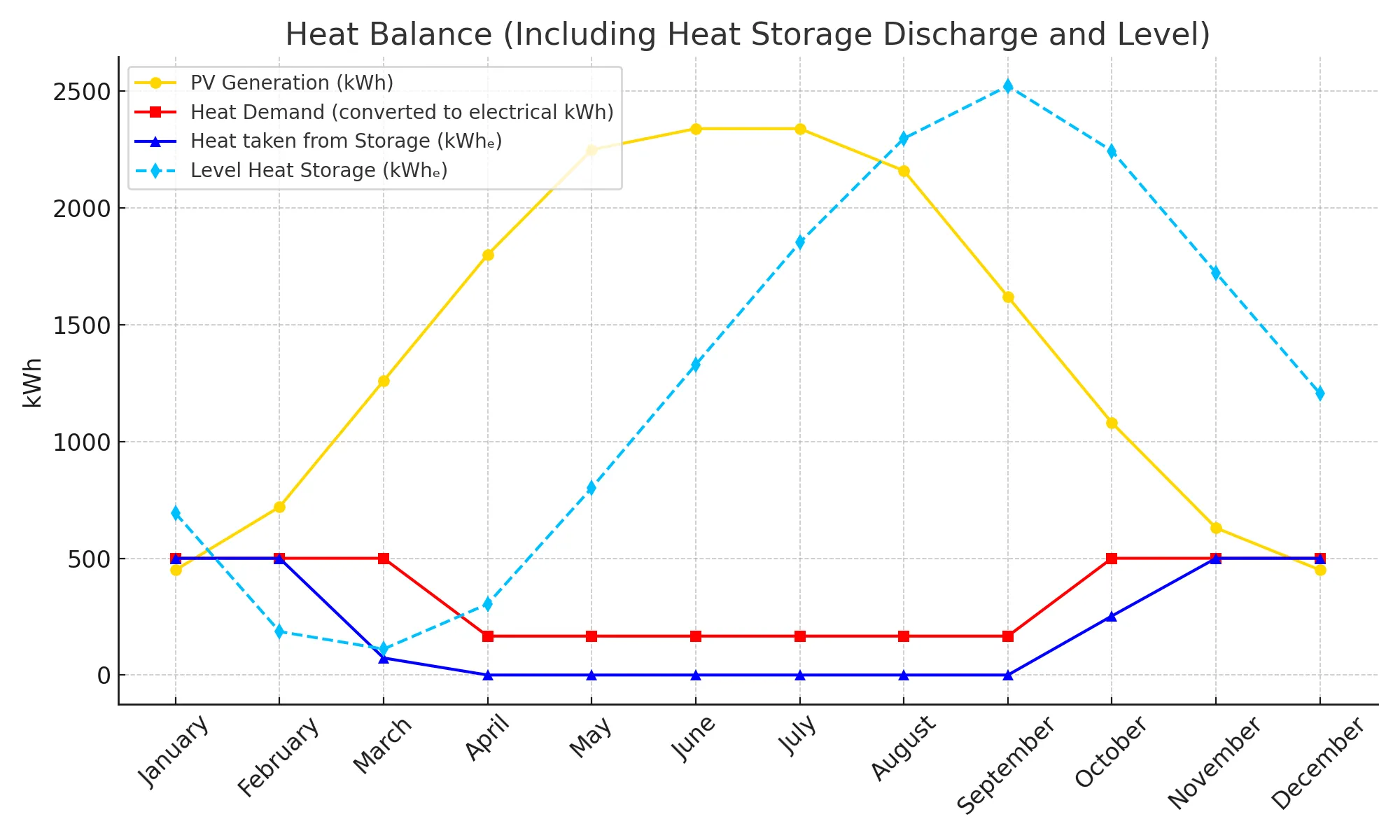
With these numbers we can also derive the needed size of each storage.
Short term battery storage
Seasonal Hydrogen storage for providing electricity in the winter
Seasonal Heat-Storage for providing heat in the winter
And now! - since we finally have a working setup for one household we can scale it up. The below table will show expected storage sizes and cost for groups of 1 to 10.000 household.
| Households (N) | Battery stored (kWhₑ) | Battery Cost ($) | H₂ stored (kWhₑ chem.) | H₂ Cost ($) | Thermal stored (kWhₜₕ) | Thermal Cost ($) | Total Cost ($) | Cost per household ($) |
|---|---|---|---|---|---|---|---|---|
| 1 | 15 | $6,000 | 3,897.1 | $312,000 | 7,568.9 | $1,135,000 | $1,453,000 | $1,453,000 |
| 10 | 150 | $60,000 | 38,971 | $2,530,000 | 75,689 | $6,810,000 | $9,400,000 | $940,000 |
| 100 | 1,500 | $600,000 | 389,710 | $19,480,000 | 756,885 | $45,400,000 | $65,480,000 | $654,800 |
| 1,000 | 15,000 | $6,000,000 | 3,897,100 | $116,900,000 | 7,568,850 | $227,000,000 | $349,900,000 | $349,900 |
| 10,000 | 150,000 | $60,000,000 | 38,971,000 | $780,000,000 | 75,688,500 | $1,135,000,000 | $1,975,000,000 | $197,500 |
Assumptions kept consistent:
Already in this table we can see how the prices can drop. Per household they drop by factor 4 if you increase the system size from 1 household to 1000 households. And Team-Utopias dream is to decreases these prices by many more orders of magnitude.
For this we will have to raise a lot of money and then setup a big team of experts who work together on developing the cheapest possible seasonal storage solution which is
This might also include to setup a production facility where components can be produced in high volumes and non-profit oriented.
This section is currently under development and not yet complete. We are actively researching and gathering information on this topic. Please check back later for the full content.
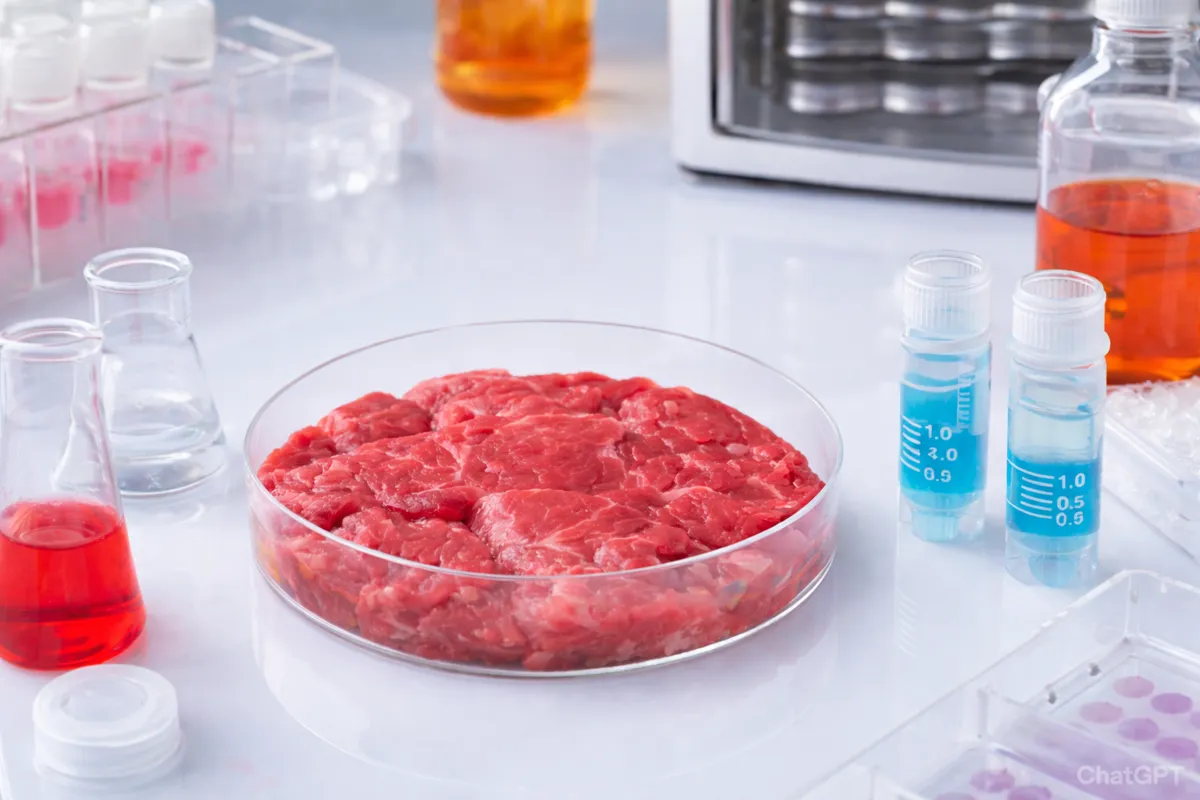
It’s not surprising news anymore that the production of animal-based food is causing 11% percent of all our global green house gas emissions. (Source: https://ourworldindata.org/food-ghg-emissions).
4% of all world-wide ghg-emissions are caused only because of beef and milk production (cattle domestication) (Source: Gates, Bill. (2021). How to avoid a climate disaster: The solutions we have and the breakthroughs we need)
Livestock alone uses 78% of all our agricultural areas. (Source: https://www.dw.com/de/faktencheck-wie-sch%C3%A4dlich-f%C3%BCr-das-klima-ist-der-verzehr-von-fleisch-wirklich/a-63252828)
And the total biomass of all poultry - raised only to be eaten by us humans - is now nearly three times as big as the biomass of all other birds existing on the planet. (Source: Thunberg, Greta. (Ed.). (2022). The climate book)
It’s also not new information that all over the world the following rule is true: The higher the standard of living, the more meat is consumed. (Source: https://ourworldindata.org/data-insights/people-in-richer-countries-tend-to-eat-more-meat)
So what does that mean for the future of our planet if we assume that in the next century not only the humans population will grow from 8.2 billion today to 10.2 billion by 2100, but also that billions of people in Africa, Asia and Latin America will for the first time in history leave poverty behind and reach something that is worth being called a “standard of living”?
It means that if we don’t find a solution to feed all these people it’s all gonna become a gigantic disaster. It means that even if we don’t think that the cruelty of mass-domestication, animal-transports, over-vaccinations, … are enough to find alternatives to animal-based food, finally this giant disaster should be enough for us to search for alternatives to animal-based food.
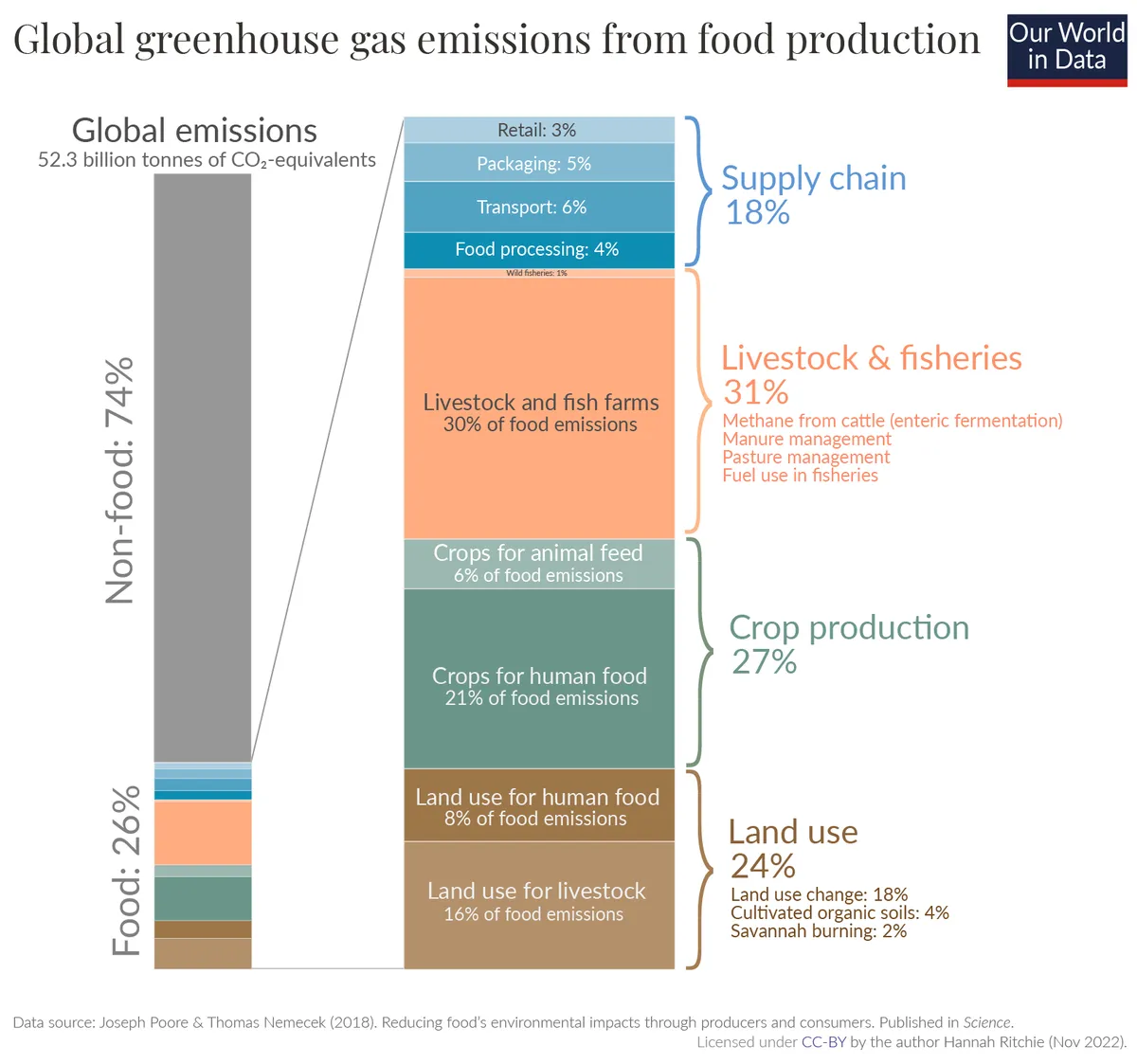
While there are already now many people in developed countries that would consider buying meat from cell-cultures, bio-reactors or 3D-printers instead of slaughtered animal meat and while already now many people in these countries switched to plant-based milk and cheese alternatives, it is still very unlikely that people in less developed countries would buy or even know about these products. The problem of competitive taste seems to be solved for many products already, but one of the biggest remaining problems to switch away from animal-based food seems to be that we still haven’t reached the point where animal-free alternatives like plant-based dairy-products and cultured meat have competitive prices. Most of these products are still much more expensive than the animal-based alternatives. But what if this would change in the future? How many more people would consider switching away from meat if it wasn’t the cheapest option. It’s probably like public transport: If it is more or equally expensive than individual traffic, people will always choose for the more convenient and well-known. This will lead to making the public transport even more expensive and less frequently available, which will again drive more people away from public transport. On the other hand, if many people use public transport it will lead to low prices and very high availability. The cheaper and higher in availability the less tempting it is to use individual traffic, up to a point where it’s a no-brainer decision and public transport is chosen automatically without even thinking, because it’s the cheapest, fastest and most convenient alternative.
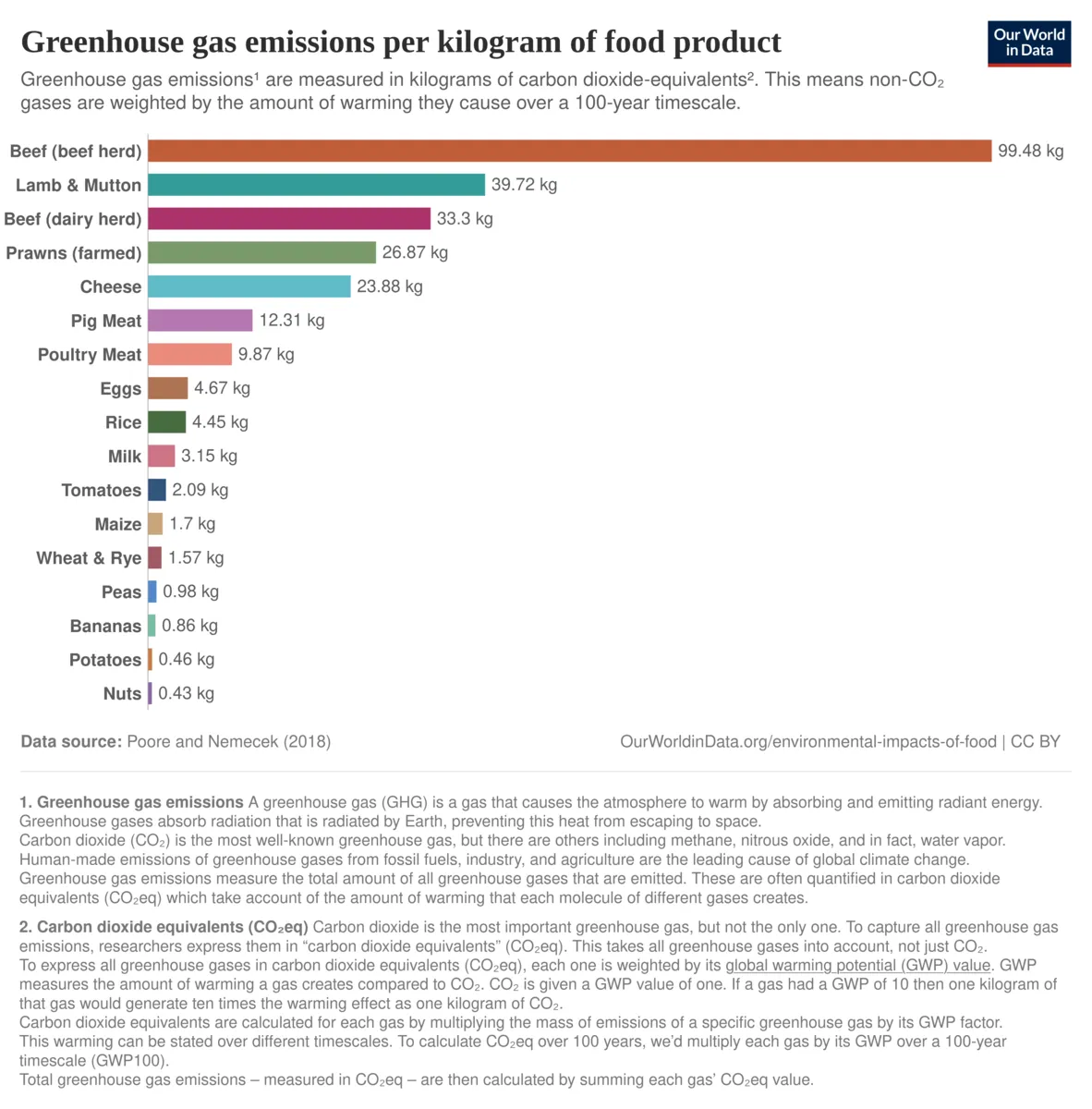
The same is true for animal-free food: If for example cultured meat is available for half the price of what normal meat costs and is even available in more places and more varieties, then it might become a no-brainer decision what to buy in the supermarket, after some years maybe even for the most sceptic meat-lovers.
To reach this point in history - the beginning of the upward-spiral, Team Utopia aims to bring together public money, leading scientists and food-/supply-chain-specialists to make animal-free alternatives equally tasty, cheaper and producible at industrial scale and then once it’s done: open-source all the information to enable food-producers to hop onto that train and to start production without the initial costs to reach this break-through.
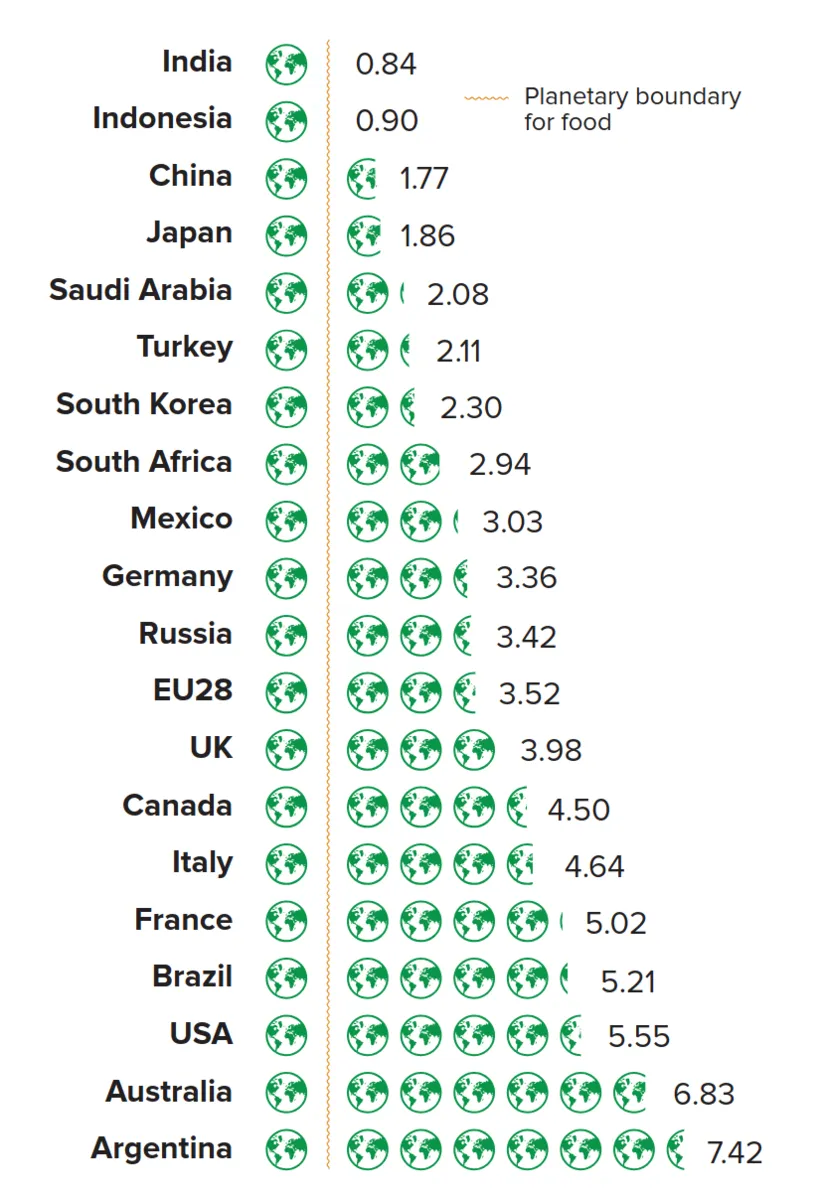
If we for example talk about cultured meat it could mean
For milk and dairy alternatives it might look similar. In the end it’s all about doing the work, fixing the initial problems, scale it to make it cheap, automated and fast in production and then finally make all this information available to everyone on the planet - for free.
This combination of public crowd-funding, non-profit and open-source could be the missing ingredient to help this technology become competitive and to avoid greater disasters in the future.
“Every refrigerator, supermarket case, and air conditioner contains chemical refrigerants that absorb and release heat, making it possible to chill food and keep buildings and vehicles cool. Refrigerants, specifically chlorofluorocarbons (CFCs) and hydrochlorofluorocarbons (HCFCs), were once key culprits in depleting the stratospheric ozone layer, which is essential for absorbing the sun’s ultraviolet radiation. Thanks to the 1987 Montreal Protocol on Substances That Deplete the Ozone Layer, CFCs and HCFCs have been phased out of use (along with the ozone-depleting chemicals that used to be standard fare in aerosol cans and dry cleaning). It took two short years from discovery of the gaping hole over the Antarctic for the global community to adopt a legally mandated course of action. Now, three decades later, the ozone layer is beginning to heal.
Refrigerants continue to cause planetary trouble, however. Huge volumes of CFCs and HCFCs remain in circulation, retaining their potential for ozone damage. Their replacement chemicals, primarily hydrofluorocarbons (HFCs), have no deleterious effect on the ozone layer, but their capacity to warm the atmosphere is one thousand to nine thousand times greater than that of carbon dioxide, depending on their exact chemical composition.
In October 2016, officials from more than 170 countries gathered in Kigali, Rwanda, to negotiate a deal to address the problem of HFCs. Despite challenging global politics, they reached a remarkable agreement. Through an amendment to the Montreal Protocol, the world will begin phasing HFCs out of use, starting with high-income countries in 2019 and then expanding to low-income countries—some in 2024, others in 2028. HFC substitutes are already on the market, including natural refrigerants such as propane and ammonium.
Unlike the Paris climate agreement, the Kigali deal is mandatory, with specific targets and timetables for action, trade sanctions to punish failure to comply, and commitments by rich countries to help finance the cost of transition. It was a monumental achievement on the path to drawdown
\[our emissions to zero\], called by then secretary of state John Kerry “the biggest thing we can do
\[on climate\]in one giant swoop.” Scientists estimate the accord will reduce global warming by nearly one degree Fahrenheit.
Still, the process of phasing out HFCs will unfold over many years, and they will persist in kitchens and condensing units in the meantime. With adoption of air-conditioning soaring, especially in rapidly developing economies, the bank of HFCs will grow substantially before all countries halt their use. According to the Lawrence Berkeley National Laboratory, 700 million air-conditioning units will have come online worldwide by 2030. All of this means parallel action is requisite: addressing the refrigerants coming out of use, as well as transitioning those going in.
Refrigerants currently cause emissions throughout their life cycles—in production, filling, service, and when they leak—but their damage is greatest at the point of disposal. Ninety percent of refrigerant emissions happen at end of life. If the chemicals (or appliances that use them) are not disposed of effectively, they escape into the atmosphere and cause global warming. On the other hand, refrigerant recovery has immense mitigation potential. After being carefully removed and stored, refrigerants can be purified for reuse or transformed into other chemicals that do not cause warming. The latter process, formally called destruction, is the one way to reduce emissions definitively. It is costly and technical, but it needs to become standard practice.” (Source: Paul Hawken, Tom Sawyers - (2017). Drawdown: The most comprehensive plan ever proposed to reverse global warming)
So why don’t we just build a Team-Utopia sub-unite that focuses on collecting these old cooling-devices BEFORE they are damage and release their coolant into the environment? The best way to reach this would be to setup a bounty program that pays good money if people return their old cooling device into a Team-Utopia return station.
Something like: WE WANT YOU - to recycle your fridge and AC. 100 US-Dollar for each returned device that is not working anymore and was produced before 2020.
If we assume that all existing cooling devices still use old refrigerants and we know that worldwide around 1.6 billion air-conditioning-units and 1.4 billion refrigerators/freezers exist such a program would cost us around 300 billion dollar. An unimaginable big amount of money, but comparatively small if would be a chance to save billions of tons of ghg emissions to get released into the atmosphere and it would speed up the switch to newer cooling devices that use other refrigerants.
This section is currently under development and not yet complete. We are actively researching and gathering information on this topic. Please check back later for the full content.
“There are nearly 300,000 designated protected areas globally, covering 16% of the planet’s lands and 8% of its oceans (Figure 4.1). They range from strict nature preserves, national parks and wildlife reserves to areas with sustainable use of natural resources.” (Source : WWF : 2024 Living Planet Report) Despite a significant expansion over recent years we are not even close to reach the UNs 30x30 target. “Target 3 of the GBF, the so-called 30x30 target, calls for 30% of lands, waters and sea to be protected by 2030 “through ecologically representative, well-connected and equitably governed systems of protected areas and other effective area-based conservation measures, recognizing indigenous and traditional territories where applicable”” (Source : WWF : 2024 Living Planet Report)
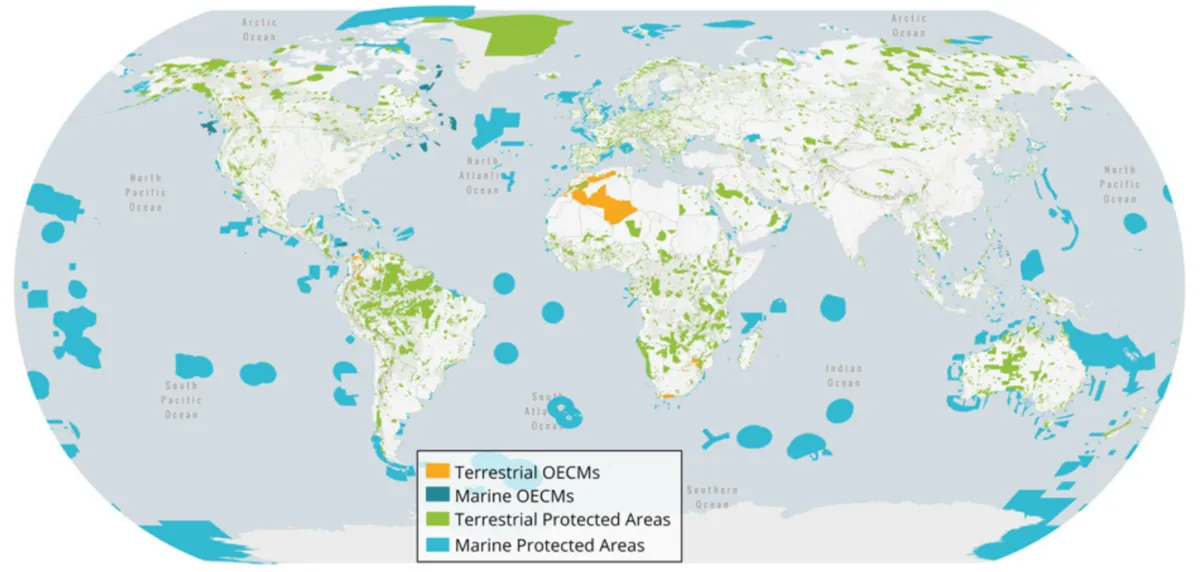
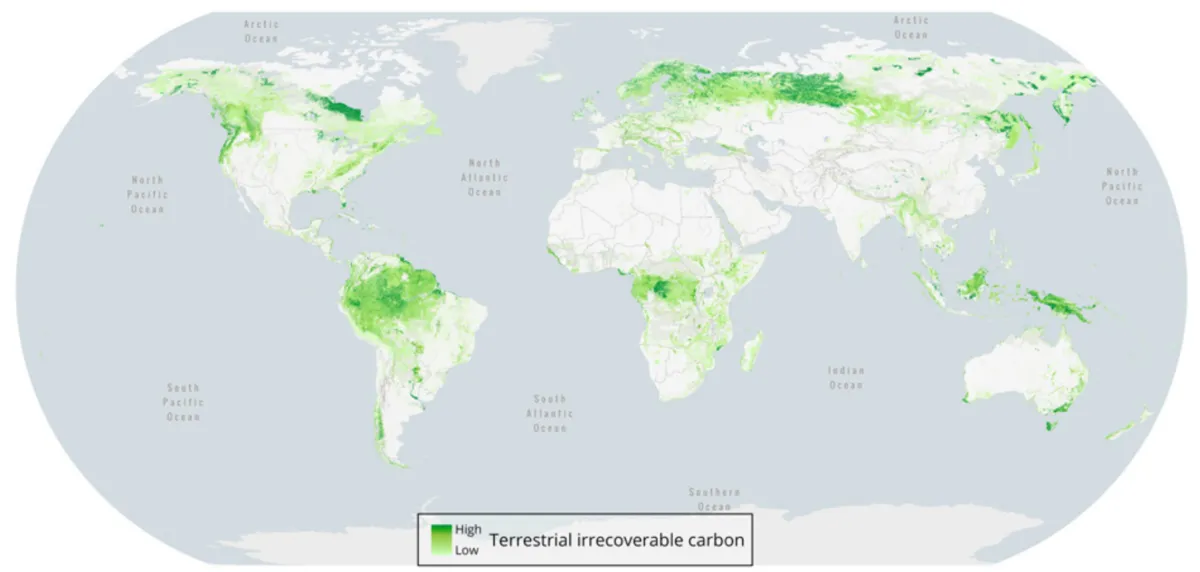
“The current rate of progress will not be sufficient for 30% coverage to be achieved in the terrestrial or marine realms by 2030, nor for the target’s other important elements to be met.” (Source : UNEP : 2024 Protected Planet Report)
So how could Team-Utopia help here? What if we just raise public money to buy all this missing land and afterwards legally protect them to not be converted for farming, mining or for building new cities? Would that be possible and how much could that cost?
It’s estimated that currently ~15% of Earth’s land is protected. This means we are still missing another ~15% of Earth’s land (around 22.34 million km² or 2.234 billion hectares).
Not all of this land is actually in the hands of private owners and can be bought by a NGO. About the two thirds about the land we talk about already now is in the hands of governments. Team-Utopias goal should be to focus on the 5-7.5% of the Earth’s total land that has to be bought from private owners. The missing 7.5-10% are already owned by the public, because they are controlled by our governments, but we need to motivate these governments to protect this land too. Our goal will be to contribute what we can contribute as union of private normal people and then publicly raise the voice to the governments that we expect them to the same step as well.
5-7.5% of the Earth’s total land corresponds to 7.45 million km² to 11.17 million km² of private land needing protection. (0.745 billion hectares to 1.1175 billion hectares))
If we multiply this with the below estimated Land cost per hectare:
we end up at a estimated total cost of:
Lower bound estimate (cheaper land at 100 US-Dollar/ha):
Upper bound estimate (more expensive land at 1,000 US-Dollar/ha):
The truth will be somewhere in the middle. But even if we use the upper bound estimate it’s not totally unrealistic to finance such a project. If 50% of all people in developed countries - which are 8% of all people on the planet - would give about 1800 US-Dollar as a one-time payment we would already be able to buy and protect all this land. The same would be true for if 75% of all people in middle-income countries would pay 30 US-Dollar per year over the next 10 years, or if we use 1 year of global governmental direct fossil-fuel-subsidies for this instead.
It’s possible to implement such changes - we as normal people can do it.
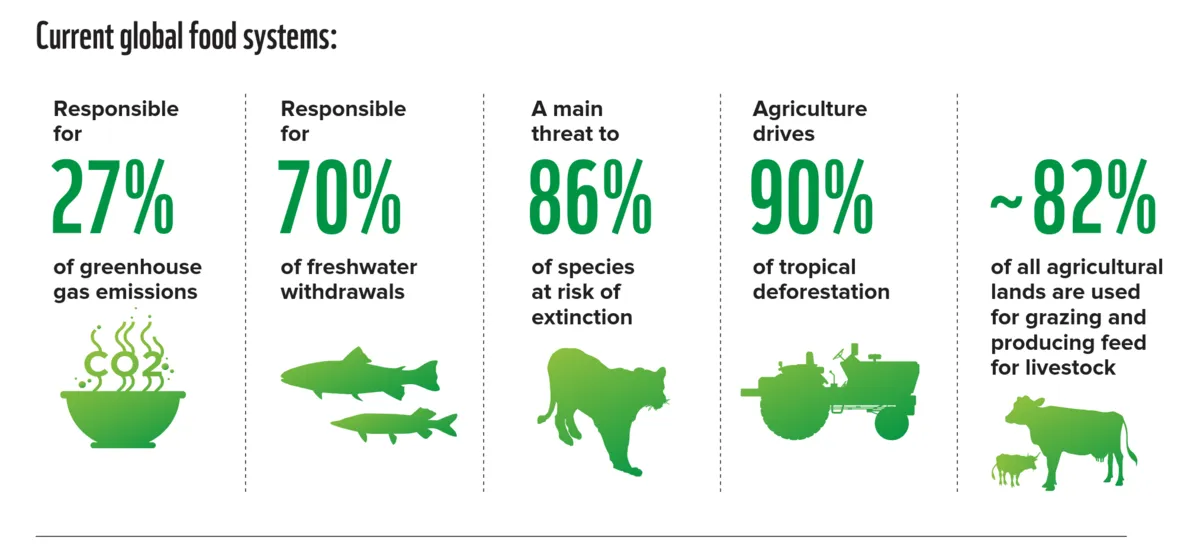
Have you ever wondered why you can find companies like McDonalds or Starbucks in nearly every country? The reason for this global success is called “Franchise”. A franchise company offers private investors to open a new branch in a new location while using the same name, the same products, all the same structures and all the working and globally successful standards. It’s like a working framework that you can buy yourself into and profit from the globally proven business concept.
But why not inventing a global franchise project that works like a non-profit, community led, democratic cooperative which aims to support farmers to switch to environment friendly farming. Why not having a working framework for agriculture, that does not only guarantee to work successfully but also is completely for free.
You could ask the question - but why should you provide all this for free and not earn good money with such a good idea. The answer is as easy as frightening - because our planet does not have time for this anymore!
Agriculture currently produces ~ 27% of all global green house gas emissions. Additionally to the impact on global warming many agriculture practices also have high negative impacts on soil-health, water-quality and bio-diversity. The overuse of fertilizers and pesticides, over-cropping and deforestation are only a few examples to name here.
It’s wrong to blame agriculture in general and treat this sector like a bad boy that only harms our planet, because without agriculture we could simply not eat anything and could also not produce many important goods. Since there are at least as many problems in the agricultural sector as possible solutions, we should instead focus on how to produce food and other agricultural products in a way that harms ours planet as little as possible. Sustainable farming methods like crop-rotation, silvo-pasture (= livestock and trees together in an symbiotic system), tree-intercropping (= trees and other plants planted together), biochar, managed grazing, farmland restoration are only a few ideas that can help improving our current farming practices.
If we put all the already now existing knowledge of how to execute successful environment-friendly farming into the McDonalds-like franchise concept we could provide a framework for small and big farmers all over the world. This framework can provide them with knowledge on how exactly they can improve their farming. Especially small farmers could benefit by having clear structures from which they know that they will lead them to successful farming results and by knowing there will be support from the head-organization if they struggle and have problems. Besides this, a large-scale global cooperative would also offer the possibility to buy tools, seeds, fertilizers and similar goods for cheaper prices (more farmers = cheaper prices) while being able to together fight for fairer prices to sell their goods. The head-organization can organize free-to-join coaching and training events and offer farmers to analyze and evaluate their farming-land to find out which practices of the franchise-framework could lead to the best results. On the other hand farmers themselves can report back their farming results and by this build up a global database about under what circumstances which farming-practices lead to go and bad results. The franchise could also provide a global non-profit farming-insurance that could help to spread the risk of a bad season over all farmers within the cooperative. If for example central Africa has a very bad farming-year maybe the results in Asia are still very good and can compensate the losses at the other side of the planet?
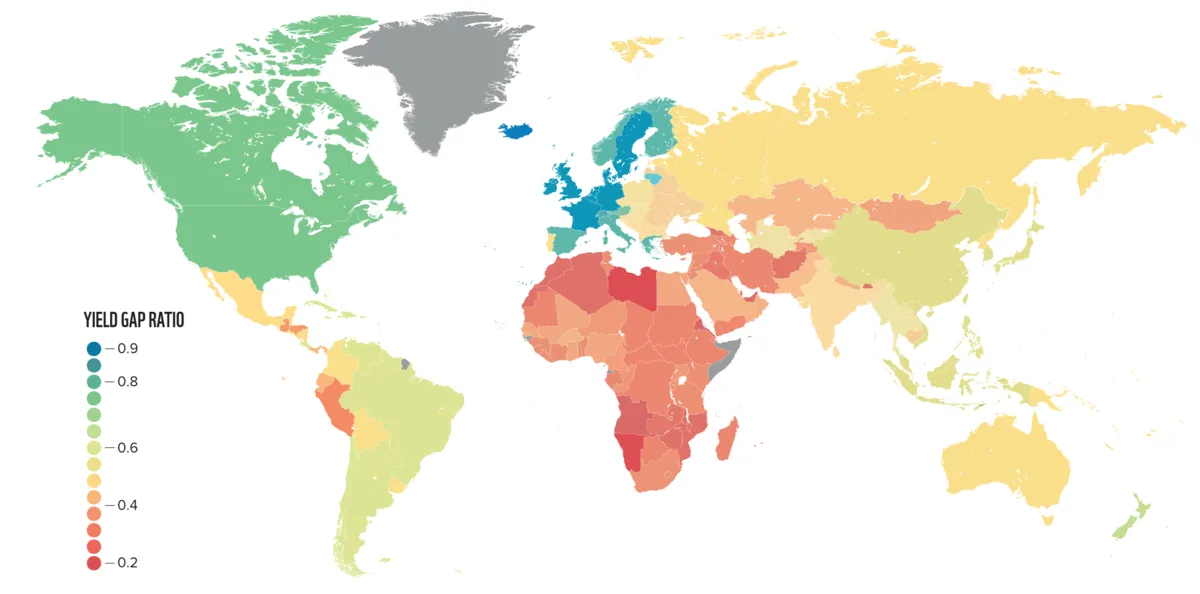
Since this franchise-cooperative aims to be 100% non-profit and open-source, the farmers won’t have any downsides from joining it. They won’t need to pay to get into the cooperative and also won’t need to pay anything of their surpluses back. The cooperative will be crowd-funding financed before it starts operation (like all other utopian projects) and does not need to produce any profits to work. If the initially financed budget of this cooperative ends after maybe 10-15 years and farmers still want to continue to use this cooperative they can start a new utopian project and raise money to finance the cooperative for another time-period.
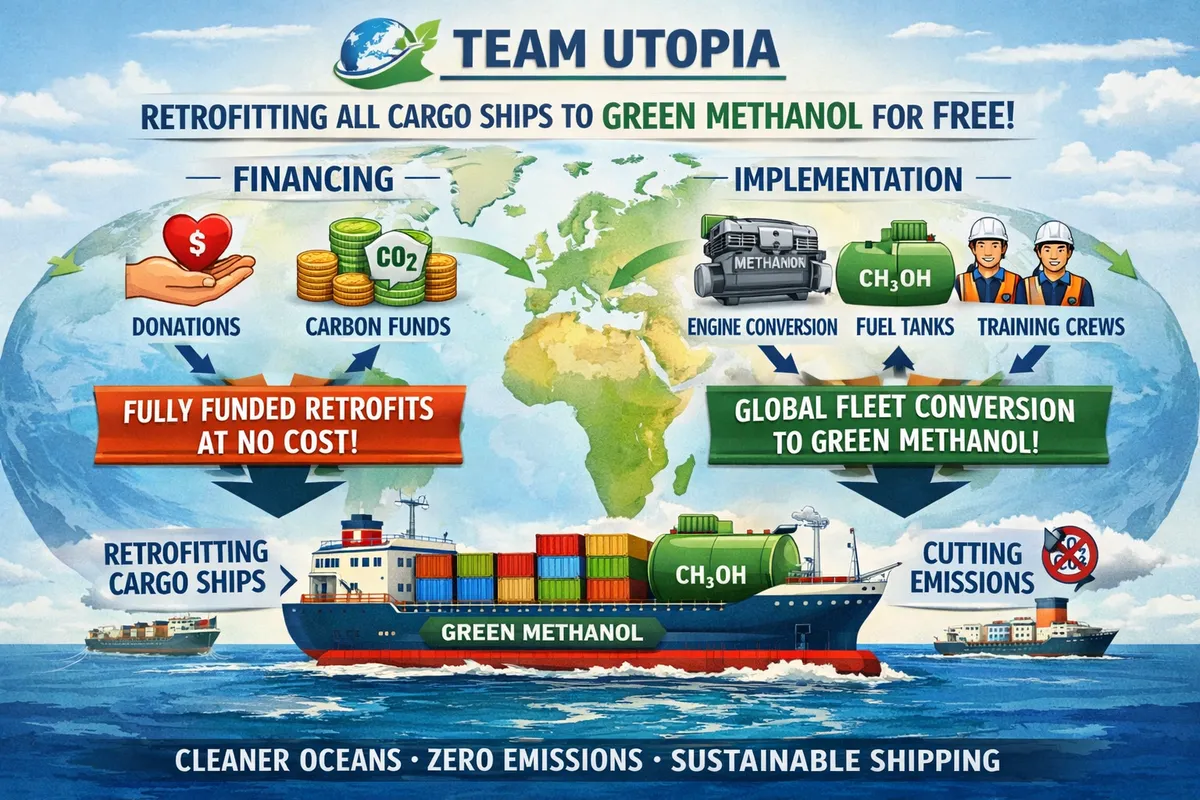
Cargo ships are one of the few sectors that will be very hard to switch away from fossil-fuels. On one hand it’s technologically challenging, if not impossible to run such big and heavy vehicles on electric batteries or hydrogen. Both energy storage types seem to be not energy dense enough for big ships. It would be comparatively expensive and would need surprisingly much space inside the ship to store the required amounts of energy in electric batteries or hydrogen- / hydrogen-ammonium-tanks. Besides the technical challenges there is also little to no interest for shipping companies to optimize their emissions. The heavy fuel oil they use is very cheap to buy and on international bodies of water no laws apply and no law-enforcement will enforce any emission regulations.
So how could we still solve this problem? What about if we just raise all the money to convert all existing cargo-ships to run on green-methanol? Green methanol is a renewable fuel made by combining captured carbon dioxide (CO2) with hydrogen produced through electrolysis powered by renewable energy sources like wind or solar. The production process synthesizes these ingredients at high temperatures and pressures to create methanol (CH3OH), which can be carbon-neutral or even carbon-negative depending on the CO2 source.
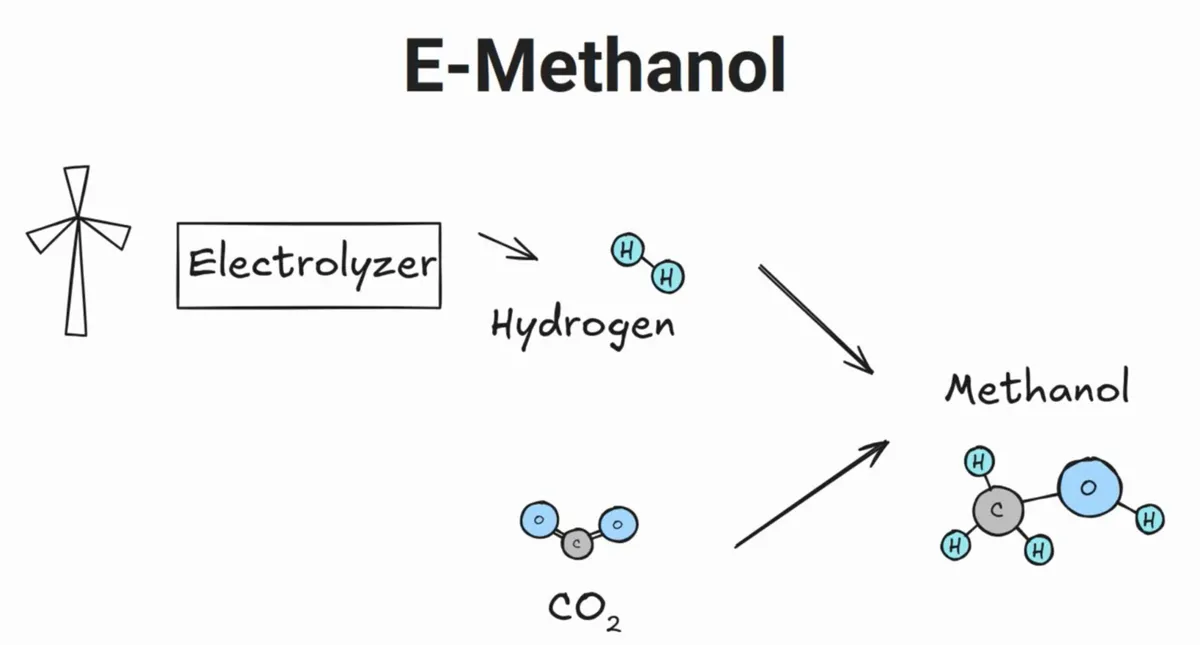
So let’s have a look at the numbers. How could such a utopian project look like?
As of 2023, there are around 60,000 merchant ships worldwide, which include bulk carriers, general cargo ships, and container ships.
The cost to retrofit a cargo ship to run on green methanol ranges between 2 million and 10 million US-Dollar per vessel, depending on factors such as:
For calculation purposes, we can assume an average retrofit cost of 5 million US-Dollar per ship.
To estimate the total cost for retrofitting all 60,000 cargo ships, we multiply the number of ships by the average retrofit cost:
$$ 60,000 \text{ ships} \times 5,000,000 \text{ USD/ship} = 300,000,000,000 \text{ USD} $$So, the total cost to retrofit all cargo ships worldwide to run on green methanol would be approximately 300 billion USD. An incredibly large amount of money - which could be paid off as a one time payment if every human in the world would contribute about 36.5 USD - or maybe a little more realistic: if every human in developed countries (the richest 16%) would pay 228 USD.
If shipping companies would get such a conversion for free, the situation would look completely different than how it would look now. It would be a clear sign of the world : We want you to be climate neutral and since we really care about this problem we will even pay you for this change.
As a second step we could make plans on how we can create enough green methanol to power all these ships - maybe another great utopian idea?
Again and again we are caught in discussions whether or not the switch to electric or hydrogen powered cars would be sustainable. And while both sides of the discussion have their points it’s very clear that:
A. We don’t have any alternative to completely switch away from combustion engines that are powered by fossil-fuels if we want to have any realistic chance to stop the global warming to below 1.5 or 2 degrees celsius. Since the transport sector is one that can technically reach zero-emissions, personal transport also has to become 100% emission-free. There is no realistic way around this. If we don’t reach this, we have zero chances to reach our global climate goals.
B. It is not helpful - with regards to emission of green house gases - to replace all existing vehicles with new electric or hydrogen cars. This is due to the fact that producing a new electric car and throwing away the already existing fossil-fuel powered car produces more green house gases than sticking to the old car and driving it to the very end. This becomes even more clear if we consider that developing countries use cars until their very very end and that for them it is not realistic to simply wait until in 5-10 years all cars are replaced by new non-combustion engines powered cars. While this might work in rich, privileged countries, it will not work in developing countries. In this case the market will not solve the problem automatically, because there simply is no market for replacing still working cars, just like luxury items that are replaced every couple of years to have the newest version.
So if we A. cannot stick to our already existing cars and B. cannot replace all of them in the next 5-10 years with new electric cars, because both would result in disastrous emissions, what could be a more realistic short-term solution?
A cheap, open-source and non-profit retrofit-package to convert already existing cars to electric or hydrogen powered cars. All the technology that we need for this is already existing now.
Companies like EV-West already now offer Conversion Kits for prices around 20.000 - 30.000 US Dollar. Complete conversions for luxury historic cars are available at Zelectric Motors for around 100.000 - 200.000 US Dollar. The missing ingredients to make this already existing idea a global scale utopian change are:
So how can Team-Utopia help to make this change happen. Big groups of people have big power and big financial resources. If we could work together with already existing organizations and help them to bring their conversion-kits to a global scale level with millions of potential customers we could also have the power to make these conversion-kits completely open-source, repairable and long-lasting.
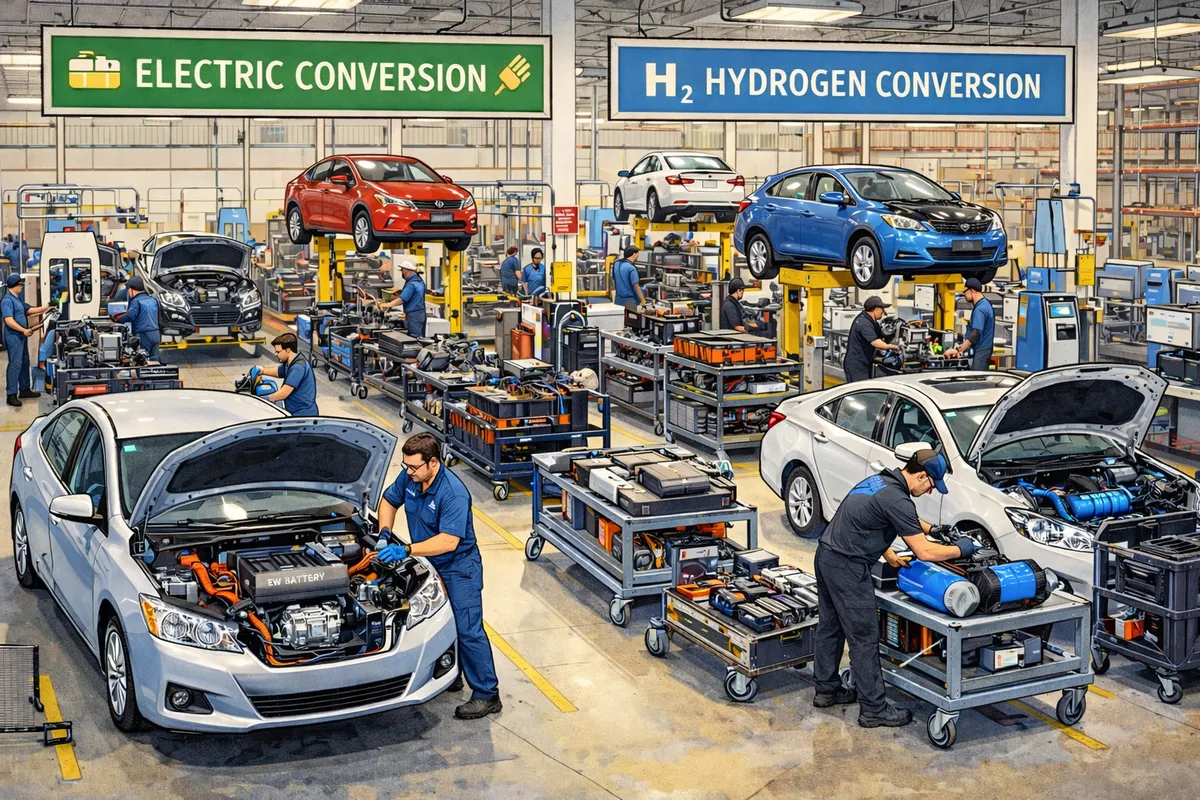
Currently retrofitting a car costs around 10,000 - 30,000 US-Dollar. According to “Wrights Law” / the “Experience curve effects” production costs usually drop by 10-30% for every doubling of produced quantity. If we could scale the production of conversion kits up to millions it seems realistic that due to the principles of “Economies of scale” we could reduce these prices by 30-90%.
Team Utopia could offer the platform to spread this project world-wide, to collect money for a first developing and production phase. Furthermore it could in a second step raise money to produce a few million conversion kits for poor developing countries to sell them to poor people for very low prices. If we start to look at this challenge from a crowd-funded pre-paid project perspective that does not aim to produce any profit it suddenly seems much more realistic to retrofit the worlds cars than it would seem with todays existing solutions.
For this kind of project it might also make sense to first focus on creating conversion kits for the most produced and used cars world-wide. For example if we first focus on creating kits (motor, battery, electronics + homologation) that would plug and play replace the combustion engines of the five cars:
this we would already help to retrofit more than 10% of the world-wide existing cars. Of course we also have to consider that all these cars evolved over the years and were produced in different versions, but even then we would probably end up at below 1000 different versions to retrofit more than 10% of the worlds cars. On a second step we could then continue to produce retrofit packages for the top 100-200 car models , which would include 30-50% of all cars existing world-wide. And if we after that would be able to offer kits for the top 500 models, we could already retrofit 75% of the cars. For all other cars it might maybe be possible to work on other solutions like hub-motors which don’t replace the main combustion motor with a main electric motor, but replace the wheel and suspension with hub-motor kit, that has a small electric motor inside the component that includes wheel, suspension, brakes and electric motor. While these kind of motors have significant downsides compared to a main motor, they might still be a way to even retrofit cars that are less common and not existing tens of millions of times.
This section is currently under development and not yet complete. We are actively researching and gathering information on this topic. Please check back later for the full content.
This section is currently under development and not yet complete. We are actively researching and gathering information on this topic. Please check back later for the full content.
If you have questions, concerns, inspirations, or — ideally — are interested in building Team Utopia together, please reach out!
Team Utopia is currently exploring whether it’s possible to find at least 10 motivated people who believe this project has a future.
If you’d like to be one of the first 10 visionaries, please send us an email!
Send Email.jpg)

.jpg)
